Kenya’s education sector stands at a paradox that defines both its progress and its pressure. On paper, it commands one of the largest allocations in the national budget, Ksh 702.7 billion for the 2025/2026 financial year. It is a figure that signals strong political commitment to education and sustained public investment in learning.
Yet beneath this impressive headline lies a more complex reality. The system is expanding rapidly, reforming structurally, and enrolling more learners than ever before, but it is doing so within a financing framework that is increasingly stretched.
The result is not collapse, but tension. Not failure, but imbalance. A system where ambition consistently moves ahead of fiscal capacity.
The education budget, therefore, is not just a financial statement. It is a reflection of Kenya’s social contract with its learners, teachers, and institutions. And that contract today is under quiet strain.
The Wage Bill Core: Stability That Defines the System
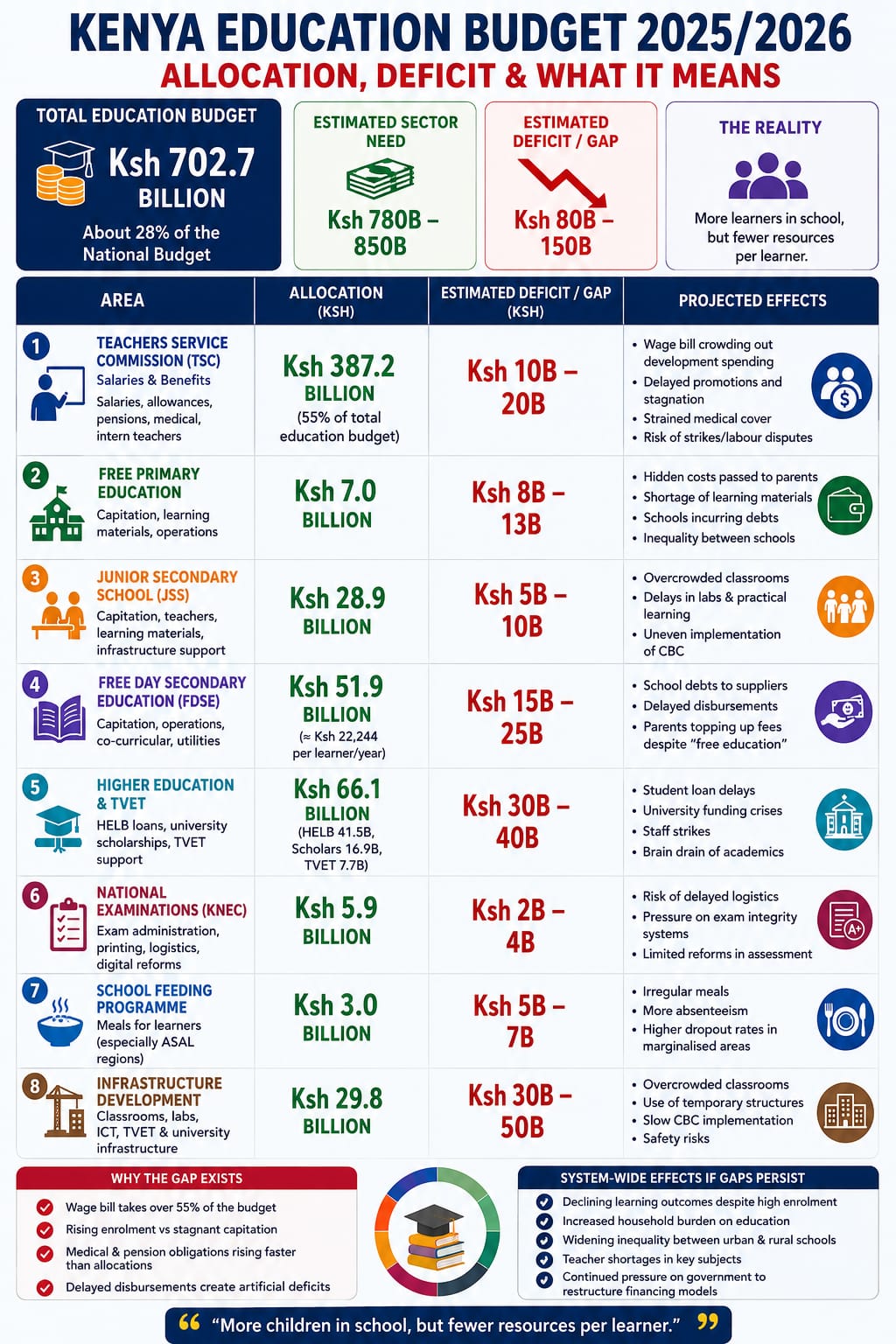
At the centre of this structure is the Teachers Service Commission (TSC), which absorbs the largest share of the education budget. A total of Ksh 387.2 billion is allocated to teacher salaries, allowances, pensions, and recruitment, including the expanding cohort of intern teachers supporting curriculum rollout.
This dominance is structural rather than incidental. Teachers are the operational backbone of the education system, and their remuneration is essential for continuity of learning across the country.
However, this necessary stability carries a significant consequence.
More than half of the entire education budget is committed before any investment is made in classrooms, laboratories, textbooks, or infrastructure. In effect, the system is heavily pre-allocated towards personnel expenditure, leaving limited fiscal space for development spending.
This creates a quiet but persistent imbalance: the system funds teaching first, but struggles to fully fund the environment in which teaching takes place.
ALSO READ;
Rachel Ruto, South Africa’s First Lady visit Montessori school during South Africa State Visit
Free Primary Education: A Symbol Under Pressure
Free Primary Education remains one of Kenya’s most visible education commitments. It represents equity, access, and national inclusion. Yet its allocation, Ksh 7.0 billion, reveals a more constrained operational reality.
On paper, this funding supports tuition-free learning. In practice, rising enrolments, inflation, and increasing curriculum demands have outpaced the allocation.
The gap is absorbed elsewhere.
Schools increasingly rely on parents to bridge operational shortfalls through informal contributions for learning materials, examinations, infrastructure maintenance, and development needs.
While not formally part of policy design, this parallel financing system has become an embedded feature of basic education delivery.
The contradiction is clear: education remains free in principle, but partially privately sustained in practice.
Junior Secondary Expansion: Rapid Reform, Uneven Capacity
The Junior Secondary School (JSS) system receives Ksh 28.9 billion and represents one of the most significant structural reforms under the Competency-Based Curriculum.
Its goal is to bridge primary and secondary education through practical, skills-based learning. However, implementation has advanced faster than infrastructure and staffing capacity.
In many schools, classrooms have been repurposed to accommodate JSS learners. Laboratories remain incomplete or insufficient. Teacher availability in specialised subjects remains uneven across regions.
The result is not uniform delivery, but uneven experience.
This is a structural gap rather than a temporary disruption. It reflects the challenge of expanding access without a matching expansion in physical and human resources.
Secondary Education: Access Maintained, Pressure Increasing
Free Day Secondary Education (FDSE) receives Ksh 51.9 billion, translating to approximately Ksh 22,244 per learner annually. This allocation sustains one of Kenya’s most important access-driven education policies.
Yet schools continue to operate under financial pressure.
Rising costs of utilities, examinations, learning materials, and co-curricular activities have steadily increased operational demands. Delays in disbursement further complicate planning, forcing schools to rely on supplier credit or parental support.
The result is a hybrid financing system, where government capitation supports education, but does not fully fund it.
Access has been preserved. Adequacy has not fully kept pace.
Higher Education: Expanding Demand, Tightening Resources
Higher education receives approximately Ksh 66.1 billion, distributed across the Higher Education Loans Board (HELB), scholarships, and TVET funding. HELB alone accounts for Ksh 41.5 billion and remains the primary mechanism for student support.
However, demand consistently exceeds available funding.
Loan applications outstrip allocations, resulting in partial disbursements and delayed awards. Students enter institutions with financial uncertainty that often persists throughout their studies.
Public universities face similar pressure, driven by rising wage obligations, infrastructure constraints, and expanding enrolments. TVET institutions, central to Kenya’s skills agenda, also face equipment and modernization gaps.
The system is expanding in size, but tightening in financial flexibility.
ALSO READ;
TSC warns teachers against spreading false reports on school fire incidents
National Examinations: Rising Complexity, Fixed Resources
The Kenya National Examinations Council (KNEC) is allocated Ksh 5.9 billion to support examination administration, logistics, security, and ongoing assessment reforms.
Yet the scale and complexity of modern examinations continue to increase. Digitisation, integrity enforcement, and expanded candidate numbers place rising pressure on operational systems.
The allocation supports continuity, but leaves limited room for innovation or expansion.
Assessment systems are evolving faster than the funding structures that support them.
School Feeding: Small Budget, High Social Impact
The school feeding programme receives Ksh 3.0 billion. Although small in proportion to the total education budget, its impact is significant, particularly in arid and semi-arid regions.
In these areas, school meals directly influence attendance, retention, and concentration levels.
However, the funding gap remains substantial. Many vulnerable learners still experience inconsistent access to meals, affecting both participation and learning outcomes.
The consequences are immediate and visible in classroom engagement and attendance patterns.
Infrastructure Development: Persistent Gap Between Need and Supply
Infrastructure receives approximately Ksh 29.8 billion, covering classrooms, TVET expansion, and university facilities.
Yet demand far exceeds supply.
The expansion of Junior Secondary education alone has created significant pressure on physical infrastructure. Many schools continue to rely on temporary structures, overcrowded classrooms, and shared facilities.
This has direct consequences for learning quality. Overcrowding reduces teacher effectiveness, limits learner engagement, and constrains practical learning approaches required under competency-based education.
Infrastructure, in practice, defines the limits of policy implementation.
The Structural Gap: Ksh 702.7 Billion vs KSh 780-850 Billion
When consolidated, Kenya’s education system reveals a structural funding gap. While the budget stands at Ksh 702.7 billion, estimated sector requirements range between Ksh 780 billion and Ksh 850 billion.
This creates a shortfall of approximately Ksh 80 billion to Ksh 150 billion.
Importantly, this gap is not concentrated in one area. It is distributed across capitation deficits, infrastructure shortages, student financing pressure, and welfare programme underfunding.
It is therefore a system-wide imbalance rather than a single-point failure.
ALSO READ;
Kericho County to conduct safety audit in all boarding schools amid rising school unrest
A System Under Strain, Not Collapse
Despite these pressures, the education system continues to function and expand. Enrolment remains high. Access has improved. Curriculum reforms are being implemented nationwide.
The contradiction lies in balance rather than survival.
Kenya is expanding educational access without a proportional increase in per-learner investment. The system is broadening reach while stretching capacity.
This creates a quiet but persistent strain—managed through adjustments rather than structural redesign.
Conclusion: A Budget That Reflects Both Commitment and Constraint
Kenya’s education budget tells two stories simultaneously.
One is a story of commitment, reflected in a Ksh 702.7 billion allocation that demonstrates strong national investment in education.
The other is a story of constraint, reflected in persistent funding gaps, infrastructure pressure, and operational shortfalls across multiple levels of learning.
Together, these realities define the current state of the system: ambitious in scope, stretched in execution, and balanced delicately between expansion and sustainability.
The challenge ahead is not simply to increase funding, but to recalibrate allocation, so that investment strengthens not only access, but also quality, equity, and learning outcomes.
Because in education, the true measure of a budget is not its size.
It is its sufficiency in the classroom.
By Hillary Muhalya
You can also follow our social media pages on Twitter: Education News KE and Facebook: Education News Newspaper for timely updates.
>>> Click here to stay up-to-date with trending regional stories
>>> Click here to read more informed opinions on the country’s education landscape