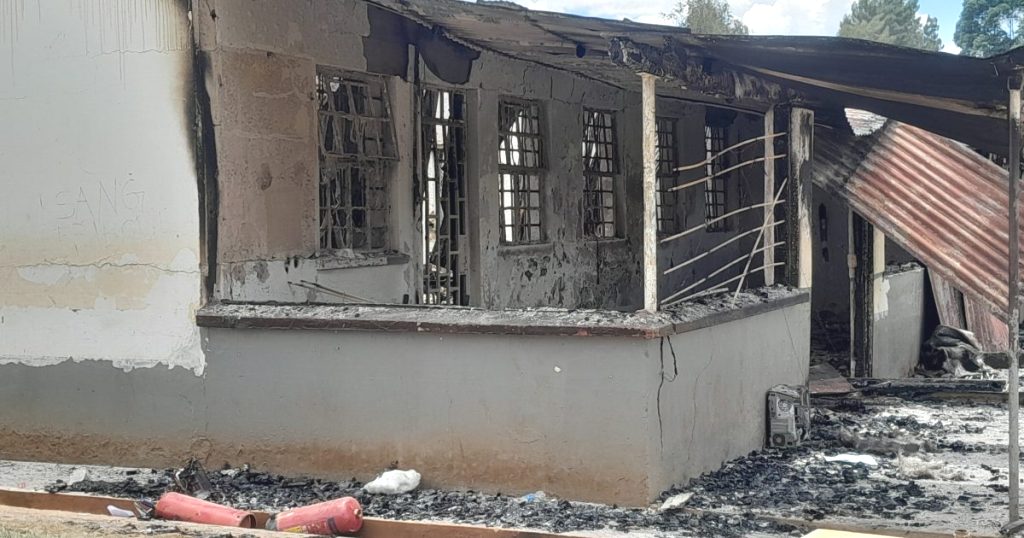
Last month, the Taita Taveta County Security banned term-opening examinations in public secondary schools as part of the efforts to tame student indiscipline and unrest.
“We have banned opening term examinations and replaced them with guidance and counselling. This is because the exams have caused anxiety and riots among students including burning of schools,” the area County Commissioner, Linda Okolla was quoted as saying.
The team made the order in the wake of 12 public secondary schools that had caused alarm in the area. More or less similar incidences have occurred across the country—mainly involving public boarding secondary schools.
I personally applaud the decision of the County security team in Taita Taveta to ban term-opening examinations in the schools in the area.
Frankly speaking, term-opening examinations have doubtful educational value. The students sit for the end term or end year examinations just before they close the term during first and second terms. They also sit for the end of the year examinations just before they close the school calendar in October.
They go for the April, August and December holidays to rest or recharge before they resume learning. In this context, term-opening exams serve zero value. First, the students are tested in the syllabus they had been taught and tested just before they closed schools. Secondly the school calendar provides for holidays; holidays allow learners to go home to rest, recharge and go back to school with renewed energy.
The students are examined in curriculum areas they have so far covered either cumulatively when they joined secondary education or for the term. This is redundancy. Total mindlessness.
Term-opening examinations don’t allow learners to rest and relax and mix freely with their respective families during the holidays. The students are ever anxious about the term-opening examinations upon reopening the school. Whatever the preparations, teachers and schools which administer these examinations know that the students don’t perform well in this test.
ALSO READ:
KICD CEO urges schools to submit accurate data to strengthen CBE, textbook distribution
The schools, however, use this term-opening examinations as part of the Continuous Assessment Test (CATs) for the term to get the aggregate average score for purposes of grading the end-term examinations.
Hence the anxiety, tension, apathy, and disorientation during the term. In these moods, the students cannot fully concentrate during the syllabus coverage for the rest of the term.
Slight irritation is likely to cause them to run riot as an excuse to be sent home and avoid any further assessment during the term.
There must be the right proportion in teaching, learning and assessment during the school calendar and the three terms. Any imbalance disrupts learning. For the avoidance of doubt, education institutions are established to educate young people; to impart knowledge, skills, values, attitudes and desired behaviours. Not to test them carelessly.
A 2001 Report of the Task Force on Students Indiscipline and Unrest in Secondary Schools, observed that there was an imbalance in teaching, learning and assessment in schools the members visited, saying: “the number of tests as part of the continuous assessment are excessive and cause stress to students, and unnecessary expenditure on parents.”
The task force, commissioned by the Minister for Education, Science and Technology at the time, Henry Kosgey, and chaired by Naomy Wangai, accordingly recommended that there be a professional balance in learning and testing in schools, with the aim of curtailing unprofessional examination of students.
The special investigation report of 2016, commissioned by then Cabinet Secretary for Education, Dr. Fred Matiang’i chaired by Claire Omollo on unrest in secondary schools also noted a similar tendency in regard to assessment, in school environment. It observed that students were subjected to many assessments with different names thereby causing unnecessary fatigue and nervousness among them.
The basis of the Term-opening examinations in the light of these reports is questionable.
ALSO READ:
Utumishi Tragedy: Police probe points to arson attack as eight students held
The Cabinet Secretary for Education is mandated, under the Constitution, to oversee educational policy, standards, curricular and examinations. This power mandate is not limited to national examinations. It covers everything in all schools, including the frequency or otherwise of the administration of internal or school level examinations.
The Basic Education Act, and the Basic Regulations 2015 is silent on this issue. Yet it has the capacity to make teaching and learning happen or not happen in school.
All told, however, the term-opening examination system is not the only reason students cause trouble in schools.
Another source of stress for learners in boarding secondary school is failure to observe class or instructional hours as provided for under the Basic Education Regulations, 2015. The regulations stipulate that official class hours are from 8 a.m. and 3:30 p.m.
Class hours refer to the hours when teachers are officially expected to conduct curriculum delivery. In our case, it is about six hours each weekday—cumulatively approximately 39 weeks in a school calendar.
Most boarding schools have made the teaching of learners before and after 8 a.m. and 3:30 p.m. respectively. The learners wake up very early and sleep late—hence causing fatigue and sleeplessness almost throughout a school term. The lack of sufficient sleep and long hours of teaching has strained the resilience they need to even be attentive during official class or instructional time.
Alarmingly, class hours outside the 8 a.m. and 3:30 p.m. unofficial class hours or instructional time takes an hour, more than the 40minute lessons the Ministry stipulates for secondary school.
ALSO READ:
Arresting the unrests: How to enhance safety of students in schools
The exhaustion students suffer from extended hours in class makes them vulnerable to drugs and substance abuse and peer pressure. Why do schools do this? They want to complete syllabus months before the third term to create time for revision, in preparation for KCSE.
Rushed syllabus coverage amounts to fuzzy teaching and learning. This is over teaching. It is done at the expense of learning—the cognitive behaviour needed to tackle the very examinations is never properly developed or imparted.
The candidates don’t master the knowledge, and skills and reasoning powers the curriculum makers envisage learners to acquire or master. It is this cognitive behaviour that enables them to cope and manage the vicissitudes of life in the long term but also useful in tackling the examinations.
When students fail they don’t get it, fear, tension, anxiety seizes them. There is nothing these students cannot do when provoked.
Don’t schools feel, see and talk about these things in the staffroom or with students?
Communication between the school administration and learners is either absent or poor. Denied opportunity to complain or raise issues concerning them, they become unruly.
Problems such as these would easily be addressed if there was synergy between the school leaders and the teachers. Lack of team spirit leaves problems to fester and transform into crises such as mass indiscipline, riots and arson by students.
It shouldn’t happen. Schools are not machines. They are stuffed with human beings with hopes, aspirations and anxieties with a common goal: to nurture young people on behalf of the society.
What is required is master leadership and all that it entails. The purpose, vision and values that animate schools should be the common possession of every member of the school: teachers, students, non-teaching staff, parents and other stakeholders of the school.
Institutional or school purpose, vision and values are the glue that buoys up an organisation through calm and stormy waters. The glue here is communication. It is the sharing of purpose, vision and values that motivates people to work in harmony. Without this, shipwrecks.
We can reduce the turbulence we see in schools through enlightened and caring leadership and of course, the unwavering support schools need from the government.
Parents should also support the government by paying school fees (for boarders) and lunch fees (for day schoolers) in good time. Sometimes, riots come from the strained finances the school suffers from. Schools need money to buy things that they need to create a supportive teaching and learning environment. When this is not forthcoming, trouble looms.
You meet such things as unrest, anarch and arson. And in their train, blood, tears, death and destruction of property. When we bury our heads in the sand, like ostriches do.
Kennedy Buhere
Communication Specialist
0725327611
You can also follow our social media pages on Twitter: Education News KE and Facebook: Education News Newspaper for timely updates.
>>> Click here to stay up-to-date with trending regional stories
>>> Click here to read more informed opinions on the country’s education landscape