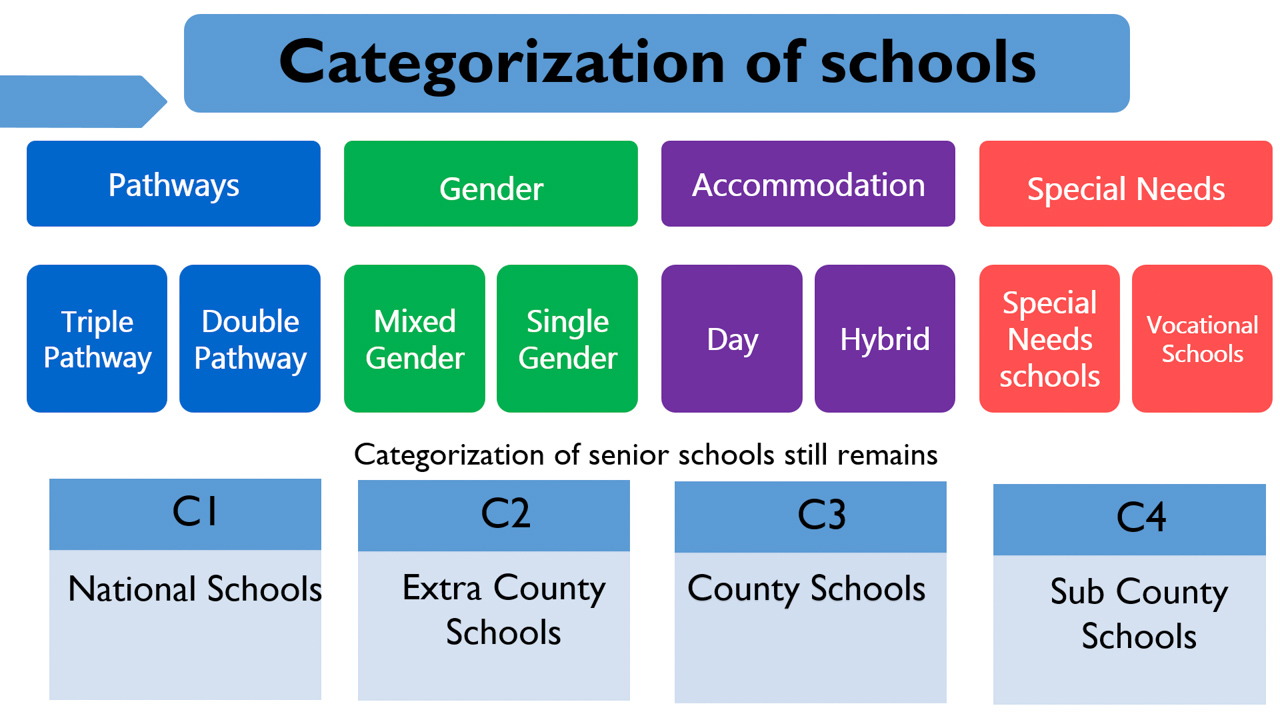
In Kenya’s secondary school system, categorization has become a shorthand for quality. Schools are grouped into C1, C2, C3, and C4, a hierarchy that subtly—and sometimes overtly—shapes public perception.
Parents aspire for C1 and C2 placements. Learners celebrate admission into these institutions as a mark of success.
Meanwhile, C3 and C4 schools are often viewed as fallback options, institutions for those who “did not make it.” But this framing is not only simplistic; it is fundamentally flawed. It ignores a deeper, more important question: what truly constitutes impact in education?
C1 and C2 schools are, by design, selective. They admit learners who have already demonstrated strong academic ability, discipline, and, in many cases, access to supportive home environments. These schools operate within a relatively stable ecosystem. Their role is to refine, extend, and showcase existing potential. Consequently, their performance metrics—mean scores, university transition rates, national rankings—tend to be predictably high. They are, in many respects, centers of academic consolidation.
C3 and C4 schools, however, tell a different story. They receive a more heterogeneous student population, often including learners who struggled in primary school, those who narrowly missed cut-off points, and those who carry the weight of social, economic, and emotional challenges. Many of these students arrive having internalized failure. They come labeled—by systems, by communities, and sometimes by themselves—as underachievers. This is the context within which C3 and C4 schools operate.
To understand their impact, one must first appreciate the starting point of their learners. Education, at its core, is not just about outcomes but about transformation. A student who enters school disengaged, lacking confidence, and performing below grade level, but leaves with self-belief, discipline, and a viable academic or vocational pathway, represents a profound success. Yet such success is rarely captured in conventional metrics.
ALSO READ:
KNUT elections: Oyuu secures second term as KNUT Secretary General unopposed
Teachers in C3 and C4 schools work at the intersection of instruction and intervention. They do not merely deliver content; they rebuild learners. They confront apathy, repair broken academic foundations, and nurture resilience. In many cases, they must first convince students that they are capable of learning before any meaningful teaching can take place. This is slow, deliberate work—often invisible, frequently undervalued, but undeniably impactful.
These schools function as spaces of second chances. They absorb the pressures and inequities of the education system. While higher-tier schools benefit from strong inputs, C3 and C4 schools take in students whose educational journeys have already been complicated. Limited resources, larger class sizes, and less external support only compound the challenge. Yet, within these constraints, they create stability and opportunity.
There is also a social dimension to their role. C3 and C4 schools often serve communities where education is not just a pathway to personal success but a critical tool for social mobility. The gains made here extend beyond individual learners; they ripple into families and communities. A student who regains direction and purpose can alter the trajectory of an entire household. This is impact at a structural level, not just an academic one.
Critically, the notion of “value addition” becomes central in this discussion. It is not enough to ask what a student achieves at the end of secondary school; we must ask how far they have come. A system that only celebrates high absolute scores risks overlooking the schools that do the heaviest lifting. When evaluated through the lens of growth rather than raw output, C3 and C4 schools often emerge as the true drivers of educational progress.
This is not to diminish the role of C1 and C2 schools. They are essential in nurturing top-tier academic excellence and producing high achievers who go on to excel in competitive fields. However, their success is built on a foundation that is already relatively strong. C3 and C4 schools, by contrast, construct that foundation where it is weak or absent. They do not simply polish brilliance; they cultivate it from difficult beginnings.
ALSO READ:
Chuka Varsity VC lauded for lecturers’ timely pay and accessible leadership
The challenge, then, is one of perception and policy. As long as categorization is interpreted as a ranking of worth rather than a reflection of context, C3 and C4 schools will continue to be undervalued. This has implications for morale, resource allocation, and even teacher deployment. Educators working in these environments deserve recognition not just for maintaining standards, but for achieving transformation under pressure.
A shift in mindset is necessary. Stakeholders—parents, policymakers, and society at large—must begin to interrogate what they celebrate in education. If the goal is merely to produce top grades, then the current hierarchy suffices. But if the goal is to change lives, expand opportunity, and build resilient, capable citizens, then the narrative must expand to include the indispensable role of C3 and C4 schools.
Ultimately, education is not a competition between institutions; it is a collective endeavor to develop human potential. Judging a school solely by its category reduces this complex mission to a simplistic label. It overlooks the daily realities of classrooms where teachers are not just imparting knowledge, but restoring hope.
C3 and C4 schools may not always dominate headlines or rankings, but within their walls, some of the most meaningful educational work is taking place. They are not the periphery of the system; they are its proving ground. And if impact is measured by the ability to change the direction of a learner’s life, then these schools stand at the very heart of what education is meant to achieve.
By Ashford Kimani
Ashford teaches English and Literature in Gatundu North Sub-county and serves as Dean of Studies.
You can also follow our social media pages on Twitter: Education News KE and Facebook: Education News Newspaper for timely updates.
>>> Click here to stay up-to-date with trending regional stories
>>> Click here to read more informed opinions on the country’s education landscape