The Kenya Science and Engineering Fair (KSEF) is increasingly emerging as a catalyst for innovation, empowering students to identify challenges in their communities and develop practical solutions.
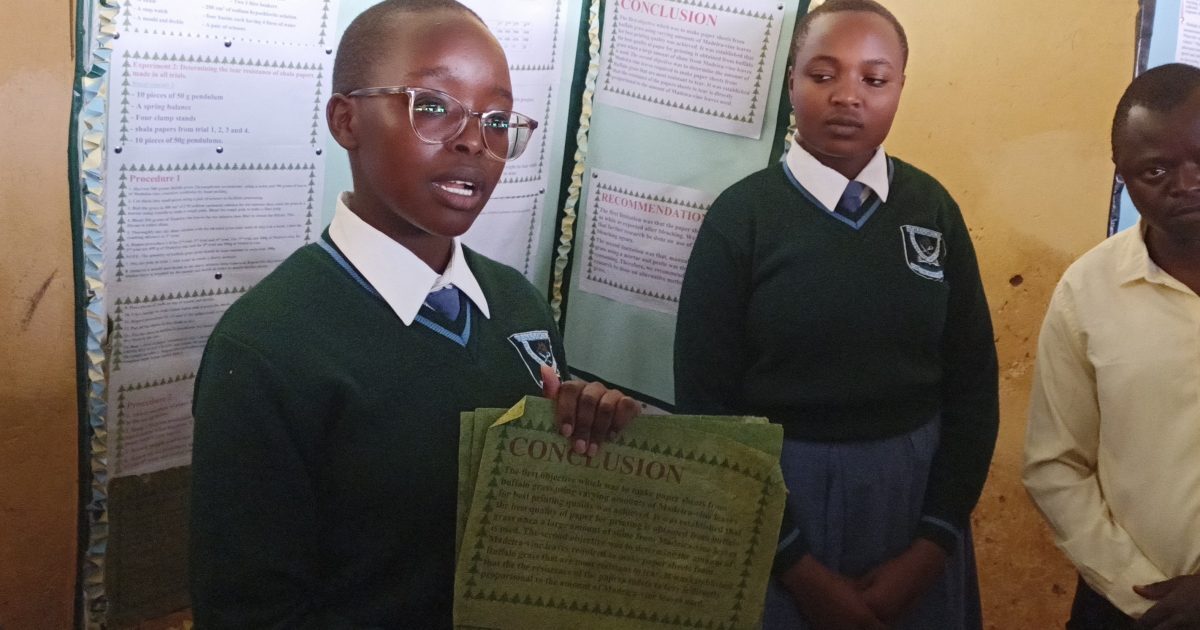
This was evident during the regional KSEF competition held at AIC Moi Girls High School in Maralal town, where two students from Nasokol Girls High School in West Pokot County showcased an environmentally friendly innovation aimed at addressing deforestation and climate change.
Form Four students Nam Shavin and Camilla Lagat developed a method of making paper using buffalo grass, an alternative to traditional tree-based paper production.
ALSO READ:
CS Ogamba orders probe into alleged irregularities in Masinde Muliro University Degrees
Their project, dubbed “Shala paper from buffalo grass,” falls under the chemistry category and aligns with the government’s initiative to plant 15 billion trees by 2032 to increase forest cover.
Explaining the process, Shavin said the eco-friendly method takes about 12 hours and involves boiling the grass and adding a sodium carbonate solution to break it down.
“Mix the grass and the blended Madeira vines inside a plastic basin to obtain a slurry mixture which is later placed on A4-sized boards and covered to dry by slow evaporation,” she explained.
She added that the thickness of the paper depends on the amount of slurry poured into the moulds.
Lagat praised the Ministry of Education for supporting student innovation through platforms such as KSEF and called for increased funding to nurture young scientists.
“We urge publishing companies and schools to take up our innovation because it is eco-friendly since grass is a renewable resource which takes a shorter time to grow compared to trees,” she said.
The students noted that their innovation could help address Kenya’s paper production gap following the closure of the Webuye paper mill in 2009, while also reducing reliance on imported paper products.
KSEF Rift Valley regional chairman Kipchumba Korir said the fair plays a crucial role in promoting technological advancement among learners.
“KSEF is one of the core co-curricular activities in schools which deals with innovations that can steer the country to great technological advancements,” he said.
Korir noted that the competition aligns well with the Competency-Based Curriculum (CBC), which emphasizes practical skills, critical thinking and real-world application.
ALSO READ:
Printing of academic certificates at risk as debts and outdated equipment cripple government printer
He also raised concerns over the challenges students face in patenting their innovations.
“There is a challenge in patenting the students’ innovations because of the tedious process of registration and we are appealing to the relevant authorities to help protect the students’ ideas,” he said.
The regional competition brought together over 800 students and featured projects across 13 categories, including mathematics, physics, biology, chemistry, agriculture, robotics, biotechnology and environmental science.
As young innovators continue to push boundaries, KSEF is proving to be a vital platform in shaping the next generation of problem-solvers and driving sustainable solutions for the future.
By Kimutai Langat
You can also follow our social media pages on Twitter: Education News KE and Facebook: Education News Newspaper for timely updates.
>>> Click here to stay up-to-date with trending regional stories
>>> Click here to read more informed opinions on the country’s education landscape