In February 2026, Acting Teachers Service Commission (TSC) Chief Executive Officer Evelyn Mitei appeared before the National Assembly’s Departmental Committee on Education to present the Commission’s Budget Policy Statement for the 2026/27 financial year, seeking a total allocation of KSh 422.95 billion. This submission marked one of the most critical interventions in Kenya’s education sector in recent years, as it directly addresses chronic teacher shortages, wage and promotion concerns, and the ongoing implementation of the Competency-Based Curriculum (CBC).
Mitei explained that the budget represented a KSh 35.75 billion increase over the previous year, largely driven by the urgent need to recruit additional teachers, convert interns into permanent staff, and enhance teacher training programs. Central to her presentation was the national teacher shortage, which has been exacerbated by CBC reforms, particularly at the junior and senior secondary levels, where enrolments have surged dramatically.
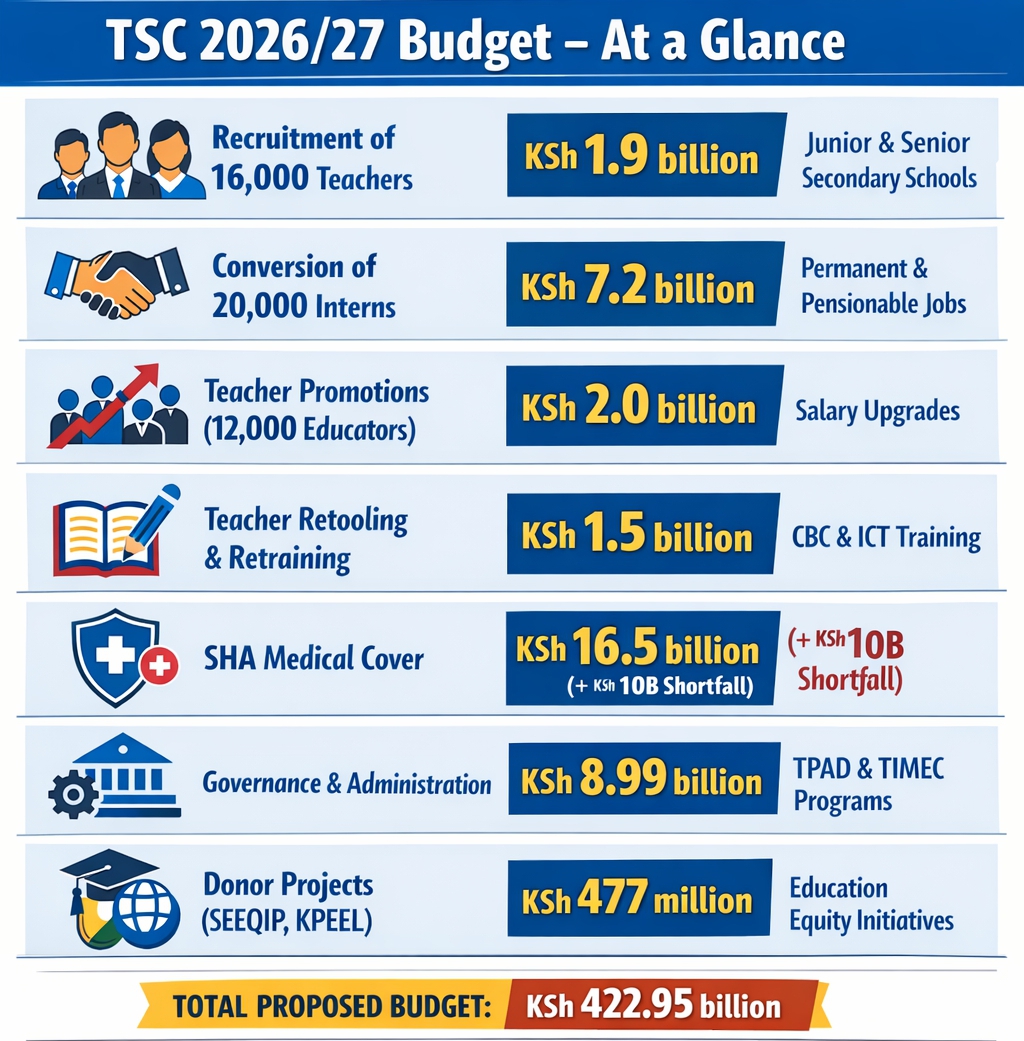
The TSC proposed to recruit 16,000 new teachers, focusing entirely on Junior and Senior Secondary Schools. This recruitment, estimated at KSh 1.9 billion, is designed to address gaps in classrooms that have strained teaching quality and student learning outcomes. Notably, Mitei confirmed that no new primary school teachers will be recruited in 2026/27, explaining that structural shifts under CBC have reduced demand at that level even as upper school levels experience higher teacher pressure.
ALSO READ:
Kitale School tops Trans Nzoia chess qualifiers ahead of national competitions
Beyond recruitment, the Commission plans to convert 20,000 intern teachers into permanent and pensionable positions, a process costing KSh 7.2 billion. This move ensures workforce stability, job security, and aligns with broader efforts to professionalize teaching in Kenya. In tandem, about KSh 2 billion has been set aside for teacher promotions across primary, secondary, and teacher training institutions, recognizing qualifications, experience, and performance in line with statutory and competitive advancement frameworks.
Recognizing that quality education cannot rely solely on numbers, Mitei emphasized the KSh 1.5 billion allocation for teacher retooling and retraining. This fund targets tens of thousands of teachers needing skills in emerging subjects, digital literacy, and new CBC learning areas, ensuring that classroom delivery meets modern standards. Programmes such as school-based mentoring, live-streamed lessons, and capacity-building initiatives under partnerships with agencies like the World Bank form part of this strategy.
Teacher welfare was also a central concern. Mitei highlighted that over 400,000 teachers and about one million dependents are now enrolled under the Social Health Authority (SHA) universal health coverage, but warned that the allocated KSh 16.5 billion may be insufficient. The Commission appealed for an additional KSh 10 billion to fully meet healthcare needs, a move crucial for maintaining teacher morale and effectiveness in classrooms.
During the parliamentary session, MPs probed TSC on several issues: the absence of primary recruitment, delays in promotions for teachers with advanced degrees, prolonged acting appointments, and gaps in health service integration under SHA. Mitei addressed each concern, reiterating the structural and operational realities while urging parliamentary support to bridge funding gaps.
At the operational level, the TSC budget also incorporates resources for performance management, teacher induction, mentorship programmes, and ICT integration, ensuring that reforms extend beyond numbers to quality, accountability, and effective classroom delivery. Programs like TPAD (Teacher Performance Appraisal & Development) and TIMEC (Teacher Induction, Mentorship & Coaching) form the backbone of ongoing efforts to enhance learning outcomes nationwide.
ALSO READ:
MoE reshuffles principals of national polytechnics in fresh changes
In essence, the KSh 422.95 billion budget is structured around four main pillars: expanding and stabilizing the teaching workforce, enhancing teacher capacity, improving welfare and health coverage, and supporting system-wide reforms. By integrating these priorities, the TSC under Mitei aims not only to solve staffing challenges but also to transform classrooms, uplift teacher morale, and improve the quality of education across Kenya.
This submission underscores the high stakes of Kenya’s education policy decisions — every KSh allocated or withheld directly affects recruitment, salaries, promotions, classroom quality, and ultimately the future of millions of learners in the country. The Departmental Committee on Education will now incorporate these proposals into its report, feeding into Parliament’s wider budget deliberations.
By Hillary Muhalya
You can also follow our social media pages on Twitter: Education News KE and Facebook: Education News Newspaper for timely updates.
>>> Click here to stay up-to-date with trending regional stories
>>> Click here to read more informed opinions on the country’s education landscape