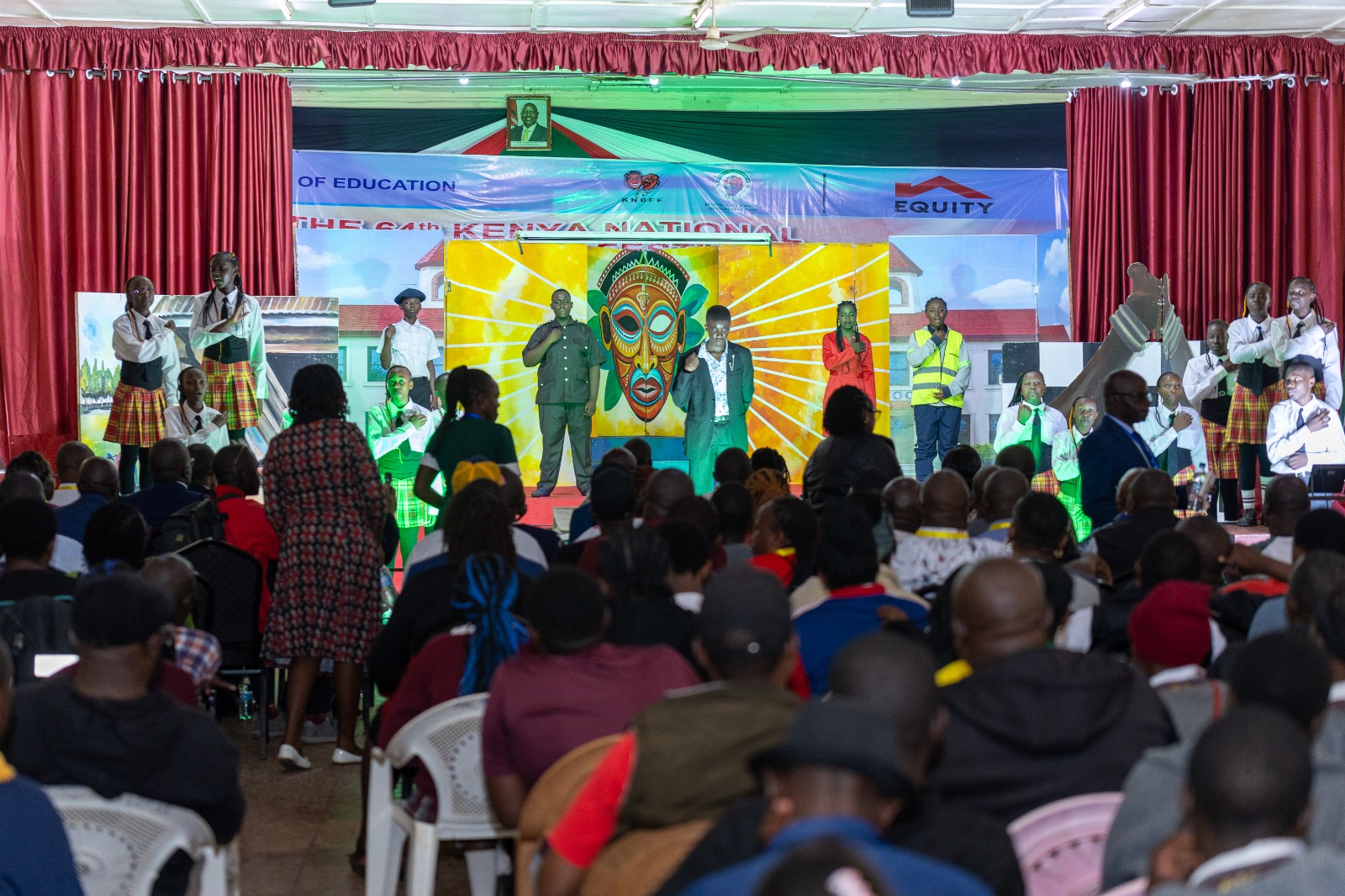
There are moments in a nation’s life when art rises above ornamentation and becomes necessity. The 2026 Kenya National Drama and Film Festival offered precisely such a moment.
What unfolded on stage was not mere performance, but a profound demonstration of how drama – when taken seriously – becomes one of the most powerful instruments of education, reflection and national consciousness.
For too long, drama in schools has been mischaracterized as an extracurricular indulgence, a break from “serious” learning. Yet the brilliance displayed by institutions such as Dagoretti High School, Fesbeth High School and Shimo la Tewa High School decisively dismantles that illusion. These performances did not sit at the periphery of education – they occupied its very core.
Take The 4th Wiseman by Fesbeth High School. Here was a production that dared to wrestle with the ethical crisis of examination malpractice, not through didactic preaching, but through layered storytelling. The stage became a courtroom of conscience. Characters embodied the tensions between ambition and integrity, societal pressure and personal responsibility. In that space, the audience was not passive; it was implicated. That is the genius of drama – it does not instruct from a distance; it immerses, confronts and unsettles.
ALSO READ;
PS Bitok in China to strengthen digital learning partnership with Huawei
Equally arresting was The Jackpot by Shimo la Tewa High School, a piece that navigated the labyrinth of digital identity. In an age where young people curate lives for invisible audiences, the production peeled back the illusion of online perfection. It exposed vulnerability, manipulation and the fragile boundaries between reality and performance. What curriculum document could so viscerally communicate the dangers of the digital age? What lecture could evoke the same emotional urgency? Drama succeeds where abstraction fails – it makes ideas felt.
Then came Tikiti by Dagoretti High School, a cultural dance that elevated movement into meaning. Rooted in tradition yet oriented toward the future, the performance translated the language of Competency-Based Education into rhythm and gesture. It reminded us that culture is not static; it is a living, adaptive medium through which societies interpret change. In that choreography lay a profound pedagogical insight: that learning is not confined to text, but is embodied, expressive and communal.
Across the festival, a pattern emerged – one that demands serious attention. These were not isolated flashes of brilliance; they were part of a larger intellectual awakening. Spoken word pieces like Barua Kapa and Timiza Ndoto revealed students grappling with identity, purpose and the anxieties of modern life. Performances addressing social media, mental health and inequality reflected a generation that is deeply aware of its context and unafraid to interrogate it.
What we witnessed, therefore, was not just art. It was scholarship in motion.
This is where the conversation must shift. If education is to be truly transformative, it must embrace drama not as an accessory, but as methodology. Drama integrates cognition and emotion, theory and practice, individual voice and collective experience. It cultivates empathy, sharpens critical thinking, and demands collaboration. In a world increasingly defined by complexity, these are not optional skills – they are essential competencies.
Moreover, drama democratizes expression. In a classroom, the most articulate student often dominates. On stage, however, every voice matters – the actor, the scriptwriter, the choreographer, the set designer. It is a space where different intelligences converge, where learners who may struggle in conventional academic settings find their brilliance recognized and celebrated. This is education in its most inclusive form.
There is also a deeper, almost philosophical dimension to what drama achieves. It preserves memory while imagining possibility. It holds a mirror to society while simultaneously offering a window into what could be. When students dramatize corruption, digital alienation, or social inequality, they are not merely reflecting reality, they are reimagining it. They are, in essence, participating in the work of nation-building.
ALSO READ;
MPs grill TVET Principals over ethnic imbalance, missing assets
And yet, despite its evident power, drama remains underutilized within the education system. Resources are limited, rehearsal time is often squeezed between academic demands, and the intellectual rigor of performances is rarely given the recognition it deserves. This must change. If the Kenya National Drama and Film Festival has shown us anything, it is that within our schools lies an extraordinary reservoir of creativity and insight, one that can significantly enrich our educational outcomes if properly harnessed.
To appreciate drama, therefore, is not to indulge in sentimentality. It is to recognize its strategic value. It is to understand that the stage is not separate from the classroom—it is an extension of it. It is where knowledge breathes, where ideas take form and where learners discover not just what they know, but who they are.
As the curtains fall on this year’s festival, the applause should not fade into routine celebration. It should provoke a deeper commitment, to invest in the arts, to integrate them meaningfully into learning, and to listen, seriously, to what our students are saying through their performances.
Because in those voices bold, creative, and unfiltered lies the future of education. And perhaps, the future of the nation itself.
By Ashford Kimani
Ashford teaches English and Literature in Gatundu North Sub-county and serves as Dean of Studies.
You can also follow our social media pages on Twitter: Education News KE and Facebook: Education News Newspaper for timely updates.
>>> Click here to stay up-to-date with trending regional stories
>>> Click here to read more informed opinions on the country’s education landscape