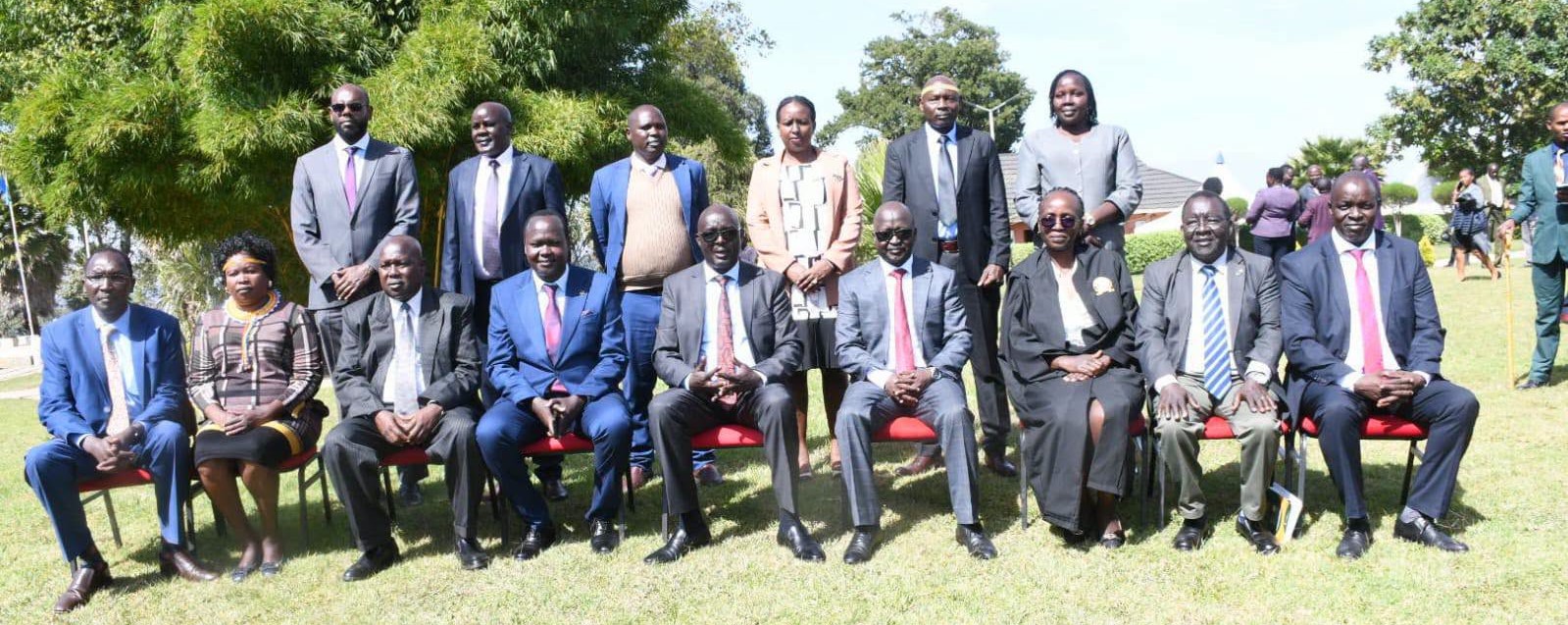
- Hillary Muhalya examines the responsibilities awaiting West Pokot’s newly appointed County Public Service Board.
- The Board wields significant authority over recruitment, discipline, staffing and human-resource planning within the county.
- Its ultimate test will be whether that authority translates into lawful, transparent and accountable public-service management.
The real test for West Pokot’s new County Public Service Board begins after the swearing-in ceremony: whether a powerful institution entrusted with recruitment, discipline, staffing and human-resource planning can turn its statutory authority into transparent, lawful and accountable public-service management.
The completion of interviews and vetting has ushered in a new team comprising James Prosso Akudian, James Loyatem, Emily Chepoghisyo and David Yator Kiptum, with Akudian designated Chairperson.
The appointments bring together experience in public health, administration, education, community leadership, theology, public service and advocacy.
But the significance of the new team extends beyond the credentials of its members.
The County Public Service Board is one of the institutions at the centre of devolved government. Its decisions can determine who joins the county workforce, who is confirmed, how officers are managed, how disciplinary matters are handled and how the county plans for its human-resource needs.
That makes the Board’s accountability obligations just as important as its recruitment powers.
The County Governments Act establishes a Public Service Board in every county and gives it substantial responsibilities in managing the county public service.
Among its statutory functions are establishing and abolishing offices, appointing and confirming officers, exercising disciplinary control, promoting constitutional values and principles, facilitating human-resource planning and budgeting, advising the county on human-resource management and development, and supporting implementation of performance-management systems.
The Board is also required to report to the County Assembly on the execution of its functions and the extent to which constitutional values and principles are being observed in the county public service.
That reporting responsibility is particularly important.
It means the Board is not simply an institution that makes decisions behind closed doors.
Its work is subject to a wider constitutional and statutory framework.
Who will carry that responsibility?
James Prosso Akudian — Chairperson
Akudian, from Suam Ward in Kacheliba Constituency, was born in 1971 and brings approximately three decades of public-service experience.
He holds a Master’s Degree in Public Health from Warwick Medical School in the United Kingdom and a Bachelor’s Degree in Public Health from Jomo Kenyatta University of Agriculture and Technology.
He also holds a Higher Diploma in Clinical Medicine and Surgery specialising in Reproductive Health and a Diploma in Clinical Medicine and Surgery from KMTC Nairobi.
His career includes service in the National Malaria Control Programme and a period as Chief Officer of Health at county level between 2014 and 2017.
He currently serves as Director of Registration and Licensing Services and Head of Strategy and Research at the Clinical Officers Council of Kenya.
As Chairperson, his role will extend beyond his professional speciality to providing leadership to the Board as it exercises its statutory mandate.
James Loyatem — Member
Loyatem, from Lomut Ward in Pokot Central Constituency, is a trained theologian and minister.
He obtained a Bachelor’s Degree in Theology from Bugema University in Uganda in 2009 and holds a Ministerial Diploma from the Adventist Institute of Eastern Uganda.
He has served as an NRVF Evangelism Director and undertaken missionary duties in Trans Nzoia, Baringo and West Pokot since 1999.
His background gives the Board experience in community engagement and institutional leadership.
Emily Chepoghisyo — Member
Chepoghisyo, from Kapchok Ward in Kacheliba Constituency, was born in 1980.
She trained as a P1 teacher at Eregi Teachers College in 2002, later obtained a Diploma in Education from the Kenya Institute of Management and earned a Bachelor of Education from the Catholic University in 2013, graduating with Second Class Honours, Upper Division.
She has served as a teacher and Head Teacher at Losam Primary School.
Her public-administration experience expanded through service as a CECM in several county portfolios, including Tourism, Culture, Sports, Youth, Gender and Social Development; Water, Environment and Natural Resources; Public Service, Administration and ICT; and Lands, Physical Planning and Urban Development.
David Yator Kiptum — Member
Kiptum, born in September 1966, comes from Siyoi Ward in Kapenguria Constituency.
He holds a Bachelor of Science degree in Animal Production from Egerton University.
His leadership experience includes serving as Chairperson of the Kapenguria Municipality Board and Executive Director of the Sengwer Indigenous Community Trust.
He has also been involved with Community Land Action Now, a national network dealing with registration of community land involving pastoralist, hunter-gatherer, fisherfolk, settled and other communities.
His professional background includes service as a Bayer East Africa Product Promoter and Kenya Seed Company Field Officer.
Continuity also matters
The new members will work alongside experienced members, including Reuben Sikuku Lopetangor and Richard Siree.
The presence of continuing members provides institutional memory as the new team assumes responsibility.
For a public institution, continuity can be important because human-resource matters rarely begin and end with a single Board.
Pending recruitment processes, disciplinary cases, staffing structures, establishment of offices, employee development and other administrative matters require institutional knowledge and orderly transition.
At the same time, continuity does not remove the need for accountability.
Every decision must still be measured against the law and the constitutional principles governing public service.
One of the Board’s most visible responsibilities will be recruitment and appointment.
This is where public confidence can easily become connected to questions of fairness, merit and transparency.
Article 232 of the Constitution provides for principles including high standards of professional ethics, efficient and economic use of resources, accountability and transparency, fair competition and merit as the basis of appointments and promotions.
For the Board, these principles provide the framework within which recruitment and human-resource decisions are expected to be made.
The critical issue is therefore not merely who gets appointed.
It is also how the decision was reached.
Were the requirements clear?
Were candidates assessed against the same criteria?
Were procedures followed?
Were decisions properly documented?
Were complaints handled according to the law?
Those questions are part of the accountability environment within which the Board will operate.
Discipline will be another major test
The Board also has statutory responsibility for disciplinary control.
That power directly affects county employees and therefore requires careful adherence to due process.
Disciplinary authority cannot simply be understood as the power to punish.
It involves applying the law, established procedures and principles of fairness while protecting the integrity of the public service.
The credibility of disciplinary decisions will therefore depend not only on their outcome, but also on the process through which they are reached.
The Board’s mandate also goes beyond individual employees.
It has a role in human-resource planning and budgeting, including issues affecting personnel expenditure.
That responsibility becomes particularly significant where counties face competing demands for limited public resources.
The county needs enough personnel to deliver services, but staffing decisions must also be connected to available resources, approved structures and actual service requirements.
This makes human-resource planning a governance issue as much as an administrative one.
The Board’s accountability does not end within its own offices.
Its statutory reporting relationship with the County Assembly provides an avenue through which its performance and compliance with constitutional values can be examined.
For citizens, the practical question is whether those accountability mechanisms produce meaningful information about how the county public service is being managed.
The Board’s reports, recruitment decisions, staffing structures and other lawful records can therefore become important reference points for assessing its performance.
The appointment of experienced professionals gives West Pokot a new Board.
But experience alone cannot establish future performance.
It will be the Board’s actions over time that show whether the institution is achieving the objectives of its mandate.
The expectations are straightforward: lawful recruitment, transparent processes, proper disciplinary procedures, effective human-resource planning, professional development, adherence to constitutional values and meaningful accountability.
Those are not achievements to be assumed at the beginning of a tenure.
They are standards against which performance can subsequently be measured.
The real accountability test
The completion of the appointment process is an administrative milestone for West Pokot County.
Governor Simon Kachapin’s administration and the wider county institutions involved in the process have now reached the point where attention can shift from the selection of Board members to the work of the institution itself.
The new members inherit significant authority.
They will have influence over the careers of county employees and the structures through which county services are delivered.
That authority comes with an equally significant responsibility to explain, justify and document decisions where the law requires it.
The public-service question facing West Pokot is therefore no longer simply who sits on the Board. It is what the Board does with the authority entrusted to it.
The new team has its credentials.
The institution has its legal mandate.
READ ALSO: New Hybrid Teaching Board Combo revolutionises classroom instruction
The county has its expectations.
What remains is the record—and that is where accountability will ultimately be measured.
By Hillary Muhalya
Get more stories from our website: Education News
To write to us or offer feedback, you can reach us at: editor@educationnews.co.ke
You can also follow our social media pages on Twitter: Education News KE and Facebook: Education News Newspaper for timely updates.
>> Click here to stay up-to-date with trending regional stories