- The Mfecane and the Ngoni migrations transformed Africa through conflict, displacement and state formation.
- Similar pressures of migration, resource competition and insecurity continue to shape parts of modern Africa.
- Experts argue that addressing the root causes of displacement remains the key to preventing xenophobia and social conflict.
Africa’s history is punctuated by periods of profound upheaval, but few events transformed the continent as dramatically as the Mfecane. Meaning “the crushing” or “the scattering,” the Mfecane was a prolonged period of warfare, migration and political reorganisation that swept across southern Africa between about 1815 and 1840. It is closely associated with the rise of Shaka Zulu, the visionary military leader who transformed a small Zulu chiefdom into one of the region’s most formidable kingdoms.
After ascending to power around 1816, Shaka revolutionised warfare by creating disciplined military regiments, introducing the short stabbing spear known as the iklwa and developing innovative battle formations that made his army exceptionally effective.
As the Zulu Kingdom expanded, it conquered or absorbed neighbouring communities, forcing thousands of people to flee their ancestral lands. These displaced populations migrated into new territories, where they often encountered other communities, triggering fresh conflicts over land, water, grazing fields and security. The result was a chain reaction of warfare and migration that reshaped much of southern Africa.
One of the most significant consequences of the Mfecane was the emergence of the Ngoni migrations.
As conflict engulfed southern Africa, Ngoni warriors under leaders such as Zwangendaba moved northwards, carrying with them the military traditions developed during the upheaval.
Their migration extended through present-day Zimbabwe, Mozambique, Zambia, Tanzania and Malawi, where they established powerful settlements after defeating or absorbing many local communities.
The Ngoni Wars extended the influence of the Mfecane far beyond southern Africa, transforming the political, social and cultural landscape of central and eastern Africa.
The Ngoni introduced disciplined military organisation, established new kingdoms and gradually integrated with local communities through intermarriage and cultural assimilation.
Their movement demonstrates how conflict in one region can reshape entire continents through migration.
Beyond Shaka Zulu
Although Shaka’s military campaigns played a central role, historians now agree that the Mfecane was not caused by one individual alone.
Prolonged drought, population growth, competition over natural resources, regional rivalries, changing trade networks and the growing influence of European expansion all contributed to the instability.
Together, these forces produced one of Africa’s largest periods of displacement and state formation.
More than two centuries later, some scholars see important parallels between the Mfecane and several contemporary African conflicts.
The comparison does not suggest history is repeating itself exactly. Rather, it illustrates how similar pressures—displacement, insecurity, resource scarcity and weak governance—can generate comparable social tensions.
Modern Africa has witnessed millions of people displaced by civil wars, terrorism, political instability, climate change and economic hardship.
Conflicts in South Sudan, eastern Democratic Republic of the Congo, Somalia and the Sahel continue to force families to abandon their homes in search of safety and opportunity.
As displaced populations move into new communities, competition over jobs, housing, healthcare, education, land and other essential resources often intensifies.
Understanding xenophobia
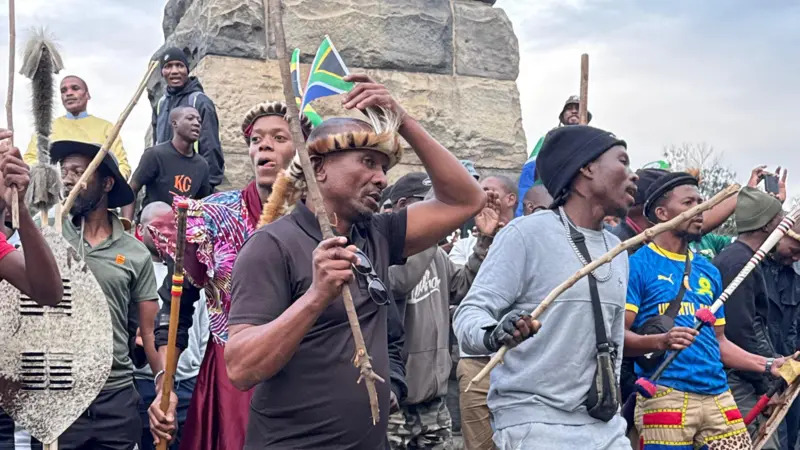
South Africa’s recurring outbreaks of xenophobic violence provide one of the clearest modern examples.
Foreign nationals from Zimbabwe, Mozambique, Somalia, Ethiopia, Nigeria and several other African countries have repeatedly faced attacks, intimidation, looting and discrimination.
Many are accused of taking jobs, operating successful businesses, increasing crime or placing pressure on public services.
However, such accusations frequently overlook deeper structural challenges, including unemployment, inequality, poor service delivery, corruption and weak governance.
At its core, xenophobia is often driven by fear.
It is the fear of losing economic opportunities, housing, security and access to limited resources.
During periods of hardship, migrants frequently become convenient scapegoats for problems they did not create.
Political rhetoric, misinformation and stereotypes further deepen these perceptions by portraying foreigners as threats rather than people fleeing conflict, persecution, environmental disasters or poverty.
Despite these similarities, significant differences remain.
The Mfecane and the Ngoni Wars were largely characterised by military conquest, migration and state formation among African societies.
Modern xenophobia, by contrast, is driven primarily by socioeconomic pressures rather than territorial expansion.
Instead of rival kingdoms competing for political dominance, today’s conflicts often involve citizens turning against migrants because of perceived competition for scarce opportunities.
Climate change is adding another dimension to these pressures.
Increasing droughts, floods, shrinking grazing land and declining agricultural productivity are forcing more people to migrate both within and across national borders.
Unless governments strengthen governance, regional cooperation, economic opportunities and sustainable resource management, environmental displacement may continue to fuel social tensions.
Lessons for the future
The comparison between the Mfecane, the Ngoni migrations and present-day xenophobia should therefore be understood as a cautionary lesson rather than a direct historical equivalence.
History demonstrates that when fear, scarcity, displacement and weak leadership converge, violence can spread rapidly.
It also reminds us that blaming outsiders has never resolved the underlying causes of poverty, inequality or political instability.
Africa’s future depends not on repeating the divisions of its past but on building inclusive societies founded on justice, economic opportunity, regional cooperation and respect for human dignity.
READ ALSO:
By addressing the root causes of migration while ensuring that development benefits both citizens and newcomers, African nations can prevent future crises that echo the destructive patterns of the Mfecane and instead build societies anchored in unity, resilience and shared prosperity.
By Hillary Muhalya
You can also follow our social media pages on Twitter: Education News KE and Facebook: Education News Newspaper for timely updates.
>>> Click here to stay up-to-date with trending regional stories
>>> Click here to read more informed opinions on the country’s education landscape