For decades, the Kenyan teacher walked a long, demanding road with a quiet understanding at the back of their mind: that one day, after years of service under the Teachers Service Commission, retirement would come—not as an explosion of reward, but as a measured release of what remained after the system had taken its share. It was not bitterness that defined this expectation, but resignation. A belief that this was simply how things worked.
A teacher would rise through the ranks, endure transfers, manage overcrowded classrooms, stretch limited resources, and give the best years of their life to shaping minds. And when the final chapter arrived, marked by farewells, speeches, and quiet reflection, the long-awaited dues would be processed. But even at that moment of culmination, the figures on paper were never quite the figures that landed in the account.
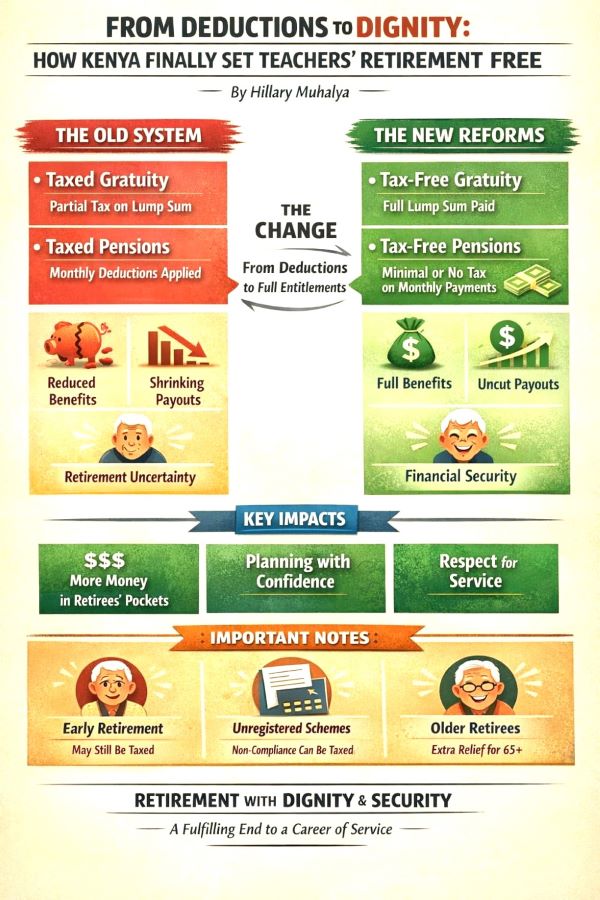
Under the old taxation regime, retirement benefits were treated as taxable income, subject to rules that often felt detached from the emotional weight of retirement itself. Gratuity—the lump sum that symbolized decades of commitment—was only partially protected. A portion of it was exempt from tax, yes, but only up to a fixed ceiling. Beyond that, the remaining amount was taxed according to prevailing income tax bands. For many teachers, especially those who had served long enough to accumulate substantial benefits, this meant losing a significant share of their final payout.
Monthly pension followed a similar pattern. While some relief was granted, it too was not entirely spared. A defined portion would be exempt, but the rest would be taxed, quietly reducing the income that retirees depended on for survival. What reached them each month was not the full expression of their service, but a trimmed version of it.
The impact of this system went beyond numbers. It altered the psychology of retirement. Instead of feeling like a moment of full reward, it often carried an undercurrent of loss. Teachers would calculate what they expected, then recalibrate what they actually received. Plans would be adjusted. Dreams scaled down. The dignity of retirement, though present, was somewhat restrained.
Yet even within this system, teachers endured. They planned carefully, saved where they could, invested modestly, and hoped that what remained would be enough to carry them through the years ahead. It was a generation that understood sacrifice not as an event, but as a lifestyle.
Then, quietly but decisively, the tide began to turn.
Recent reforms introduced through the government’s fiscal restructuring brought a fundamental shift in how retirement benefits are perceived and treated. Working through institutions such as the Kenya Revenue Authority, the state re-examined the logic of taxing retirement dues and arrived at a new conclusion: that what teachers receive at retirement is not merely income—it is deferred earning, accumulated patiently over a lifetime of service.
From that shift in thinking came a powerful change in policy.

Today, the landscape of retirement for teachers under TSC is markedly different. Gratuity, once partially shielded and partially exposed, is now fully protected. The lump sum payment that a teacher receives at retirement is no longer subject to taxation. What is calculated is what is paid. There are no deductions, no silent adjustments, no last-minute reductions. It arrives whole, intact, and unburdened.
For many retiring teachers, this change feels nothing short of revolutionary. It transforms the final payout from a compromised reward into a complete one. It restores the sense that the system recognises and respects the full value of their service.
Equally transformative is the treatment of the monthly pension. Where it was once reduced through taxation, it now flows with minimal or no tax burden. This means that retirees can plan their lives with greater certainty. They can budget, support their families, manage healthcare, and live with a stronger sense of financial security.
The difference between the old and the new systems is therefore not subtle—it is profound. Where there were once ceilings, there is now openness. Where there were deductions, there is now preservation. The journey from the classroom to retirement has been redefined at its final stage.
But as with any policy shift, the story is not entirely without nuance. While the new framework offers broad protection, there remain exceptional situations where taxation may still apply. These exceptions do not undermine the reform, but they serve as important guardrails that define its boundaries.
One such situation arises in cases of early withdrawal. If a teacher exits the profession before meeting the formal conditions of retirement—whether through resignation, dismissal, or voluntary early exit—the benefits accessed at that point may not enjoy full tax exemption. The law distinguishes between retirement at the appropriate time and premature access to funds. In such cases, taxation may still be applied to portions of the payout.
There is also the question of compliance. TSC pensions are structured within recognized and regulated frameworks, ensuring that teachers benefit from the protections provided by law. However, in the rare event that funds are drawn from non-compliant or unregistered schemes, the tax-free status may not apply. The integrity of the system depends on adherence to approved structures.
Another layer of complexity lies in timing. Teachers who retired under the previous system may still bear the imprint of the old tax regime. Their benefits were processed before the new provisions took effect, and as such, they experienced the deductions that defined that era. For them, the reform represents progress—but progress that arrived just beyond their reach.
Age-related considerations also continue to play a role. Traditionally, retirees above a certain age—particularly 65—have enjoyed broader tax reliefs. The new system reinforces and expands this position, ensuring that older retirees are even better protected. It aligns policy with the reality that retirement income is not meant to be eroded, but preserved.
What ultimately emerges from this transformation is a deeper philosophical shift in governance. Retirement benefits are no longer viewed through the narrow lens of taxable income. They are seen for what they truly are: the accumulated result of years of discipline, patience, and service. Taxing them heavily at the point of retirement increasingly appears inconsistent with that understanding, and the reforms correct that imbalance.
For teachers, this shift carries both practical and symbolic weight. Practically, it means more money in their pockets—money that can be used to build homes, support children and grandchildren, invest in small ventures, or simply live comfortably. Symbolically, it signals respect. It tells the teacher that their service has been fully acknowledged, not partially reclaimed.
It also reshapes how younger teachers view the profession. Knowing that retirement benefits will be preserved in full adds a layer of motivation and reassurance. It strengthens the social contract between the educator and the state. It says, in clear terms, that commitment will be honoured—not just in words, but in tangible outcomes.
In many ways, this evolution mirrors the journey of education itself in Kenya: gradual, sometimes uneven, but ultimately forward-moving. It reflects a system learning from its past, correcting its excesses, and aligning itself more closely with the needs and realities of its people.
The classroom may still present its daily challenges—limited resources, evolving curricula, demanding expectations—but at least at the end of that long road, there is now a clearer promise. A promise that the years invested will not be diminished at the point of reward.
READ ALSO: Why TSC is betting on principals to drive the engine of transformation under CBE
And so, the Kenyan teacher today stands at a different threshold. Retirement is no longer shadowed by the quiet subtraction of value. It is illuminated by the assurance of full entitlement. The journey from chalkboard to pension is still long, still demanding—but its conclusion has been fundamentally transformed.
From deductions to dignity, the shift is complete. What was once partially taken is now largely protected. What was once adjusted is now delivered in full. And in that transformation lies a powerful message—not just for teachers, but for the nation as a whole: that service, when truly valued, must be honoured without compromise.
By Hillary Muhalya
You can also follow our social media pages on Twitter: Education News KE and Facebook: Education News Newspaper for timely updates.
>>> Click here to stay up-to-date with trending regional stories
>>> Click here to read more informed opinions on the country’s education landscape
>>> Click here to stay ahead with the latest national news.