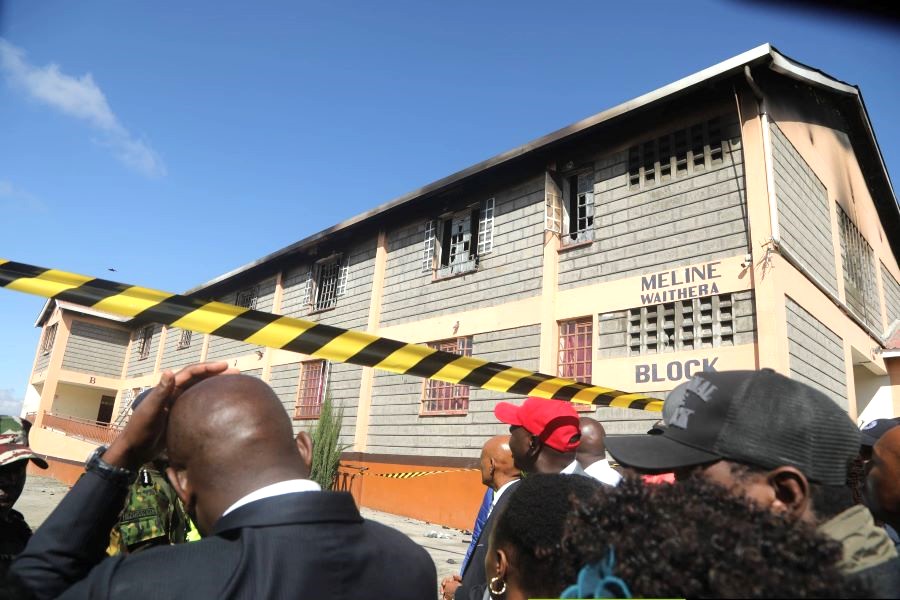
The tragic fire at Utumishi Girls Academy that claimed the lives of 16 young girls and left dozens injured has shaken the nation. The subsequent arrest of eight students in connection with the suspected arson has raised painful questions about discipline, emotional wellbeing, values, and the role of education in shaping responsible citizens.
As Kenyans mourn the loss of innocent lives, we must resist the temptation to view this tragedy as an isolated incident. It is a reflection of deeper challenges facing our schools, families, and society.
The conversation should not only focus on who started the fire, but also on why young learners would reach a point where destruction, anger, or violence becomes an option.
Beyond examinations and grades
For many years, education in Kenya was largely centred on examinations and academic performance. Success was measured by grades, rankings, and certificates.
While academic excellence remains important, society is increasingly discovering that high grades alone do not automatically produce responsible, ethical, and emotionally stable citizens.
This is where Competency-Based Education (CBE) becomes important.
Unfortunately, many people continue to misunderstand CBE. Some view it as a system that has lowered standards or abandoned discipline. Others focus only on the challenges of implementation while ignoring its intended purpose.
Yet, when properly implemented, CBE has the potential to address some of the very issues that continue to fuel unrest, violence, and indiscipline in schools.
Building the whole learner
At its core, CBE is not merely about teaching Mathematics, English, Science, or Social Studies. It is about nurturing the whole learner.
It seeks to develop communication, collaboration, critical thinking, creativity, citizenship, self-efficacy, and digital literacy. Most importantly, it seeks to produce ethical and responsible members of society.
A learner who has genuinely gone through a well-implemented competency-based system should understand empathy, conflict resolution, self-awareness, emotional regulation, and accountability.
Such a learner should be able to manage frustration without resorting to violence or destruction.
The Utumishi Girls tragedy reminds us that education must go beyond passing examinations. It must intentionally build character.
The role of parents and schools
The truth is that bad behaviour does not emerge overnight. A learner does not wake up one morning and suddenly become violent, disrespectful, or destructive.
Such behaviour often develops gradually through years of poor guidance, weak boundaries, lack of accountability, and inconsistent correction.
Many parents today confuse discipline with punishment. They fear correcting their children because they do not want to appear harsh. Yet discipline is not about beating children. It is about teaching responsibility, consequences, respect, and self-control.
When children are allowed to insult adults and it is celebrated as confidence, when they break rules and it is called independence, or when they refuse correction and it is defended as self-expression, society should not be surprised when such attitudes eventually manifest in schools, workplaces, and communities.
Schools alone cannot solve this problem.
Teachers interact with learners for only a few hours each day. The foundation of values is laid at home. Parents remain the first teachers.
If respect, responsibility, honesty, and emotional control are not nurtured at home, schools are left struggling to repair what should have been built from childhood.
At the same time, schools must also play their role. Learning institutions should not focus exclusively on academic content while neglecting character formation.
Guidance and counselling departments should be strengthened. Learners should be given opportunities to express concerns, manage emotions, resolve conflicts peacefully, and participate in meaningful leadership activities.
Learner engagement and ethical education
A properly implemented CBE system provides room for this. Through community service learning, mentorship programmes, leadership activities, and values-based education, learners are empowered to become active and responsible citizens rather than passive recipients of information.
The tragedy at Utumishi Girls should also challenge education stakeholders to rethink student engagement.
Many cases of unrest arise when learners feel unheard, disconnected, frustrated, or overwhelmed. Schools must create environments where students can safely express concerns before those frustrations escalate into dangerous actions.
CBE encourages learner participation, collaboration, and problem-solving. When learners are actively engaged in their education and feel valued within the school community, they are more likely to develop a sense of ownership and responsibility toward their environment.
Equally important is the need to strengthen ethical education.
Knowledge without values can be dangerous. A learner may be academically gifted but lack empathy, integrity, and respect for life.
Education must therefore aim to produce individuals who not only know what is right but are willing to do what is right even when nobody is watching.
A lesson Kenya must not ignore
As investigations continue into the Utumishi Girls fire, Kenya must learn from this painful moment.
The country cannot afford to focus solely on punishment after tragedies occur. Greater attention must be given to prevention through strong parenting, values-based education, emotional support systems, and proper implementation of CBE.
The lives lost in Gilgil cannot be recovered. The dreams of sixteen young girls have been cut short forever.
But their deaths should compel us to ask difficult questions about the kind of society we are building and the kind of citizens we are raising.
If Competency-Based Education is implemented as intended—not merely as a curriculum change but as a transformation of how we nurture learners—we can raise a generation that is engaged, empowered, ethical, and responsible.
READ ALSO: Confronting homosexuality in schools: A call for guidance, counselling and moral formation
Such a generation will not solve problems through destruction.
It will solve them through dialogue, empathy, innovation, and leadership.
That is the promise of CBE.
And that is the lesson Kenya must not ignore.
By Polycarp Ateto
Polycarp Ateto is pursuing a Master’s degree in Education Leadership and Policy Studies.
You can also follow our social media pages on Twitter: Education News KE and Facebook: Education News Newspaper for timely updates.
>>> Click here to stay up-to-date with trending regional stories
>>> Click here to read more informed opinions on the country’s education landscape