- National Fund for the Disabled of Kenya (NFDK) says demand for disability support far exceeds resources, leaving thousands of learners and institutions without essential services.
- Over 10,000 individuals apply annually for assistive devices and support, but only about 2,500 receive help due to budget constraints, underscoring the scale of unmet demand.
- New facilities like the Muriranjas girls’ dormitory offer hope, yet experts stress more investment in classrooms, vocational training, ICT centres and inclusive education to secure equal opportunities for learners with disabilities.
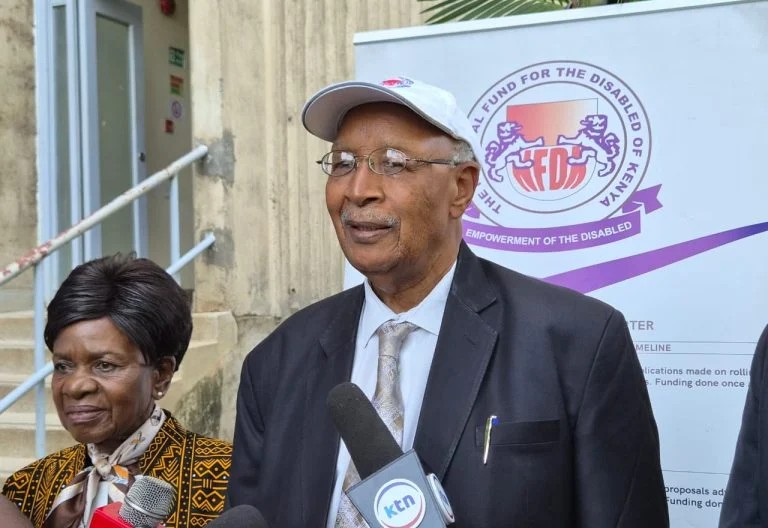
The National Fund for the Disabled of Kenya (NFDK) is turning away the majority of institutions seeking support for learners with disabilities every year, funding only about 60 of more than 250 applications it receives annually, the agency’s Board of Trustees Chairperson Francis Kibera has revealed.
Speaking during the commissioning of a newly constructed girls’ dormitory at Muriranjas Rehabilitation Centre in Murang’a County, Kibera said the fund is overwhelmed by requests from schools, rehabilitation centres and individuals seeking assistance, with demand rising every year against a stagnant pool of resources.
“The need is increasing every year, yet the available resources remain limited. We receive more than 250 applications from institutions annually, but we can only support about 60 during a financial year,” Kibera said.
The shortfall is even starker among individual applicants. NFDK data shows more than 10,000 persons with disabilities apply annually for wheelchairs, hearing aids, crutches, prosthetic limbs, mobility equipment and tools of trade to start small businesses, yet only about 2,500 of them receive assistance each year due to budget constraints.
Kibera said the widening gap reflects mounting pressure on institutions trying to deliver inclusive education while operating with inadequate facilities and thin financial support. Across the country, special schools and rehabilitation centres are seeking funding for dormitories, classrooms, kitchens, dining halls, sanitation blocks, therapy rooms and vocational training workshops, facilities education experts say are central to achieving genuine inclusive education. Without them, many institutions are unable to accommodate rising enrolment or give learners an environment that supports both education and rehabilitation.
He appealed to county governments, development partners, corporate organisations and well-wishers to deepen collaboration with the fund, arguing that inclusive development can only be realised when persons with disabilities have equal access to education, healthcare, employment and economic opportunities.
The newly commissioned girls’ dormitory is expected to give female learners safer, more comfortable accommodation while improving privacy, security and overall well-being. School administrators believe it will also boost attendance, ease overcrowding and create a more conducive environment for learning and rehabilitation, demonstrating how targeted infrastructure investment can directly improve outcomes for vulnerable learners.
ALSO READ:
CS Ogamba announces nationwide special needs assessment in schools
Even with the new facility in place, Muriranjas Rehabilitation Centre Deputy Manager Johnson Njoroge said significant gaps remain. The centre currently serves 102 learners, nearly 90 per cent of whom live with disabilities and require specialised educational and rehabilitation services. Njoroge appealed for support to establish a modern ICT centre and acquire additional vocational and artisan training equipment, saying digital literacy and practical technical skills are increasingly critical in preparing learners for employment, entrepreneurship and independent living, and would help them compete effectively in today’s job market while reducing dependency.
NFDK, established in 1980, remains one of Kenya’s leading state agencies promoting disability inclusion. It provides grants of up to Sh3 million for major infrastructure projects and up to Sh300,000 for smaller community-based initiatives, assistive devices and income-generating activities for persons with disabilities. Even with its limited resources, the fund continues to roll out projects nationally, among them three classrooms at Muiri Primary School in Nyandarua County, three classrooms at Lkurroto Primary School in Samburu County and two classrooms at Muchatha Primary School in Kiambu County, all aimed at expanding access to inclusive education.
Area Chief Mathew Miako used the occasion to challenge parents and communities to embrace inclusive education by enrolling children with disabilities in specialised learning institutions early. He expressed concern that some children remain hidden at home due to stigma, misinformation and cultural misconceptions about disability, noting that early intervention allows children to access specialised education, rehabilitation and life-skills training that prepare them to become productive, independent members of society. He urged communities to replace discrimination with acceptance, saying every child deserves an equal opportunity to learn and fulfil their potential.
Disability advocates say the completion of the Muriranjas dormitory is a symbol of progress, but also a reminder of how much remains undone. With more than 250 institutions and over 10,000 individuals applying for support each year against a fraction of that number being served, sustained investment in inclusive education, rehabilitation programmes, accessibility, assistive technology and vocational training will be critical if thousands of learners and families still waiting for support are not to be left behind.
By Hillary Muhalya
You can also follow our social media pages on Twitter: Education News KE and Facebook: Education News Newspaper for timely updates.
>>> Click here to stay up-to-date with trending regional stories
>>> Click here to read more informed opinions on the country’s education landscape