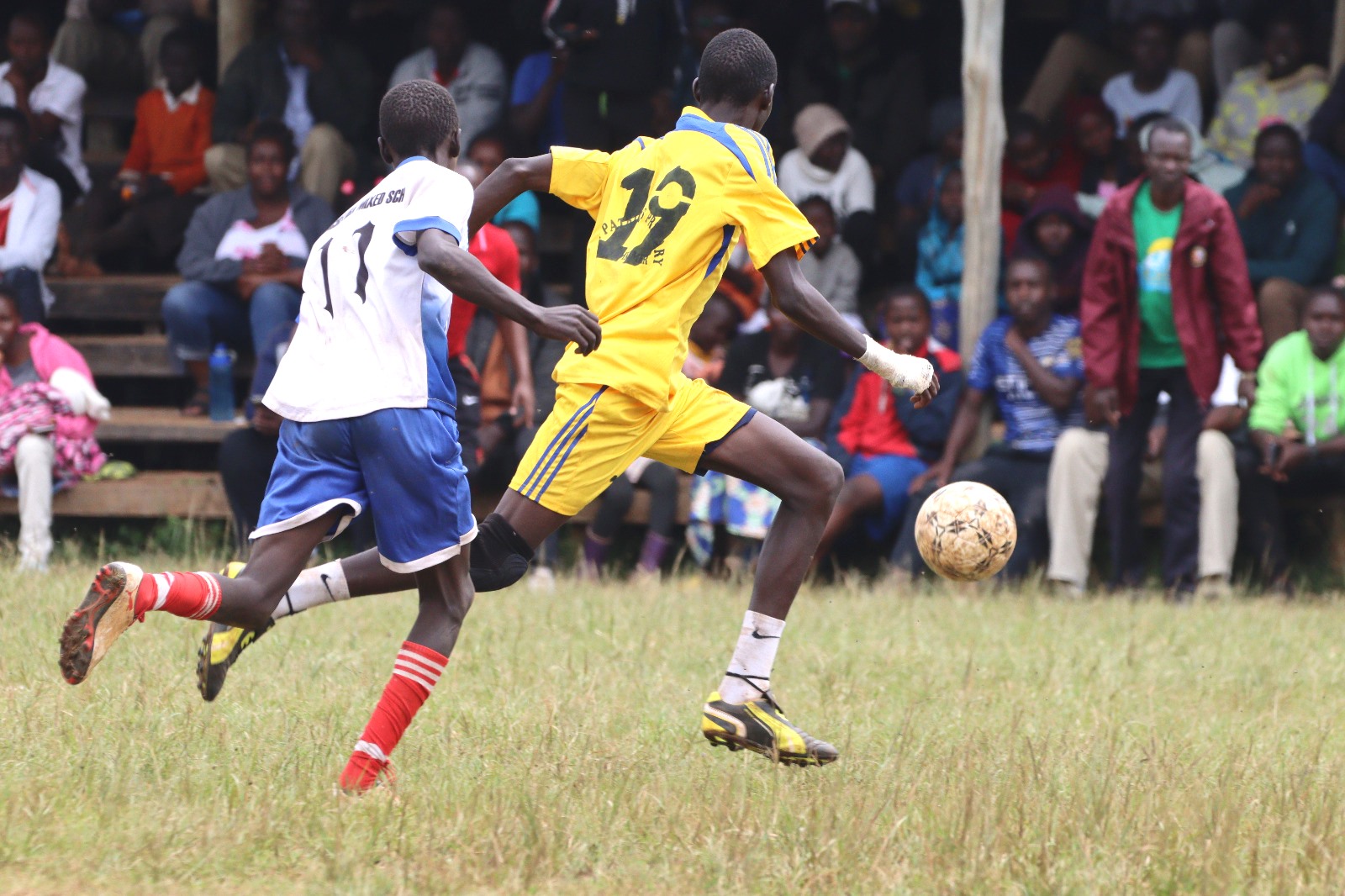
“If you miss the ball, don’t miss the leg!” That was the rallying cry of Jerry Awuor, the headmaster of Jusa Primary School, as he urged his team on from the sidelines during a heated match against Nyangera Primary School. The game was played at Jusa’s dusty field in Yimbo Location—now part of Usigu Sub-County in Siaya County, Western Kenya.
In the 1960s, such instructions were not only common but accepted. Football was as physical as it was passionate. Players were often carried off the pitch after heavy tackles, and referees rarely intervened. A foul that would earn a red card today might once have gone unnoticed. Times have since changed; the modern game no longer tolerates such brutality.
Yet even in those rough early days, Yimbo Location distinguished itself as a cradle of football talent. As early as the 1940s, Gaetano Ogalo Mahima represented Kenya in the Gossage Cup. By the 1960s, players such as William Chege Ouma and Odori Nyathikwach carried the region’s reputation forward on the national stage.
The mid-1970s ushered in one of Yimbo’s most gifted athletes: Paul Oduwo, famously nicknamed “Cobra.” Unlike many of his predecessors, Oduwo’s talent spanned multiple disciplines. At Nyangera Primary School, he moved seamlessly between volleyball and football. On the volleyball court, he was a formidable front-line spiker whose powerful shots were nearly impossible to block. On the football pitch, he was a commanding defender—calm, calculated, and as lethal as his nickname suggested.
ALSO READ:
KNEC tightens verification rules as schools race to meet 2026 exam deadline
From a young age, Oduwo enjoyed unwavering support from his father, Douglas Otieno, who attended nearly every match. His enthusiastic cheers—often delivered in praise-filled vernacular—became a familiar soundtrack to Oduwo’s rise, even when the young player faced teams led by his own relatives.
Although Oduwo sat for his Certificate of Primary Education (CPE) in 1970, it was his athletic prowess that opened doors. He secured a place at Sawagongo Secondary School and later employment with Kenya Posts and Telecommunications in Nairobi. In the capital, his football career flourished. He joined Gor Mahia—popularly known as K’Ogalo—eventually captaining the team and leading it to prominence across East and Central Africa, as well as in continental competitions.
Throughout his career, Douglas Otieno remained a constant presence, cheering from the stands and fueling his son’s determination.
Remarkably, Oduwo and many of his contemporaries rose to prominence without the benefit of modern football academies. Their success was rooted in raw talent, discipline, and an enduring passion for the game. This same passion propelled Gor Mahia to the finals of the African Cup Winners’ Cup in 1979, where they finished runners-up to Canon Yaoundé of Cameroon.
Eight years later, in 1987, under the guidance of British coach Len Julians, Gor Mahia reached the pinnacle of African club football. They won the African Cup Winners’ Cup—also known as the Nelson Mandela Cup—defeating Espérance of Tunisia. It was a crowning achievement for Kenyan football.
Still, the journey was not without controversy. In 1985, during a quarter-final match against Zamalek in Cairo, Gor Mahia found themselves battling not only their opponents but also questionable officiating. Frustration boiled over when player Abass Magongo confronted the referee, an incident that led to Gor Mahia’s two-year ban from continental competitions. The moment, dramatically captured by commentator Leonard Mambo Mbotela’s exclamation “Referee chini!” (“Referee down!”), remains etched in Kenyan football history.
ALSO READ:
Why children learn differently: Experts warn against labeling learners as lazy
Despite such setbacks, Gor Mahia rebounded. By 1987, with goalkeeper David Ochieng “Kamoga” guarding the posts, they secured continental glory. Kamoga would later admit that Oduwo’s presence in the team inspired him to join.
Back then, football offered limited rewards—perhaps a modest job, admiration from fans, and fleeting fame. Today, the game has transformed into a professional enterprise. Clubs like Gor Mahia and AFC Leopards now pay their players, and structured systems support talent development.
The introduction of Competency-Based Education (CBE) and sports science in Kenya signals a new era. These frameworks promise to refine raw talent and provide viable career pathways in sports. Yet questions remain about implementation and expertise. As Dr. Oneko Ndiewo, a lecturer and sports historian, observes, the challenge lies in nurturing talent effectively within these new systems.
Will these reforms succeed where earlier education models faltered? Can they identify and elevate the next Oduwo from local clubs like Ururi Midland or Erico FC?
More than half a century after Jerry Awuor’s uncompromising slogan echoed across a village pitch, football has evolved dramatically—from a rugged pastime to a disciplined, professional sport.
Time, as always, will tell whether the next generation can match the passion, resilience, and brilliance of those who came before.
By OchiengD Ndiewo
You can also follow our social media pages on Twitter: Education News KE and Facebook: Education News Newspaper for timely updates.
>>> Click here to stay up-to-date with trending regional stories
>>> Click here to read more informed opinions on the country’s education landscape