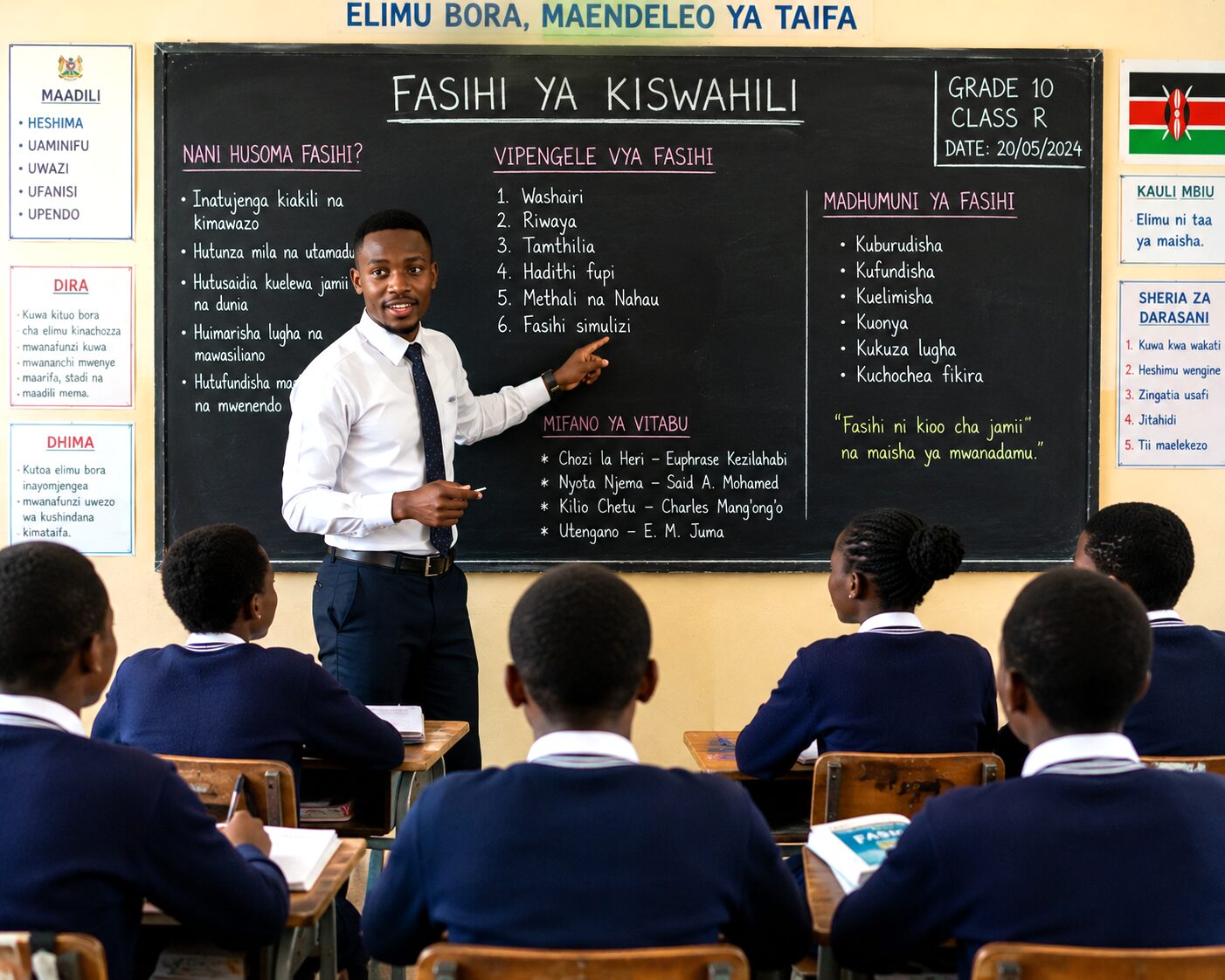
The introduction of the Competency-Based Education (CBE) framework in Kenya was received as a progressive reform intended to transform learning from the narrow pursuit of examination grades into the broader development of competencies, creativity, innovation and practical skills.
It promised to nurture the whole learner by recognising talent, personal interest and the ability to apply knowledge in real life. However, within this ambitious vision has emerged a worrying academic trend: many learners joining Senior School appear hesitant to select Fasihi ya Kiswahili as part of their pathway choices. Public discussions surrounding the first Grade 10 transition in 2026 have largely highlighted the strong attraction toward STEM pathways, while comparatively fewer learners have shown interest in Arts and language-oriented areas. Reports indicate that more than half of learners selected STEM pathways, around 437,000 selected Social Sciences, while about 124,000 selected Arts and Sports. This suggests that many students are being drawn toward subjects considered more marketable or prestigious, while literary disciplines receive lower preference.
Yet this situation should not be interpreted simply as a matter of personal taste. It reveals a deeper philosophical crisis regarding how society values knowledge. When learners turn away from Fasihi ya Kiswahili, they are often responding to social messages that place economic return above cultural depth, technical skill above moral imagination and immediate utility above intellectual heritage. In this sense, the challenge is not the subject itself, but the worldview surrounding it. Society has unconsciously taught young people that science builds futures while literature only fills time. Such thinking is dangerously incomplete.
Fasihi ya Kiswahili occupies a vital place in education because literature is among the disciplines that humanise society. Philosophers across generations have argued that education must shape character as much as it sharpens intellect. Science may teach how to construct roads, machines and systems, but literature teaches how human beings should live with one another while using those systems. Mathematics can train precision, yet literature cultivates empathy, reflection, ethical judgment, creativity and identity. A society that produces technologically skilled citizens without moral imagination risks becoming materially advanced but spiritually impoverished.
More specifically, Fasihi ya Kiswahili preserves the memory and wisdom of East Africa. Through poetry, drama, oral narratives, proverbs, folktales and modern fiction, learners encounter the voices of their ancestors and the realities of their communities. They engage themes of justice, leadership, family, love, betrayal, struggle, hope and national identity through an African linguistic lens. To neglect Fasihi is therefore not only to neglect a school subject, but also to distance learners from the cultural soul of their people. A nation that forgets its stories soon forgets itself.
Several forces have contributed to the low uptake of Fasihi ya Kiswahili in Senior School. One of the strongest is the rise of economic instrumentalism, where learners are encouraged to choose subjects based only on direct job prospects. Many parents and communities repeatedly communicate that medicine, engineering, technology and business are the only reliable roads to success. As a result, students begin to fear any discipline that does not appear immediately commercial. Another factor is the persistent misrepresentation of Fasihi as difficult, old-fashioned or suitable only for less competitive learners. Such stereotypes are intellectually unfair and discourage capable students from exploring the subject.
Additionally, many learners receive limited career guidance regarding the practical value of literature. Few are shown that Fasihi can open doors into education, journalism, publishing, diplomacy, law, script writing, media production, translation, public communication, research and the growing digital creative economy. In an age where communication determines influence, mastery of language has become more valuable, not less. Even developments in artificial intelligence increasingly depend on language data, translation systems and natural language processing, areas in which Kiswahili has rising importance.
Teaching methods also contribute significantly to learner attitudes. Where literature is reduced to memorising notes, themes and examination responses, students lose sight of its living beauty. Fasihi was never meant to be imprisoned in revision booklets. It was born in performance, imagination, dialogue, storytelling and emotional experience. When schools fail to dramatise plays, recite poetry with passion, stage debates, encourage creative writing or connect texts to modern realities, learners understandably assume the subject is lifeless.
If Kenya is to reverse this trend, a philosophical reawakening is necessary. First, the dignity of literary knowledge must be restored. Schools, parents and policymakers must stop speaking of language subjects as if they are lesser alternatives to science. Every field of knowledge contributes uniquely to human flourishing. Engineers need communication skills, doctors need empathy, leaders need historical consciousness, and entrepreneurs need persuasive language. Fasihi equips learners with these deeper capacities.
Second, the subject must be reimagined for the modern age. Learners need to see the clear connection between Fasihi and contemporary opportunities such as film production, content creation, advertising, speech writing, media strategy, publishing, podcasting, digital storytelling and cultural entrepreneurship. Once students understand that language can generate both income and influence, attitudes will begin to change.
Third, the teaching of Fasihi must become experiential rather than mechanical. Learners should encounter literature through performances, spoken word, dramatisation, storytelling festivals, literary clubs, online discussions and creative projects. When students perform a play, compose a poem or reinterpret a folktale through digital media, they discover that literature is not a dead archive but a living force.
Fourth, Fasihi must be presented as central to national identity. Kenya cannot meaningfully develop while alienated from its languages and stories. Learners should appreciate that Kiswahili is not merely examinable content but also a language of unity, regional integration, diplomacy and African intellectual expression. To study Fasihi is to participate in preserving memory and shaping the future.
Parents also require reorientation. Many well-meaning parents unknowingly narrow their children’s imagination by insisting only on a few prestigious professions. Yet the twenty-first-century rewards not only technical ability but also creativity, communication, emotional intelligence and adaptability. Families must understand that success is increasingly multidisciplinary and that literature can be a foundation rather than an obstacle.
A deeper warning must be stated clearly. When a nation teaches its children to pursue only what is profitable, it produces consumers. When it teaches them also to pursue what is meaningful, it produces citizens. Fasihi belongs to the realm of meaning. It asks enduring human questions: Who are we? What is justice? What kind of leadership should society embrace? How should people love, forgive, resist oppression or preserve dignity? These are questions no laboratory can answer on its own.
READ ALSO: KNEC to award CBE learners dual certificates after Senior School
In conclusion, the low selection of Fasihi ya Kiswahili in Senior School should concern every serious educator. It reflects not the weakness of the subject, but confusion about the purpose of education itself. Competency-Based Education was designed to develop whole persons, not merely workers. If Kenya remains faithful to that vision, Fasihi must be repositioned as a central pillar of intellectual and cultural growth. A strong nation needs scientists who can reason ethically, leaders who understand narrative, citizens who appreciate identity and professionals who communicate with wisdom. Reviving Fasihi ya Kiswahili is therefore not a backward step into tradition; it is a forward step into balanced, humane and meaningful progress.
By Isaiah Rolvin
Rolvin is an educator and Kiswahili Master’s student at Kenyatta University.
You can also follow our social media pages on Twitter: Education News KE and Facebook: Education News Newspaper for timely updates.