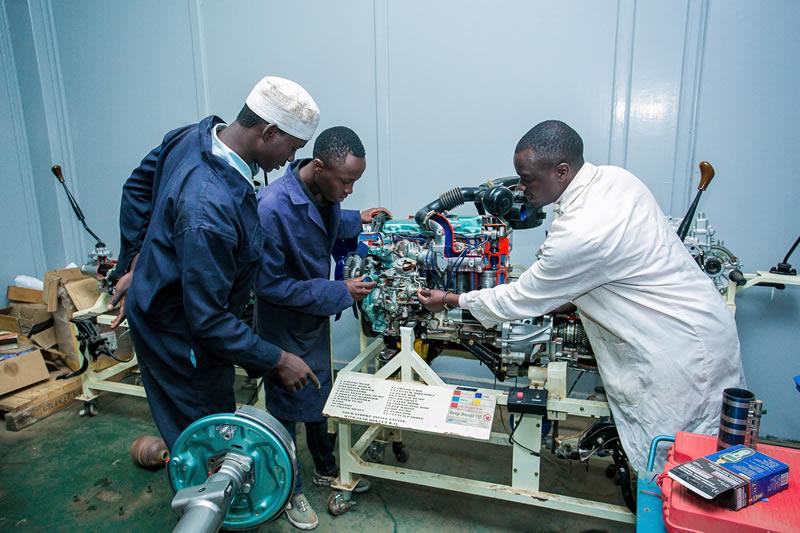
- CBET shifts training towards demonstrable skills, practical performance and competence measured against defined occupational standards.
- Its clearest application is within TVET, where training and assessment are closely linked to workplace requirements.
- Understanding the distinction between CBE and CBET is critical as Kenya reforms education and skills development.
For years, education has often been measured by what learners can remember, the examinations they pass and the certificates they earn. But the world of work is asking a more demanding question: What can this person actually do?
That question sits at the heart of Competency-Based Education and Training (CBET), an approach that places practical competence, workplace performance and the application of knowledge at the centre of training.
CBET is increasingly important in discussions about the future of education and skills development, but one point must be made clear: CBET should not be confused with a system that automatically replaces the entire education curriculum from ECDE to university. Its strongest and most direct application is in technical, vocational, occupational and professional training, although competency-based principles can influence learning at different levels.
At its core, CBET shifts the emphasis from simply completing a syllabus to demonstrating mastery of defined competencies. A learner is not considered fully prepared merely because they have attended classes or passed a written examination. They should be able to demonstrate that they can perform a task correctly, safely and to the required standard.
This creates a fundamental change in the role of the learner. Instead of being a passive recipient of information, the learner becomes an active participant through practical exercises, projects, demonstrations, simulations and workplace experiences.
The trainer also takes on a different role. Rather than concentrating mainly on delivering notes and preparing students for examinations, the trainer becomes a facilitator, coach, mentor and assessor, helping learners acquire and demonstrate the required competencies.
Where CBET is strongest
CBET has its strongest application in TVET and other occupational training programmes. It can be used in engineering, manufacturing, automotive technology, building and construction, electrical installation, plumbing, agriculture, hospitality, tourism, ICT, fashion and design, beauty therapy, refrigeration and air conditioning, renewable energy, electronics and many other technical and service occupations.
For example, an automotive trainee should not only know the theory of an engine. The learner should be able to diagnose faults, service the vehicle, repair components and carry out maintenance according to the required standard.
In construction, competence may involve masonry, carpentry, plumbing, electrical installation, welding, tiling or other specialised skills. In agriculture, it may involve crop production, animal husbandry, irrigation, farm machinery, food processing and agribusiness.
The same principle applies to ICT. A learner should not merely memorise computer concepts but demonstrate the ability to install systems, develop software, manage networks, maintain equipment or solve technology-related problems, depending on the programme.
Assessment is one of the biggest areas of change. CBET places greater emphasis on continuous and practical assessment rather than relying entirely on a final written examination. Demonstrations, projects, practical assignments, simulations, observations and workplace tasks can all be used to establish whether a learner has achieved the required competency.
The approach also strengthens the relationship between training institutions and industry. Industrial attachment, internships, apprenticeships and workplace-based learning allow learners to encounter real equipment, customers, deadlines, safety requirements and professional expectations.
CBET also provides an important opportunity for people who already possess skills but lack formal qualifications through Recognition of Prior Learning (RPL). Where appropriate systems exist, competencies acquired through work experience, apprenticeships or informal learning can be assessed against established standards and formally recognised.
But CBET is not only about changing assessment. Its success depends on the quality of the entire training environment. Institutions require qualified trainers, competent assessors, modern workshops, adequate equipment, appropriate technology, learning materials and strong links with industry.
Where does CBET fit from ECDE to university?
At ECDE, competency development is relevant, but young children should not simply be subjected to an occupational CBET model. Early childhood education focuses on holistic development, play, foundational learning and age-appropriate experiences. CBET is more relevant to the training and preparation of ECDE teachers than to the way young children themselves are trained for occupations.
At the primary and junior school levels, competency-based principles are increasingly important because learners are expected to develop abilities beyond memorisation. However, this broader competency-based approach should not automatically be labelled CBET.
At Senior School, competency development can become increasingly prominent, particularly in technical, creative, vocational and applied learning areas where learners are expected to develop practical abilities alongside academic knowledge.
It is in TVET and occupational training, however, where CBET has its clearest and strongest application. Here, programmes can be organised around specific occupational competencies and industry standards, with learners assessed on whether they can actually perform the required tasks.
At university level, CBET does not automatically replace academic university education. Universities may incorporate competency-based approaches into professional and practice-oriented programmes such as medicine, engineering, education, ICT, nursing and other disciplines.
The distinction is important: CBE and CBET are related, but they are not identical. Competency-Based Education is a broader approach to developing competencies across learning, while CBET is more specifically associated with structured education and training aimed at occupational and workplace competence.
From qualification to demonstrated competence
Ultimately, the real power of CBET lies in changing the meaning of qualification.
The question should no longer be simply, “What did you study?”
It should increasingly be:
“What can you do with what you have learned?”
For a country seeking to address youth unemployment, strengthen technical skills, improve productivity and prepare citizens for a rapidly changing economy, that question could become one of the most important in the future of education.
READ aLSO: Every learner heading to university should read this before leaving home
CBET is therefore not simply another curriculum. It is a shift in philosophy — from certificates alone to competence, from memorisation to application, and from classroom learning to the ability to perform in the real world.
By Hillary Muhalya
You can also follow our social media pages on Twitter: Education News KE and Facebook: Education News Newspaper for timely updates.
>>> Click here to stay up-to-date with trending regional stories
>>> Click here to read more informed opinions on the country’s education landscape
>>> Click here to stay ahead with the latest national news.