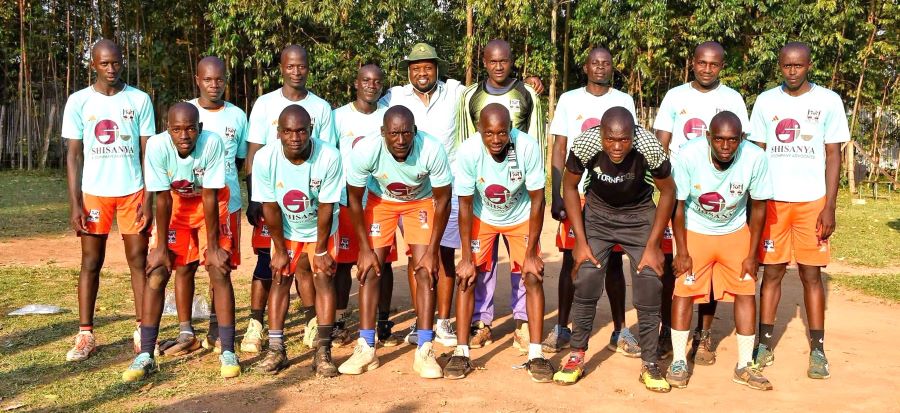
- Kenya heads to Morogoro seeking to retain the FEASSSA boys’ handball title won by Kimilili Boys.
- St. Joseph’s Boys Kitale, Matuu Memorial and Musingu Boys will carry the country’s title hopes.
- Rwanda, Uganda and hosts Tanzania are expected to provide a stern test for the Kenyan representatives.
The 23rd Edition of the East Africa Secondary Schools Sports Association (FEASSSA) Games in Morogoro, Tanzania, presents Kenya with a demanding test as it seeks to retain its grip on the boys’ handball title.
Kenya arrives as the reigning champion following Kimilili Boys’ success in 2025, but the defending champions will not be in Morogoro. Instead, the responsibility of carrying the Kenyan challenge has shifted to St. Joseph’s Boys Kitale, Matuu Memorial and Musingu Boys.
That change makes this year’s championship less about defending a title and more about establishing whether Kenya has developed sufficient depth to remain at the top of East African school handball.
Kimilili Boys’ victory last year was significant because it added a third FEASSSA boys’ handball title to Kenya’s record, following previous triumphs in 2004 and 2016.
The 2025 success also broke the traditional dominance of Rwanda and Uganda and demonstrated that Kenya can compete for regional honours.
However, the biggest question in Morogoro is whether that success can be replicated by a different generation of players.
St. Joseph’s Boys Kitale, Matuu Memorial and Musingu Boys must therefore carry the burden of expectation. Their performances will provide an important indication of whether Kenya’s rise is based on broader development or was largely driven by Kimilili Boys’ exceptional campaign.
Jobo holds the key in Group B
St. Joseph’s Boys Kitale could emerge as Kenya’s most important team in the competition.
Placed in Group B alongside Uganda’s Wampeewo Ntaake S.S., Tanzania’s Maweni and Kilombero, and Rwanda’s GS Tabagwe, Jobo faces a group that offers little margin for error.
The presence of GS Tabagwe is particularly significant. Rwanda has won eight FEASSSA boys’ handball titles — the highest tally in the competition — and its teams traditionally bring strong tactical organisation and handball experience.
Jobo will therefore need to start strongly. Dropping points in the group could complicate its route to the knockout stage, while topping the pool would provide an important psychological boost.
Group A could test Kenya’s depth
Matuu Memorial and Musingu Boys have been drawn in Group A with Uganda’s Gombe Secondary School and Mbogo Mixed Secondary School, as well as Tanzania’s Kikuyu.
Gombe presents perhaps the biggest historical challenge in the group.
The Ugandan school won three successive FEASSSA titles between 2005 and 2007, establishing itself as one of the competition’s early powerhouses.
Its presence means Kenya cannot rely solely on recent form. Matuu Memorial and Musingu Boys will have to cope with a side carrying considerable tournament experience.
The group could also provide an early indication of Kenya’s overall depth. If both Kenyan teams progress comfortably, it would strengthen the argument that the country’s handball success is becoming increasingly sustainable.
Rwanda remains the benchmark
Any assessment of the championship must take Rwanda seriously.
With eight titles, Rwanda remains the most successful nation in FEASSSA boys’ handball. Its dominance has been reinforced by schools such as Adegi, which won four championships in 2018, 2019, 2022 and 2024.
GS Tabagwe may not carry the same historical profile as Adegi, but the Rwandan system remains one of the strongest in the region.
For Kenya and Uganda, defeating Rwanda is likely to require more than physical strength. Tactical discipline, defensive organisation and efficiency in front of goal could determine the outcome of matches against the Rwandan representative.
Uganda could reignite its challenge
Uganda has six FEASSSA titles and remains another major threat.
Gombe’s return is particularly interesting because of its historic success, while Wampeewo Ntaake S.S. and Mbogo Mixed Secondary School give Uganda additional opportunities to challenge for the title.
Uganda’s strength lies in its long-standing handball tradition. The country has repeatedly produced teams capable of performing on the regional stage, making its representatives dangerous opponents in the knockout rounds.
If Gombe progresses from Group A and Jobo emerges from Group B, the competition could eventually produce another Kenya-Uganda battle for regional supremacy.
Can Tanzania exploit home advantage?
Tanzania enters the championship with an advantage that the other contenders cannot replicate — home conditions.
Kikuyu, Maweni and Kilombero give the hosts three representatives and a strong presence in the competition.
Home support can provide an important boost, particularly in closely contested matches. However, it also creates pressure.
Tanzania will need to demonstrate that its teams possess the consistency required to compete against Rwanda, Uganda and Kenya.
A Tanzanian team reaching the final would significantly alter the traditional balance of power in FEASSSA handball.
The bigger question for Kenya
The most important issue for Kenya is not simply whether one of its teams wins the championship.
It is whether the country can establish sustained dominance.
Kimilili Boys proved in 2025 that Kenya has the ability to defeat the established powers. Morogoro will test whether that victory was the beginning of a new era or an isolated breakthrough.
The presence of three Kenyan teams provides an opportunity to answer that question.
If St. Joseph’s Boys Kitale, Matuu Memorial and Musingu Boys perform strongly, Kenya’s handball programme will have demonstrated considerable depth.
If they struggle early, questions could emerge over whether the country remains overly dependent on individual schools to produce regional champions.
Verdict: Kenya has a genuine chance
The championship remains difficult to predict, but Kenya has legitimate reasons for optimism.
Rwanda has the strongest historical record, Uganda possesses enormous experience and Tanzania enjoys home advantage. Kenya, however, has the psychological advantage of entering the tournament as the defending nation.
The absence of Kimilili Boys means there is no guarantee that the trophy will remain in Kenyan hands.
But St. Joseph’s Boys Kitale, Matuu Memorial and Musingu Boys have an opportunity to prove that Kenya’s 2025 triumph represented more than a single school’s achievement.
Morogoro will ultimately provide the answer.
Kenya may not have the strongest historical record, but it has momentum. The challenge now is turning that momentum into sustained regional dominance.
By Godfrey Wamalwa
You can also follow our social media pages on Twitter: Education News KE and Facebook: Education News Newspaper for timely updates.
>>> Click here to stay up-to-date with trending regional stories
>>> Click here to read more informed opinions on the country’s education landscape