- Hillary Muhalya argues Philadelphia’s literacy debate offers Kenya important lessons about how adult learning should be measured.
- He says adult learners bring practical knowledge that conventional literacy assessments may fail to adequately recognise.
- Kenya, he argues, needs flexible, dignified and digitally relevant adult education built around learners’ everyday lives.
More than half of Philadelphia adults aged 18 to 64 have been described as reading at or below a fifth-grade level, a statistic that has renewed attention on the city’s long-running adult literacy challenge and the funding pressures facing adult education programmes.
The figure is striking.
But it is also where the story becomes more complicated.
A recent analysis published by The Conversation argues that standardised literacy scores can expose genuine learning difficulties while simultaneously failing to capture the full range of knowledge and abilities possessed by adults.
That distinction matters far beyond Philadelphia.
It should matter in Kenya, where adult and continuing education has for decades provided a second chance to people who missed, interrupted or never completed formal schooling.
Kenya’s own policy documents have long recognised that adult education is about more than simply teaching adults to read and write. Adult and Continuing Education encompasses literacy, numeracy and the acquisition of knowledge, skills and attitudes that can help adults adapt to changing technologies, improve self-reliance and participate in lifelong learning. Kenya’s education policy framework similarly recognises alternative approaches for out-of-school youth and adults.
That is precisely where the Philadelphia story should lead Kenya.
The Philadelphia warning
The assessment data cited in The Conversation indicate that 32 per cent of Philadelphia adults aged 16 to 74 performed at or below the lowest literacy level of the Programme for the International Assessment of Adult Competencies.
There is no reason to minimise such a finding.
Adults who struggle to understand written information can face real disadvantages in employment, education, healthcare, government services and family life.
But describing those adults simply as “fifth-grade readers” risks turning a measurement into an identity.
A standardised test may ask someone to identify the main idea of a passage, interpret information in a chart or locate a specific detail.
Life asks different questions.
Can the person understand a child’s school communication?
Can they follow instructions on medication?
Can they calculate the cost of goods?
Can they understand a mobile-money transaction?
Can they complete a government form?
Can they operate a small business?
Can they help their children with schoolwork?
Those are also measures of functional literacy.
And this is where Kenya needs to enter the conversation.
Kenya has been here before
Kenya is not starting from zero.
The country has an established Adult and Continuing Education system and has historically recognised literacy as a foundation for further learning, participation and national development.
But the challenge has always been implementation.
Kenya’s National Adult Literacy Survey revealed significant literacy disparities across the country. Government education documents cite the survey as showing that about 7.8 million adults, representing 38.5 per cent of the adult population at the time, had not attained the minimum literacy level. The disparities were particularly stark geographically, with Nairobi recording much higher literacy than the former North Eastern Province.
The important point is that Kenya’s problem cannot be reduced to a single national literacy percentage.
The country contains dramatically different educational realities.
A literate adult in Nairobi may navigate smartphones, online banking, government portals and digital work with relative ease, while an adult in a remote rural community may confront entirely different barriers involving language, access, distance, poverty, learning materials and opportunity.
That means one number cannot tell the whole Kenyan story.
The Kenyan adult learner is not a failed child
This is perhaps the most important lesson Kenya can draw from Philadelphia.
An adult who did not complete school should not automatically be treated as an older version of a primary-school pupil.
Adult learners bring experience into the classroom.
They may be farmers, traders, parents, artisans, domestic workers, entrepreneurs, community leaders or informal-sector workers.
They may already possess sophisticated practical knowledge acquired outside formal education.
The role of adult education should be to connect that knowledge to new literacy, numeracy, digital and problem-solving skills.
This is consistent with the broader international understanding of adult learning. UNESCO defines literacy as a continuum encompassing abilities to read and write, understand, interpret, create, communicate and compute, as well as solve problems in an increasingly technological and information-rich environment.
That definition is particularly relevant to Kenya today.
The phone may be the new classroom
Consider the Kenyan adult who can operate a mobile phone but struggles to read a long official document.
Is that person illiterate?
The answer is more complicated than a simple yes or no.
The individual may be perfectly capable of using mobile money, calling customers, listening to educational content, sending voice messages and conducting business.
But if a digital government service requires reading a complex form, the same person may suddenly find themselves excluded.
This is why Kenya must increasingly distinguish between print literacy, functional literacy and digital literacy.
For Kenya, adult education cannot remain trapped in an exclusively paper-based model.
The adult learner of 2026 needs to understand not only books and forms, but also phones, digital platforms, online information, electronic transactions and the increasingly complex digital environment.
Kenya has already begun incorporating digital learning into adult education. UNESCO’s global reporting highlights Kenyan efforts around ICT infrastructure, curriculum gaps, instructor training, acquisition of ICT resources and e-learning in Adult and Continuing Education.
Kenya already has evidence that practical literacy works
There are powerful Kenyan examples showing what happens when adult education is connected to everyday life.
In West Pokot, UNESCO documented the experience of an adult learner who acquired literacy alongside basic technology and agricultural skills. She subsequently applied that knowledge to farming and established a small business growing and selling millet.
That is adult literacy with a tangible outcome.
It is not merely about passing an examination.
It is about reading, calculating, communicating, producing, trading and becoming more economically independent.
The same experience also exposed structural obstacles facing adult education: inadequate resources, stigma, competing household responsibilities and shortages of educators.
UNESCO reported that West Pokot had 7,200 adult learners but only 330 adult educators, with funding constraints and failure to replace retiring staff contributing to the shortage.
That example should force a broader national question.
What happens when Kenya identifies adults who need education but does not provide enough educators, materials, flexible programmes and sustained financing to reach them?
Adult education must fit adult lives
It would be easy to conclude that the answer is simply more money.
Kenya certainly needs greater investment in adult learning.
But financing alone will not solve a system that is not sufficiently adapted to adult realities.
Adults have jobs.
They have children.
They run businesses.
They care for relatives.
They travel.
They migrate.
They experience financial shocks.
A mother may have to choose between attending a literacy lesson and taking care of her children.
A farmer cannot necessarily attend class during peak agricultural activity.
A trader cannot simply close a stall because a lesson begins at a fixed time.
UNESCO’s experience in West Pokot illustrates precisely this tension. Adult learners, particularly women, can be forced to balance classes against childcare, household duties and earning a livelihood.
Kenya therefore needs adult education that bends around adult life — not adult lives forced to bend around rigid education structures.
Kenya already has examples of this approach. UNESCO documentation of functional adult literacy programmes describes flexible non-formal classes in which learners help determine when they attend, allowing programmes to accommodate their work and other responsibilities.
The motivation is bigger than employment
Another mistake would be to judge adult education exclusively by employment outcomes.
Employment matters.
Income matters.
Entrepreneurship matters.
But adult learners can have motivations that never appear in employment statistics.
A parent may attend literacy classes because they want to read a child’s homework.
Another may want to understand a letter from a school.
Someone else may want to read a medicine label.
Another may simply want the confidence to sign documents independently.
These outcomes may appear small when compared with national economic statistics.
They are not small to the person whose life has changed.
And they can have an intergenerational effect.
An adult who becomes more confident in reading can become more capable of supporting children with learning at home.
That means adult literacy can become an investment in the next generation’s education.
UNESCO’s West Pokot account illustrates this transformation vividly: an adult learner who previously could not read later became able to read her child’s school report card independently.
Kenya should stop measuring only the deficit
This is where the Philadelphia debate becomes a powerful warning for Kenyan policymakers.
If adult literacy is assessed only through standardised tests, policy can become obsessed with deficits.
How many adults cannot read?
How many are below a particular level?
How many lack a qualification?
Those questions are useful.
But they are incomplete.
Kenya should also ask:
How many adults can now read a school communication independently?
How many can use digital government services?
How many can manage a mobile-money transaction?
How many can read agricultural instructions?
How many can calculate business costs?
How many can support their children academically?
How many have gained enough confidence to participate more fully in their communities?
Those questions measure capability rather than deficiency.
The digital opportunity
Kenya has already recognised the importance of integrating ICT into Adult and Continuing Education.
The next step should be to make that ambition central rather than peripheral.
Adult education should take learning to where adults already are.
That could mean mobile-based lessons, community digital centres, flexible evening classes, local-language resources, audio learning, blended instruction and practical digital-skills programmes.
Technology should not replace adult educators.
It should extend their reach.
Kenya’s Community Learning and Resource Centres already demonstrate the potential of a broader approach. UNESCO describes them as multifunctional hubs offering literacy and continuing education alongside digital learning, farming training, childcare and small-business support.
The language of failure must change
There is also a cultural challenge.
Adults with limited literacy can experience embarrassment and stigma.
UNESCO’s experience in Kenya found that some adults did not want to be taught in school buildings because they feared appearing uneducated.
That means adult education must protect dignity.
A successful programme should not make adults feel that they have returned to school to be reminded of everything they failed to achieve as children.
It should make them feel that they are acquiring new tools for the lives they are living today.
The classroom should therefore become a place of empowerment rather than humiliation.
From Philadelphia to Kenya — and beyond
The Philadelphia statistic is important precisely because it forces society to ask what lies behind the number.
Kenya should ask the same question of its own literacy data.
A percentage can tell us how many people are struggling.
It cannot, by itself, tell us what those people know, what they can do, why they stopped learning, what they need or how best to help them.
That requires a more sophisticated understanding of adult learning.
UNESCO’s framework places adult education within lifelong learning and recognises flexible learning opportunities, active citizenship and second-chance programmes for people who never attended school or left formal education early.
Kenya should embrace that broader vision.
The country needs stronger financing for Adult and Continuing Education, adequate recruitment and replacement of instructors, updated learning materials, better data, flexible delivery models and programmes designed around real community needs.
But above all, it needs a philosophical shift.
Adult education should stop being treated as education for people who failed the first time. It should be treated as lifelong education for people whose learning needs did not end when they left school.
That is the real lesson from Philadelphia.
The question is not whether an adult reads like a fifth-grader.
The question is whether that adult can read the information that matters, understand it, use it to improve their circumstances, support their family and participate fully in society.
For Kenya, that is the standard that should matter.
Because literacy is not simply the ability to decode words on a page.
READ ALSO: KNEC releases 2025 KPSEA and KJSEA school-specific reports for download
It is the ability to turn information into opportunity — and to turn learning into a better life.
By Hillary Muhalya
Get more stories from our website: Education News
To write to us or offer feedback, you can reach us at: editor@educationnews.co.ke
You can also follow our social media pages on Twitter: Education News KE and Facebook: Education News Newspaper for timely updates.
>>> Click here to stay up-to-date with trending regional stories
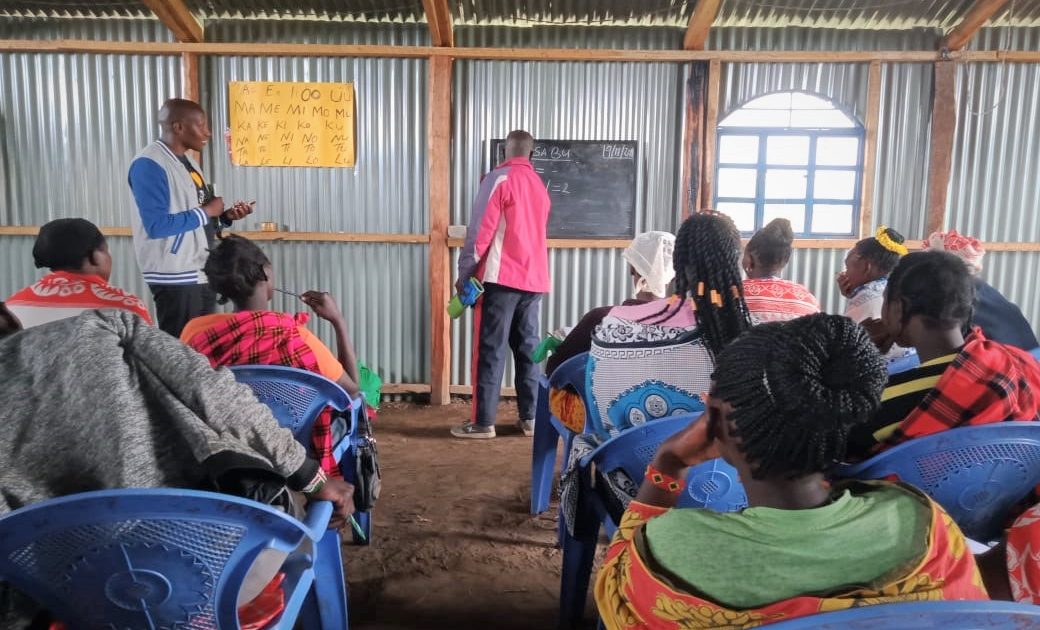
Photo caption: Adult learners participate in a learning session. Hillary Muhalya argues Kenya should measure adult literacy through practical capabilities alongside conventional assessment.