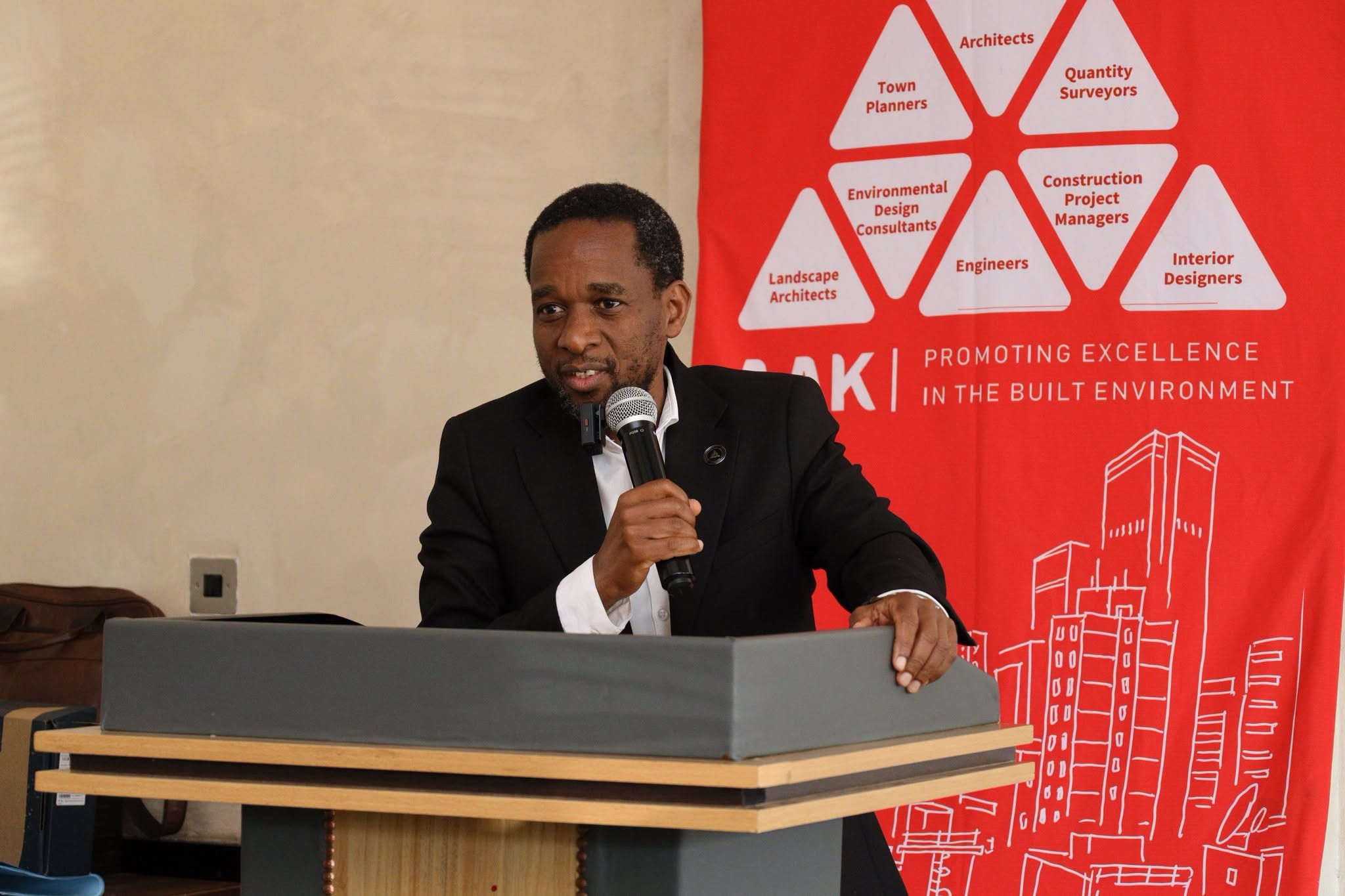
- Kenya National Association of Architects President George Ndege has urged members to embrace AI in designing safe, climate-resilient buildings during the Kisii Branch annual meeting.
- Ndege has highlighted a shortage of registered architects and engineers in Kenya, urging secondary school students to pursue science subjects to fill the profession’s gap.
- The event featured the unveiling of a modernised traditional Abagusii hut and a cultural exhibition, with leaders calling for documentation of the community’s traditional building knowledge.
The Kenya National Association of Architects President, George Ndege, has challenged members of the association to embrace Artificial Intelligence (AI) in their quest to guide construction proposals meant to preserve human lives in a changing world.
Ndege was speaking during the association’s Annual Kisii Branch meeting at Hotel Humphreys, where he addressed more than 17 architects and engineers from the region during the unveiling of a traditional Abagusii house, built with a blend of modern architectural techniques designed to withstand emerging climatic changes such as El Niño and La Niña.
Ndege said architects must differentiate houses from homes, noting that some architects have contributed to poorly constructed houses that host diseases such as malaria. “Show me a good house, and I will show you a healthy society,” he said.
Ndege said the construction industry is evolving fast and architects must move with technology to design houses that are safe, affordable and climate-resilient, adding that AI can assist in developing strong designs, cost estimation and predicting how buildings will respond to floods, strong winds and earthquakes. He decried the small number of architects in the country, noting that there are only 2,000 qualified and registered architects and 1,000 engineers nationally, and urged secondary school students to embrace science subjects to help fill the gaps in the profession.
“We are going to become old and retire from the profession. Who will replace us unless we mentor and encourage our brothers and sisters to work hard in class?” he posed.
The meeting was attended by Borabu MP Patrick Osero and former Kisii University Vice Chancellor Prof. John Akama, alongside their spouses, and Kisii County Secretary in charge of Culture, Social Services, Sports, Youth and Chicken, Dr Margaret Obaga, who was accompanied by her husband. Osero thanked the Kiong’anyo Cultural Organisation (KICO), chaired by Samson Nyamoko and directed by Moses Okemwa, for hosting the event in Kisii County, and appealed to the organisation to extend similar cultural exhibitions to Nyamira County. “We are one people as the Kisii community despite having different administrative names. I hope you will touch Nyamira too,” he said.
ALSO READ:
Prof. Akama, who led the unveiling of the Gusii traditional huts with a modern architectural touch at Kiang’anyo Hill, challenged the architects to incorporate the community’s concept of societal ethics known as Chinsoni, which he said has safeguarded the community through its historical migrations from Mount Elgon to its present settlement in Kenya’s highlands. He urged scholars to research the community’s traditional house-building methods and combine them with modern architectural technology to document timeless principles for future generations.
Dr Obaga said a building is defined not only by its structure but also by what it houses. She noted that the community holds a wealth of undocumented traditional wisdom, including the historically recognised traditional head surgery practised by the Abamachuki, and called on researchers, scholars and journalists to document such knowledge for posterity.
The meeting included a presentation on the construction and features of the traditional Kisii hut known as Enyomba. The circular hut is designed to allow wind to flow around it, reducing the risk of it being blown away. At its centre stands a strong wooden post called Ritiro Rinene, which supports the entire roof and holds the structure firm against strong winds.
The walls are made from a woven framework called Chindigi, consisting of thin, straight sticks tied together with creepers and plastered with a mixture of red soil and cow dung known as Esike Y’esimbagera, which seals cracks, prevents dust, repels insects and regulates indoor temperature. The same mixture is used on the floor to keep away fleas and jiggers.
ALSO READ: Probe launched as Murang’a teacher found dead in rented house days after going missing
The roof is constructed using long poles called Chindege running from the Ritiro Rinene to the walls, topped with thatch made from dry grass such as Ekenyoru, Ekebabe, Esinde or Chimboba, depending on availability. The thatch does not rust, regulates temperature naturally and its sloped design allows rainwater to drain quickly, preventing leaks during heavy El Niño rains. A small opening at the top allows smoke from the indoor fireplace to escape, which treats the thatch, extends its lifespan and helps keep mosquitoes away.
The event featured traditional foods, including dishes made from finger millet served with roasted meat and traditional sour milk, along with traditional brews Ebusaa and Amabere Amaruranu. The gathering concluded with a traditional Abagusii dance known as Entabanania, led by Enguba traditional dancers playing the Obokano, an eight-stringed instrument central to major community celebrations. The dance, characterised by rhythmic shoulder movements, vigorous stamping and synchronised waist motion, drew participation from the audience through ululating and clapping as the performance built to a close.
By Enock Okong’o
Get more stories from our website: Education News
To write to us or offer feedback, you can reach us at: editor@educationnews.co.ke
You can also follow our social media pages on Twitter: Education News KE and Facebook: Education News Newspaper for timely updates.
>> Click here to stay up-to-date with trending regional stories