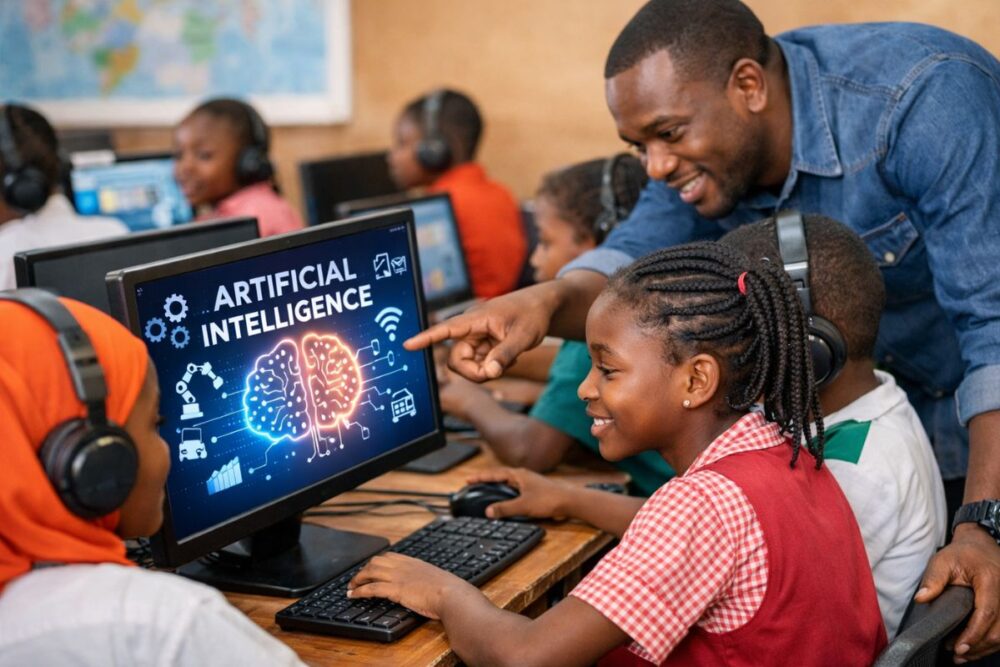
Walk into many classrooms today and you will still find a familiar scene. A teacher at the front. Students taking notes. The same lesson delivered in the same way to everyone. Yet outside that classroom the world has changed. Technology is no longer just a tool we use. It is becoming something that can guide learning itself.
Artificial Intelligence (AI) is part of that shift. Not in a dramatic science fiction way but in small practical ways that are beginning to reshape education. For Kenya this is not just another trend. It is an opportunity.
The reality we rarely talk about
A single teacher can face fifty or more students in one class. Each learner is different. Some understand quickly. Others need more time. Some are afraid to ask questions. The system expects them all to move together. That is where many learners get left behind.
Artificial Intelligence introduces a different idea. Learning does not have to move at one speed. It can adjust to the learner. A student who is struggling can get simpler explanations. Another who is doing well can be challenged further. Learning becomes more personal. Not perfect. Not magical. But more responsive than what we have now.
What this means for teachers
There is a common fear that technology will replace teachers. That fear misses the point. Teaching is not the delivery of content. It is interpretation. It is judgment. It is the ability to sense confusion before it is spoken and to respond in a way that makes understanding possible.
No system has mastered that. Yet the reality is that much of a teacher’s day is not spent in that space. It is spent on tasks that are necessary but cognitively repetitive. Planning lessons. Marking scripts. Preparing assessments. Tracking performance over time.
ALSO READ:
PSC completes recruitment for UoN, Kenyatta University Vice Chancellors
At this point a fair question arises. We have had systems doing this for years. Digital grade books. Learning management systems. Automated quizzes. Why then claim that Artificial Intelligence changes anything
The answer lies in the level at which the work is done.
Traditional systems operate at the level of execution. They follow instructions. If an answer matches a predefined pattern it is marked correct. If it does not it is rejected. There is no room for interpretation. No awareness of context. No recognition of partial understanding.
Artificial Intelligence operates at a different layer.
It does not simply check answers. It analyzes them. It looks for structure in responses. It identifies patterns in errors across multiple learners. It can detect when a student is not just wrong but consistently misunderstanding a concept in a specific way. This is a shift from marking outputs to examining thinking. For example a traditional system can tell you that twenty students got a question wrong.
An AI system can suggest that those same students are struggling with a particular concept and may need a different explanation approach. That difference matters. Because teaching is not about counting errors. It is about understanding them.
This is where Artificial Intelligence becomes meaningful in the daily work of a teacher. It can assist in generating lesson pathways rather than just lesson notes. It can surface insights that would otherwise require hours of manual review. It can act as a layer of analytical support behind the classroom.
Not as a replacement for professional judgment but as an extension of it. In practical terms this does not remove the teacher from the process. It removes the lower-level cognitive load that limits how much attention a teacher can give to each learner. What is created is not automation in the traditional sense but augmentation. Time is still saved.
But more importantly attention is redirected. From routine processing to meaningful engagement. From managing tasks to understanding learners. From delivering content to shaping how that content is experienced and that is where the real value lies.
ALSO READ:
Back to school: Why schools’ opening days are never academic
A learner is no longer limited to the classroom
One of the quiet strengths of Artificial Intelligence is that it does not wait for the timetable. A student can ask a question at night and get an explanation. They can revise a topic repeatedly without feeling embarrassed. They can explore beyond what is in the textbook.
For many learners this changes confidence. The quiet student who never raises a hand in class now has a way to ask questions. The struggling learner can revisit concepts without pressure. Learning becomes continuous. But there is a danger Let us be honest.
If used poorly Artificial Intelligence can weaken learning. Students may copy answers without understanding. They may depend on systems instead of thinking. Work may look correct but learning may not have happened. That is why guidance matters. Students must learn to use these tools to understand not to escape effort.
Teachers must remain present as mentors not just instructors. Technology should support thinking not replace it. Kenya’s moment Kenya has always adapted quickly to new technology. From mobile money to digital platforms the country has shown that it can innovate within its own realities. Education can follow the same path.
Artificial Intelligence will not fix every challenge. It will not replace the need for good teachers strong schools and supportive policies.But it can strengthen what already exists. It can help a teacher reach more learners effectively. It can help a student learn with more confidence.
It can bring a sense of possibility into classrooms that often feel limited by resources. The real question is not whether Artificial Intelligence will enter education. It already has. The real question is how we choose to use it.
Will it become a shortcut that weakens learning or a tool that strengthens it, the answer will depend on how teacher’s students and institutions approach it. Used wisely it can open doors that were once closed and quietly without much noise it could become one of the most important shifts in how we teach and how we learn.
By Nick Odundo
ICT Specialist | Education Technology Integration Advocate
You can also follow our social media pages on Twitter: Education News KE and Facebook: Education News Newspaper for timely updates.
>>> Click here to stay up-to-date with trending regional stories
>>> Click here to read more informed opinions on the country’s education landscape