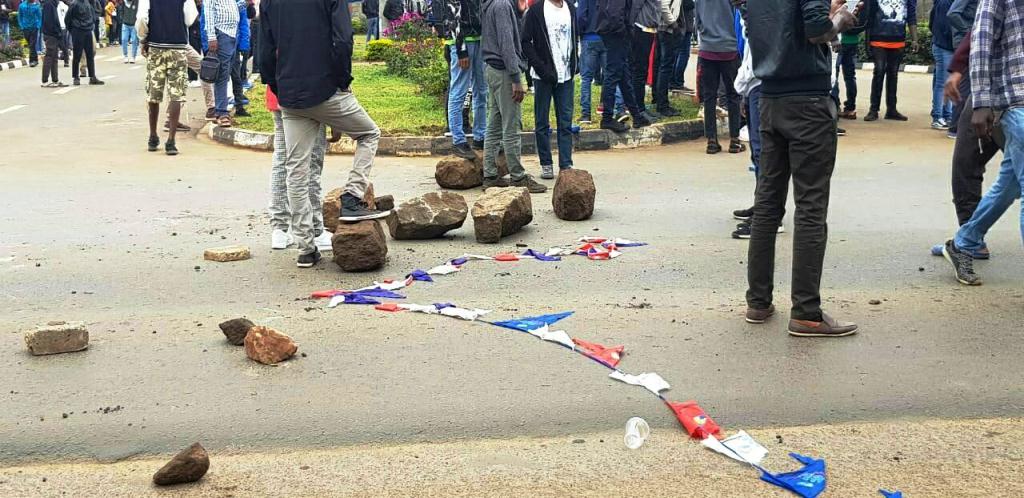
- French students are protesting teacher shortages, overcrowded classrooms and deteriorating facilities as demonstrations spread across the country.
- The unrest has escalated into fires, confrontations with police and attacks or threats against education staff.
- Hillary Muhalya argues that legitimate demands for better education cannot justify violence against teachers and school leaders.
A nationwide revolt over missing teachers, overcrowded classrooms and deteriorating schools has taken a disturbing turn, with reports of attacks on education staff, fires and violent confrontations.
France’s schools are at the centre of a rapidly escalating crisis.
What began as student anger over the conditions in which young people are expected to learn has spilled beyond protests over staffing and infrastructure, with schools disrupted and reports emerging of teachers and school leaders being assaulted or threatened.
The developments have placed French education authorities under growing pressure to confront two problems simultaneously: the grievances driving students onto the streets and the violence threatening the safety of those inside schools.
Students have been protesting over a range of education concerns.
Among the issues reported are teacher and staff shortages, overcrowded classrooms and school buildings described as being in poor condition.
For students, these are not abstract policy arguments.
A missing teacher can mean a cancelled lesson.
An overcrowded classroom can make learning more difficult.
A deteriorating school building can affect the daily experience of thousands of young people.
Those grievances have helped fuel demonstrations across France. The protests began in the Paris region in late September before spreading to schools elsewhere in the country. Reports from France indicate that students have also complained about long timetables and other pressures within the education system.
But the protests have increasingly produced consequences extending beyond the original demands.
When the protest reaches the classroom door
Reports of teachers and school leaders being attacked have added a deeply troubling dimension to the unrest.
Several school principals have been injured, harassed or assaulted during blockades, while fires and other incidents have disrupted school operations.
Educators who are supposed to teach and protect learners can suddenly find themselves dealing with threats and confrontation.
In some locations, fires and damage have also disrupted school operations.
The result is a vicious cycle.
Students protest because they want better schools.
The protest disrupts schooling.
Teachers become targets.
Schools struggle to function.
And learners lose more time in the classroom.
The very institution at the centre of the protest becomes another casualty of the protest.
A teacher is not the entire system
One of the most important distinctions emerging from the crisis is the difference between challenging an education system and attacking an individual educator.
A teacher does not necessarily determine how many colleagues are employed.
A classroom teacher does not set the national education budget.
A school leader may have little control over the condition of a building inherited from previous administrations.
Yet teachers are among the most visible representatives of the education system.
When anger becomes personal, they can become convenient targets for frustrations created by decisions made elsewhere.
That does not make legitimate criticism disappear.
It makes the search for solutions more urgent.
The French protests raise a difficult but fundamental principle.
Students have a right to express concerns about their education.
They can demand better facilities.
They can question staffing levels.
They can call for reforms.
They can challenge authorities.
But the right to protest does not turn violence against teachers into a legitimate education demand.
Once physical attacks, arson or serious intimidation enter the picture, the safety of everyone inside the school is threatened.
Students themselves can become victims.
By October 2, about 400 of France’s 3,700 high schools had been closed, while 560 had reported protests or disruptions, according to figures attributed to the French Ministry of National Education
The authorities now face the challenge of addressing the conditions that triggered the protests while preventing further violence.
Ignoring genuine education grievances risks allowing frustration to deepen.
Ignoring attacks on teachers risks allowing schools to become unsafe.
Neither problem can be solved by pretending the other does not exist.
The immediate challenge is therefore bigger than restoring normal classes.
France must rebuild confidence that schools can be places where difficult questions are confronted through dialogue, evidence and reform — not through fear.
The young people protesting want an education system that works for them.
Teachers want to be able to teach.
School leaders want to run safe institutions.
Parents want their children protected.
Those interests do not have to be enemies.
But the longer violence becomes part of the confrontation, the harder it becomes to separate the legitimate demand for educational reform from the damage caused by the unrest itself.
READ ALSO: Emurua Dikirr MP demands fair bursary distribution as constituency gets Sh70 million
France’s school revolt began with a demand for better education. The danger now is that violence could make education itself the casualty.
By Hillary Muhalya
Get more stories from our website: Education News
To write to us or offer feedback, you can reach us at: editor@educationnews.co.ke
You can also follow our social media pages on Twitter: Education News KE and Facebook: Education News Newspaper for timely updates.
>> Click here to stay up-to-date with trending regional stories