- Hillary Muhalya reflects on the life of cardiologist David Silverstein, who served Daniel arap Moi for decades.
- Silverstein also helped develop modern cardiac care in Kenya and trained generations of medical doctors.
- His remarkable career connected medicine, State House, Nelson Mandela and more than five decades of Kenyan history.
Dr David Silverstein, the American-born cardiologist who became one of former President Daniel arap Moi’s most trusted confidants after serving as his personal physician for decades, has died aged 82.
Silverstein died on Sunday while undergoing treatment, marking the end of an extraordinary medical career that stretched across more than five decades and became deeply intertwined with Kenya’s presidential history. His death was confirmed by former Baringo Senator Gideon Moi, while President William Ruto also paid tribute to him as a distinguished medical practitioner and pioneer of cardiology in Kenya.
But Silverstein was far more than Moi’s doctor. He was one of the pioneers of modern cardiac care in Kenya, a teacher and mentor to generations of doctors, and a physician whose career brought him into contact with some of the most prominent figures in Kenya and Africa, including Nelson Mandela.
He arrived in Kenya in 1974 as a young American doctor, expecting what might have been a short professional assignment. Instead, Kenya became his lifelong home, and he went on to leave an enduring imprint on both the country’s medical profession and its political history.
Born in Chicago in August 1944, Silverstein grew up in the United States and developed an early interest in medicine. He studied at the University of Chicago Medical School, graduating in 1967 at the age of 22.
He subsequently undertook further medical training in Seattle and served in the United States military before returning to Seattle for specialist training in cardiology.
His decision to come to Kenya in 1974 would change the course of his life.
At the time, Kenya had a much smaller pool of highly specialised doctors and limited capacity for sophisticated cardiac diagnosis and treatment. Silverstein became part of a generation of specialists who helped transform that landscape.
At Kenyatta National Hospital, he helped run the cardiac catheterisation laboratory and later became head of the hospital’s cardiology unit. He also joined the University of Nairobi Medical School as a senior lecturer, teaching and mentoring generations of medical students.
His contribution earned him recognition as one of the pioneers of modern cardiology in Kenya.
In 1977, he was appointed chief cardiothoracic physician for the Government of Kenya.
It was also around this period that he began treating Daniel arap Moi, then Vice President.
What began as a doctor-patient relationship gradually developed into one of the longest and most remarkable medical associations in Kenya’s presidential history.
When Moi became President in 1978, Silverstein’s role grew in importance. In 1983, he was formally appointed Moi’s personal physician and remained closely associated with the former president’s health for decades.
The position demanded more than medical expertise. A presidential physician operates in an environment where confidentiality, discretion and trust are paramount. Silverstein accompanied Moi on numerous journeys and became a trusted presence around the former president.
Their relationship eventually went beyond medicine.
Silverstein later recalled conversations with Moi that covered politics, religion, Israel and other subjects. The doctor became sufficiently close to the Moi family to be regarded not merely as a medical professional but as a trusted friend.
Yet his professional identity was never confined to State House.
Silverstein continued treating ordinary Kenyans and became one of the country’s best-known cardiologists. He later practised at The Nairobi Hospital while remaining involved in teaching and professional mentorship.
The Mandela connection
His career also brought him into contact with some of the most significant personalities of his generation.
One of the most notable episodes occurred in July 1990, when Nelson Mandela fell ill with pneumonia during a regional tour and travelled to Nairobi for treatment. Contemporary reports confirm Mandela arrived in Kenya suffering from pneumonia and was taken to hospital.
Accounts published later, including Kalonzo Musyoka’s autobiography, state that Silverstein attended to Mandela at The Nairobi Hospital and monitored him overnight.
The episode placed Silverstein at an unusual intersection of African history: Mandela, the global symbol of the struggle against apartheid; Moi, Kenya’s long-serving president; and Silverstein, the American-born cardiologist whose professional life had become firmly rooted in Kenya.
Another defining experience came in 1998, when the United States Embassy in Nairobi was bombed.
Silverstein was working at The Nairobi Hospital, while Channa Commanday, who had nursing and emergency-care experience, was involved in treating casualties following the attack. Their relationship later developed into marriage.
Silverstein eventually put many of his experiences into writing.
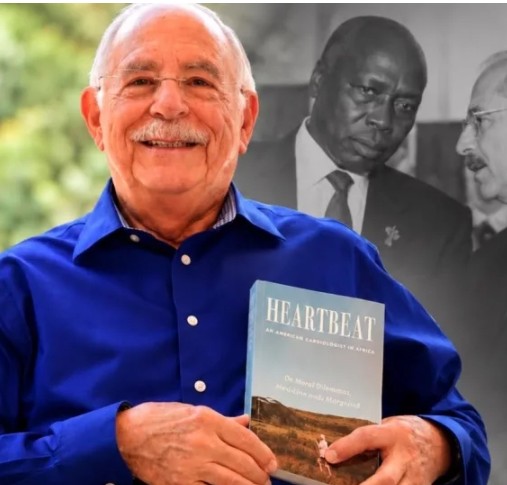
In 2023, he published his memoir, Heartbeat: An American Cardiologist in Kenya, documenting his journey from Chicago to Nairobi and the extraordinary professional and personal experiences that followed.
The memoir offered a rare perspective on Kenya from a man who arrived as an outsider but gradually became deeply embedded in the country’s medical and social life.
It chronicled his medical career, his relationship with Moi, encounters with prominent personalities and the development of specialised medicine in Kenya.
Silverstein’s relationship with Moi continued after the former president retired from office in 2002.
When Moi died in February 2020, Silverstein delivered an emotional tribute to the man he had treated for decades. Their relationship had by then evolved from that of doctor and patient into one of deep personal trust.
That bond was recognised by the Moi family even after Silverstein’s own death.
Gideon Moi confirmed Silverstein’s death and paid tribute to the doctor for his decades of service to the family, describing the compassion and humanity he brought to his medical practice.
For the Moi family, Silverstein was therefore much more than a physician.
For Kenya’s medical fraternity, however, his significance may ultimately lie elsewhere.
His greatest contribution was the development of cardiac medicine.
When he arrived in Kenya in 1974, sophisticated cardiovascular services were still developing. Through clinical practice, specialised cardiac services, teaching and mentorship, Silverstein helped lay foundations upon which subsequent generations of Kenyan specialists built.
His career also illustrates the changing nature of Kenya’s medical profession.
Foreign specialists played an important role in developing specialised services during the early decades after independence. Over time, Kenyan doctors increasingly took over these fields, building on the institutions, training and expertise established by earlier pioneers.
Silverstein was part of that transition.
He came to Kenya as an American doctor but spent more than five decades building a professional life in the country.
He witnessed Kenya through several political eras, from the post-independence years and the Moi presidency to the administrations that followed. His career consequently became a living bridge between different periods of the country’s history.
That is why describing him simply as “Moi’s doctor” does not fully capture his contribution.
He was a pioneer cardiologist.
He helped develop advanced cardiac services.
He taught medical students.
He mentored younger doctors.
He treated ordinary Kenyans as well as presidents and international personalities.
He was among the medical professionals involved in caring for Nelson Mandela during the South African leader’s illness in Nairobi.
He documented his extraordinary experiences in a memoir.
And for decades, he remained one of the most trusted medical figures in the life of Daniel arap Moi.
Perhaps the most remarkable aspect of Silverstein’s story is how unexpectedly it began.
He came to Kenya in 1974 as a young American doctor with no apparent reason to believe that the country would become the defining setting of his professional life.
He stayed.
He built.
He taught.
He treated.
He mentored.
And eventually, he became part of Kenya’s history.
His death at 82 therefore marks not merely the passing of a former presidential physician, but the end of a remarkable medical journey that crossed continents and generations.
For the Moi family, it is the loss of a trusted doctor and friend.
For the medical profession, it is the passing of one of the figures associated with the early development of modern cardiac care in Kenya.
For the wider country, it is the loss of an unusual historical witness — an American-born doctor who arrived in Kenya as a young specialist and remained long enough to become woven into the country’s medical and political story.
Dr David Silverstein’s life demonstrates that some of the people who shape a country’s history do not necessarily do so from political office.
Some do it from the consultation room, the hospital ward, the lecture hall and the bedside.
Silverstein did all four.
He arrived in Kenya as a young cardiologist.
He became a medical pioneer.
He became a presidential physician.
READ ALSO: Nyeri High welcomes Wachira as new principal as Kahura moves to Nanyuki High
He became a mentor and author.
And after more than five decades in the country, he leaves behind a legacy that extends far beyond the presidency he once served.
By Hillary Muhalya
Get more stories from our website: Education News
To write to us or offer feedback, you can reach us at: editor@educationnews.co.ke
You can also follow our social media pages on Twitter: Education News KE and Facebook: Education News Newspaper for timely updates.
>> Click here to stay up-to-date with trending regional stories