- Public entities could face consequences for failing to implement recommendations from key financial oversight institutions.
- The changes target recommendations by the Auditor-General and Controller of Budget, including those adopted by legislatures.
- The real test will be whether stronger legal provisions translate into action on persistent audit queries.
By Hillary Muhalya
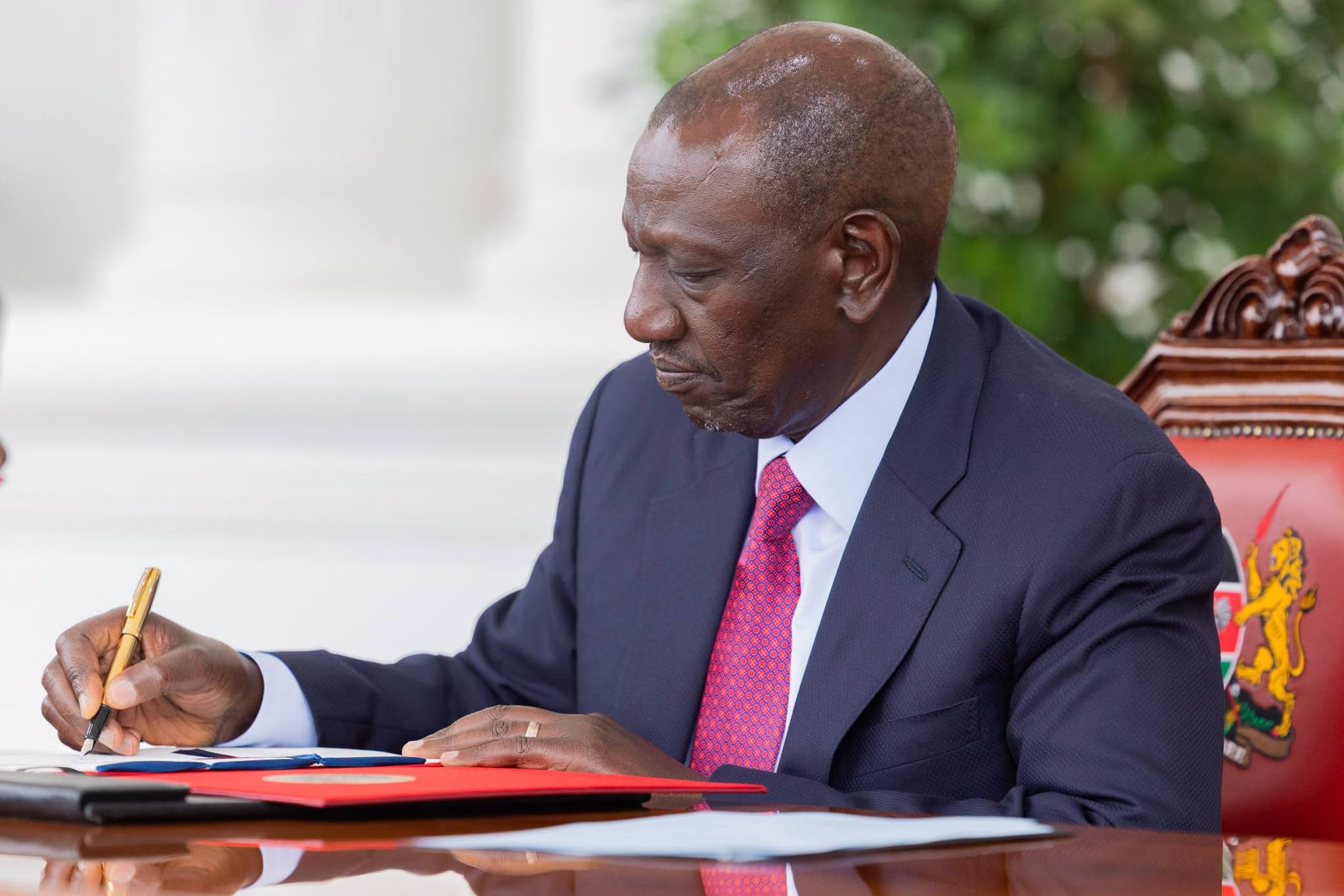
President William Ruto has signed into law a major change to Kenya’s public finance framework that could make it harder for government institutions to simply ignore adverse audit findings and recommendations.
The new law strengthens accountability by providing consequences for public entities that fail to implement recommendations arising from reports by the Auditor-General and the Controller of Budget, particularly recommendations that have been adopted by Parliament or county assemblies.
The legislation is contained in the Public Finance Management (Amendment) Bill, 2025, one of four Bills signed into law by President Ruto on Tuesday, September 8, 2026. The other legislation covers air passenger service charges, population and development, and trust administration.
The move could mark a significant shift in how Kenya deals with audit queries that have, for years, remained unresolved across government ministries, departments, agencies, state corporations and county governments.
For years, the Auditor-General has flagged questionable expenditure, unsupported payments, stalled projects, irregular procurement, unexplained balances and failure by public institutions to account for public funds.
Yet an audit finding has often been only the beginning of a long process, with some queries remaining unresolved through successive financial years.
That culture is now coming under renewed pressure.
The central issue is not simply whether an institution receives an adverse audit opinion. It is whether those responsible actually act on the recommendations contained in the audit report.
The Government itself acknowledged in June that recurring audit queries and delays in implementing audit recommendations continued to expose public resources to fiscal risks and weaken service delivery. It consequently proposed a framework for tracking implementation of audit recommendations and parliamentary resolutions, with accountability mechanisms for non-compliance.
The new legislation therefore comes at a time when Parliament and oversight institutions are increasingly demanding that audit findings lead to action rather than becoming annual entries in government reports.
This could have far-reaching consequences.
A public institution that repeatedly fails to address audit concerns may now face greater scrutiny, while accounting officers and managers could find it increasingly difficult to treat audit queries as routine administrative matters.
A new era for accounting officers
The law puts the spotlight on those entrusted with managing public money.
Accounting officers are expected to ensure that public resources are used lawfully, efficiently and for the purposes for which they were appropriated.
Where an audit exposes weaknesses, the expectation is no longer simply that the institution will respond to the Auditor-General.
The bigger question will be whether the corrective action was actually implemented.
That distinction is important.
An institution can provide a response to an audit query without necessarily correcting the underlying problem.
For example, where an auditor questions unsupported expenditure, the issue cannot be considered settled simply because officials submit an explanation. Where procurement procedures were breached, the response should address the breach. Where public money cannot be accounted for, the responsible institution must provide evidence showing how the funds were used.
The new accountability framework seeks to close the gap between responding to an audit and implementing an audit recommendation.
Counties and state agencies in the spotlight
The implications extend beyond the national government.
County governments have faced their own share of audit queries, including concerns over pending bills, procurement, expenditure controls, development projects and management of public assets.
County assemblies have increasingly used audit reports as a tool for questioning county executives over financial management.
The strengthened framework could give such oversight greater force by ensuring that recommendations adopted through the constitutional oversight process do not simply disappear into government files.
State corporations and other public entities will also face increased pressure to demonstrate that they have acted on audit recommendations.
This is particularly important because unresolved audit issues can accumulate from one financial year to another.
A query appearing in one audit report may reappear several years later, sometimes with the same institution providing similar explanations.
That cycle has frustrated efforts to strengthen financial discipline.
Billions at stake
Kenya’s annual public expenditure runs into trillions of shillings.
Even relatively small weaknesses in financial controls can therefore translate into substantial losses when repeated across hundreds of government entities.
The importance of the new law is consequently not only about punishing individuals.
It is about creating an incentive for institutions to correct weaknesses before they become systemic.
If properly enforced, the law could also strengthen the hand of auditors and parliamentary committees when demanding answers from public officials.
For taxpayers, the significance is straightforward: money allocated for classrooms, hospitals, roads, water, agriculture, social programmes and other public services should be traceable and properly accounted for.
Signing the law is only the first step.
Its success will ultimately depend on whether the government and Parliament enforce it consistently.
Kenya has no shortage of audit reports.
What has often been missing is a sufficiently strong mechanism to ensure that recommendations translate into corrective action.
The challenge now will be to ensure that the new provisions do not become another set of rules that public institutions can circumvent.
Oversight committees will need to follow up on implementation. Accounting officers will have to demonstrate what they have done. Auditors will need to continue tracking unresolved issues. And where the law provides for consequences, those consequences will need to be applied.
The message emerging from the new legislation is therefore clear:
An audit finding is no longer supposed to be the end of the story. It is a demand for action.
For a country where Auditor-General reports routinely expose weaknesses in the management of public resources, that could prove to be one of the most important changes in Kenya’s public finance system.
The ultimate measure of the law, however, will not be how many officials are punished.
READ ALSO: Global reading decline raises warning for Kenya as AI and screen use grow
It will be whether fewer public institutions appear year after year in audit reports for failing to correct the same financial weaknesses.
By Hillary Muhalya
Get more stories from our website: Education News
To write to us or offer feedback, you can reach us at: editor@educationnews.co.ke
You can also follow our social media pages on Twitter: Education News KE and Facebook: Education News Newspaper for timely updates.
>> Click here to stay up-to-date with trending regional stories