
- Ashford Kimani profiles Wawira Njiru’s journey from feeding 25 children to building one of Kenya’s largest school-feeding initiatives.
- He argues that Food4Education demonstrates how nutrition, technology and local partnerships can strengthen learning and community development.
- Kimani says school feeding should be treated as an investment in children’s education, dignity and Kenya’s long-term human capital.
There are people who identify problems, people who discuss solutions, and then there are those who possess the courage and determination to build the solutions they envision. Wawira Njiru belongs firmly in the third category.
Through Food4Education, she has transformed a simple but profound conviction — that no child should have to sit in a classroom hungry — into one of Kenya’s most remarkable social-impact initiatives.
What began in 2012 as a modest programme serving just 25 children has grown into a major school-feeding initiative serving hundreds of thousands of meals every day. Food4Education’s own history confirms that its first kitchen served 25 children in 2012. The organisation says it now serves more than half a million children daily and is working towards reaching one million children a day by 2027.
This remarkable journey is not merely a story of organisational growth; it is a story of vision, resilience, innovation and an unwavering belief in the potential of African children.
The greatness of Wawira Njiru’s contribution lies in her ability to see beyond the obvious. Hunger, in her understanding, is not merely a food problem. It is an education problem, a health problem, an economic problem and, ultimately, a national development problem.
A hungry child struggles to concentrate in class, may become absent from school and may fail to benefit fully from the educational opportunities available.
When children go through the school day without adequate nutrition, their capacity to learn and participate is compromised.
By confronting hunger at the school level, Food4Education is therefore addressing one of the often-overlooked barriers to educational achievement.
The initiative has helped demonstrate that a school meal should not be regarded simply as charity. It is an investment in human capital and in the future of the country.
Combining compassion with innovation
What makes Wawira’s story even more inspiring is that she did not allow Food4Education to remain a small charitable project.
She built systems around the idea.
The organisation has embraced technology, centralised kitchens, local food sourcing, partnerships and efficient distribution mechanisms to take school feeding to a scale that few would have imagined when the first meals were served.
The Tap2Eat system is one of the most notable innovations associated with the programme, using technology to facilitate access to meals while supporting the management of a large and complex operation.
Food4Education describes Tap2Eat as an NFC-enabled wristband system through which pupils access meals using cashless virtual wallets, helping the organisation manage meal distribution efficiently.
This combination of compassion and innovation is perhaps one of the strongest features of Wawira’s leadership.
She has demonstrated that solving African problems does not always require imported ideas. African challenges can be addressed through African creativity, local knowledge, technology and strategic partnerships.
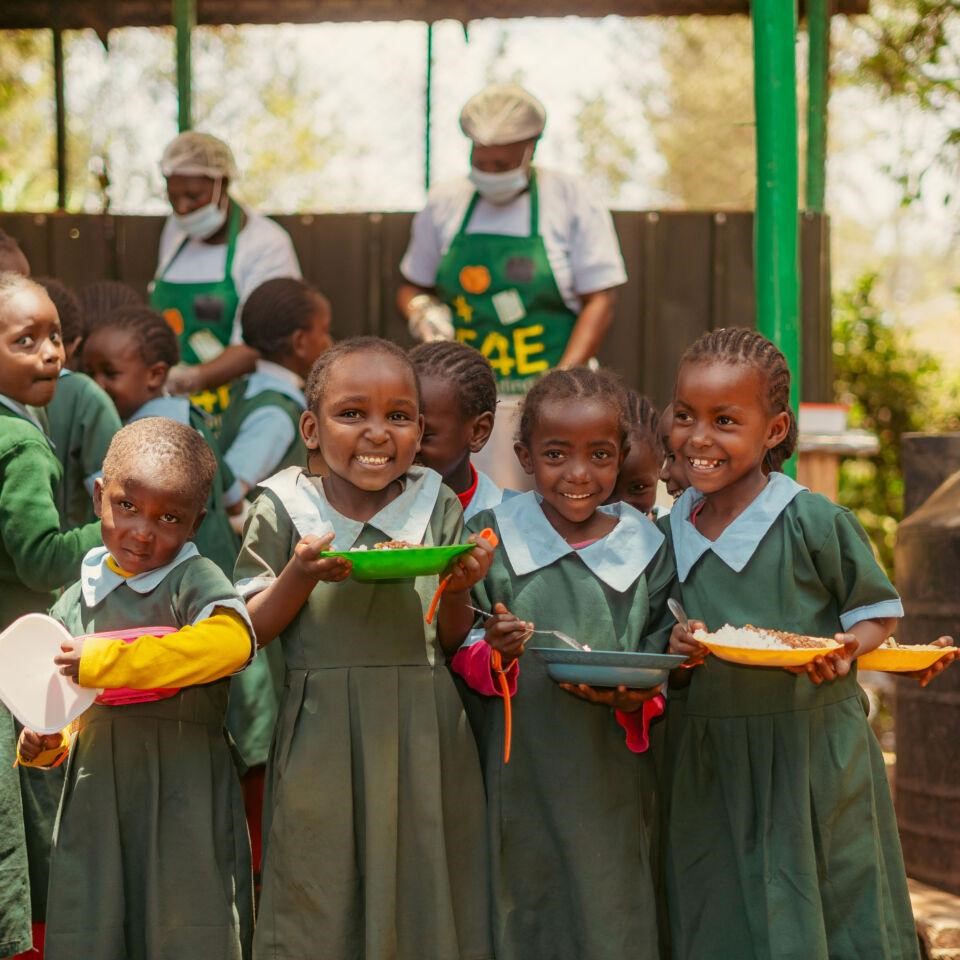
Food4Education is also significant because its impact extends beyond the child receiving a meal.
Its model creates an ecosystem involving farmers, food suppliers, cooks, parents, schools and government.
Local sourcing creates markets for farmers and suppliers, while the kitchens and distribution networks create employment opportunities.
Food4Education says it sources large quantities of locally produced food, much of it from smallholder farmers, while creating thousands of jobs through its operations.
Parents benefit from the reduced burden of providing meals during the school day, while children benefit from having access to food in an environment where they are expected to learn.
This interconnectedness makes Food4Education much more than a feeding programme.
It is an intervention with educational, nutritional, social and economic dimensions.
It demonstrates that effective development initiatives are often those capable of addressing several challenges simultaneously.
Putting the learner at the centre
Wawira Njiru’s achievement is particularly important at a time when Kenya and many other African countries are seeking practical solutions to persistent inequalities in education.
Governments can build classrooms, recruit teachers and provide learning materials, but the effectiveness of these investments is weakened when learners arrive in class hungry.
Education is ultimately about the whole child.
A learner cannot be reduced to examination grades or attendance figures.
The learner is a human being whose ability to benefit from education is influenced by nutrition, health, family circumstances and the wider social environment.
Food4Education brings this reality into sharp focus.
There is also something deeply inspiring about the scale of Wawira’s ambition.
She began with a small group of children but refused to allow the size of the initial project to define the size of the dream.
Food4Education has grown into a movement with ambitions extending beyond Kenya. Its current strategy includes reaching one million children daily by 2027 and sharing its school-feeding model with other African countries.
Her journey sends an important message to young Africans: meaningful change does not require waiting for perfect circumstances.
Sometimes transformation begins with identifying a problem in one’s immediate environment and deciding to do something about it.
Her achievements have also attracted international recognition, demonstrating that locally conceived African solutions can have global significance. Food4Education lists Njiru among recipients of the Skoll Award, Elevate Prize and other international honours.
Yet perhaps the most meaningful recognition is not an award or international platform.
It is the sight of a child receiving a meal and then returning to class ready to learn.
It is the relief of a parent who knows that their child will not spend the school day hungry.
It is the farmer who has a reliable market for produce.
It is the worker who earns a livelihood through the programme.
These everyday outcomes give deeper meaning to the statistics associated with Food4Education.
Feeding children is an investment in Kenya
For educators, policymakers and citizens alike, Wawira Njiru’s story offers a powerful lesson.
Education does not begin with a textbook, a lesson plan or an examination paper.
It begins with the learner.
Before we ask a child to concentrate, analyse a poem, solve a mathematical problem, conduct an experiment or prepare for a national examination, we must consider whether that child has the basic conditions necessary to learn.
Food4Education has helped bring nutrition into the centre of the education conversation and has reminded the country that feeding a child is not an optional act of generosity when the objective is to build an educated and productive society.
Ultimately, Wawira Njiru deserves praise not merely because she founded an organisation, but because she challenged a long-standing assumption about what is possible.
She saw hungry children and chose action instead of excuses.
She started with 25 children but dreamed of reaching millions.
She combined compassion with technology, entrepreneurship with social responsibility, and local action with a continental vision.
Her greatest contribution may therefore be the example she has set for a generation of Africans who want to solve problems rather than merely describe them.
Food4Education is a powerful reminder that nation-building can sometimes begin with something as simple as a plate of nutritious food.
Behind every meal is a learner with renewed energy, a classroom with greater possibility and a society investing in its own future.
Wawira Njiru has shown Kenya that feeding children is not simply about satisfying hunger; it is about protecting their dignity, unlocking their potential and giving them a fairer chance to succeed.
Her story is a celebration of what visionary leadership can accomplish when courage meets compassion and when a simple idea is pursued with extraordinary determination.
READ ALSO: OneVoice27: If we have the Gospel, why are we still silent?
In nourishing children today, Food4Education is helping nourish the Kenya of tomorrow.
By Ashford Kimani
Ashford is a teacher of English and Literature and writes on education and social affairs.
Get more stories from our website: Education News
To write to us or offer feedback, you can reach us at: editor@educationnews.co.ke
You can also follow our social media pages on Twitter: Education News KE and Facebook: Education News Newspaper for timely updates.
>> Click here to stay up-to-date with trending regional stories