- The Ministry of Education has signed an MoU with KCB Bank Kenya to finance, install and maintain solar energy systems across universities, supported by asset-based financing arrangements.
- PS Inyangala has urged universities to involve students and technicians in the installation process, framing the initiative as an opportunity for hands-on renewable energy skills development rather than a simple equipment rollout.
The Ministry of Education has entered into a Memorandum of Understanding (MoU) with KCB Bank Kenya Limited to support the transition of universities to solar energy and improve energy efficiency across institutions of higher learning.
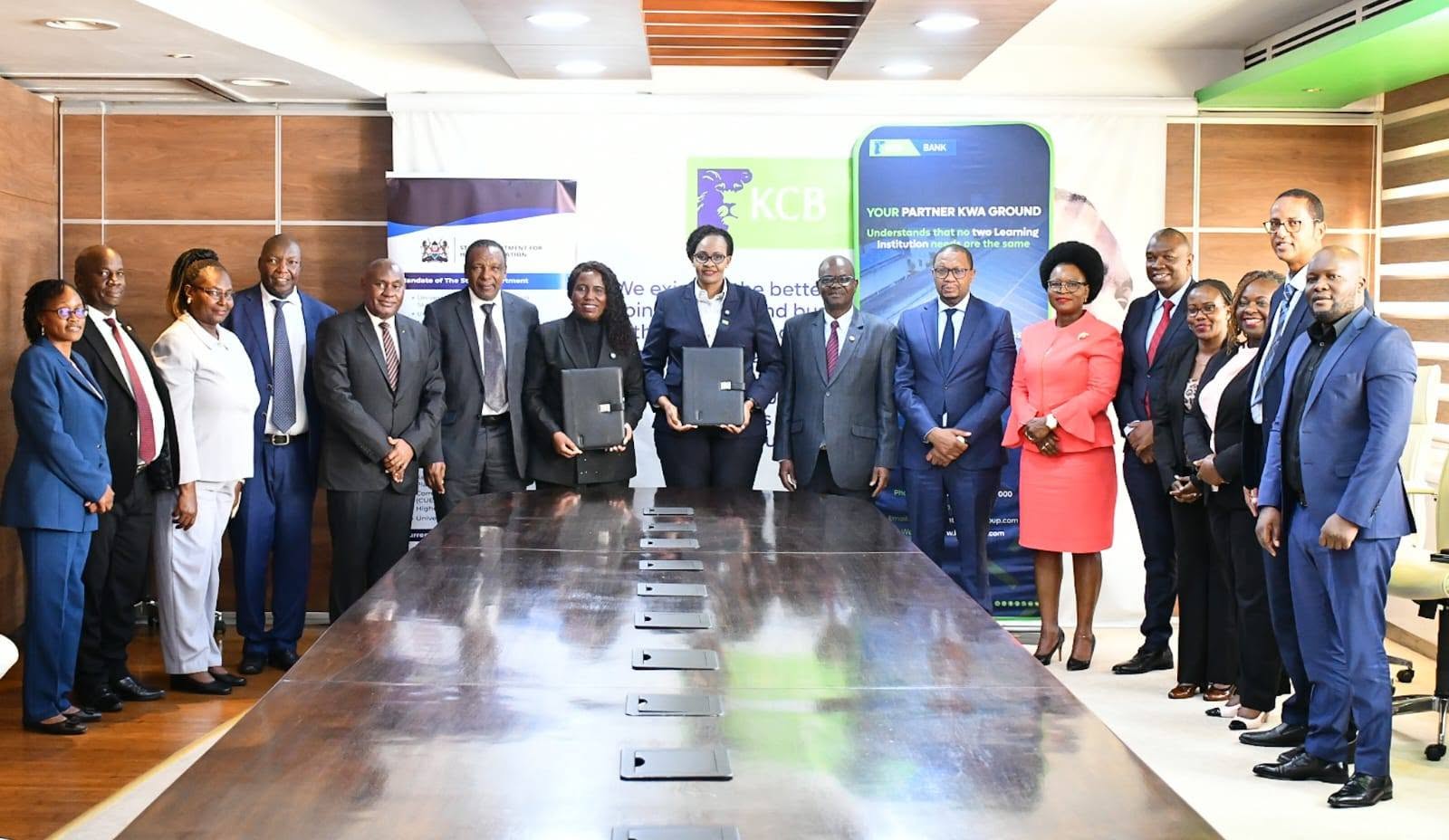
The partnership, signed by Principal Secretary for the State Department for Higher Education and Research, Dr. Beatrice Inyangala, will facilitate the financing, installation and maintenance of solar energy systems and energy efficiency solutions in universities.
The initiative will be guided by comprehensive energy audits and assessments of institutional power needs, with universities and KCB jointly undertaking preliminary screening of facilities based on historical power consumption patterns.
Detailed site assessments will subsequently be conducted to determine the most appropriate solar solutions for individual institutions.
Under the framework, the programme will be supported through asset-based financing arrangements for individual university facilities, allowing institutions to adopt clean energy technologies in a structured and sustainable manner.
ALSO READ:
Teachers in ASAL, hardship areas push for faster promotion, recognition of acting administrators
Speaking during the signing of the MoU, Dr. Inyangala said the initiative should go beyond installing solar equipment and instead provide students and university staff with opportunities to acquire practical skills in renewable energy.
“Our young people must acquire the skills to design, install, operate, maintain and improve these systems,” she said.
The PS cautioned universities against importing and installing equipment without involving students and technicians in the process.
She said the solarisation programme should turn university campuses into practical learning and innovation hubs where students can gain hands-on experience in renewable energy technologies.
“Let the campus become a classroom. Let the solar plant become a laboratory. Let the energy management system become a research platform,” Dr. Inyangala said.
She further challenged universities to encourage students to develop innovations around energy efficiency and storage while partnering with industry to commercialise solutions emerging from the programme.
Dr. Inyangala commended KCB for its role in supporting the transformation of universities through sustainable energy solutions, noting that the MoU demonstrates the potential of collaboration between the education and financial sectors.
ALSO READ: Breaking free from gambling addiction: A message to newly recruited teachers
The partnership is expected to help universities reduce their dependence on conventional electricity, manage energy costs more efficiently and provide a practical environment for research and skills development in renewable energy.
The signing ceremony brought together vice-chancellors from public universities, led by their chairperson, Prof. Daniel Njiru Mugendi, as well as University of Nairobi Vice-Chancellor Prof. Eng. Ayub Gitau and Vice-Chancellor Prof. Dr. Benedict Mwavu Mutua.
KCB Managing Director Mrs. Annastacia Kimtai led the bank’s delegation, alongside other KCB representatives and officials from the Ministry of Education.
By Obegi Malack
Get more stories from our website: Education News
To write to us or offer feedback, you can reach us at: editor@educationnews.co.ke
You can also follow our social media pages on Twitter: Education News KE and Facebook: Education News Newspaper for timely updates.
>>> Click here to stay up-to-date with trending regional stories