- Petanns Technical College graduates have received business equipment to help translate their technical training into income.
- Felix Njenga reports that Kiambu Woman Representative Anne Wamuratha supported selected beneficiaries through NGAAF.
- The initiative encourages graduates to start small businesses rather than depend solely on formal employment opportunities.
For years, the graduation certificate has been the ultimate symbol of academic achievement for young Kenyans.
But for thousands leaving colleges every year, the real struggle begins after the ceremony: finding a job, raising capital or acquiring the equipment needed to turn training into an income.
In Kiambu, a new push to close that gap is putting tools directly into the hands of graduates, with the National Government Affirmative Action Fund (NGAAF) being used to help young people move from classrooms into businesses.
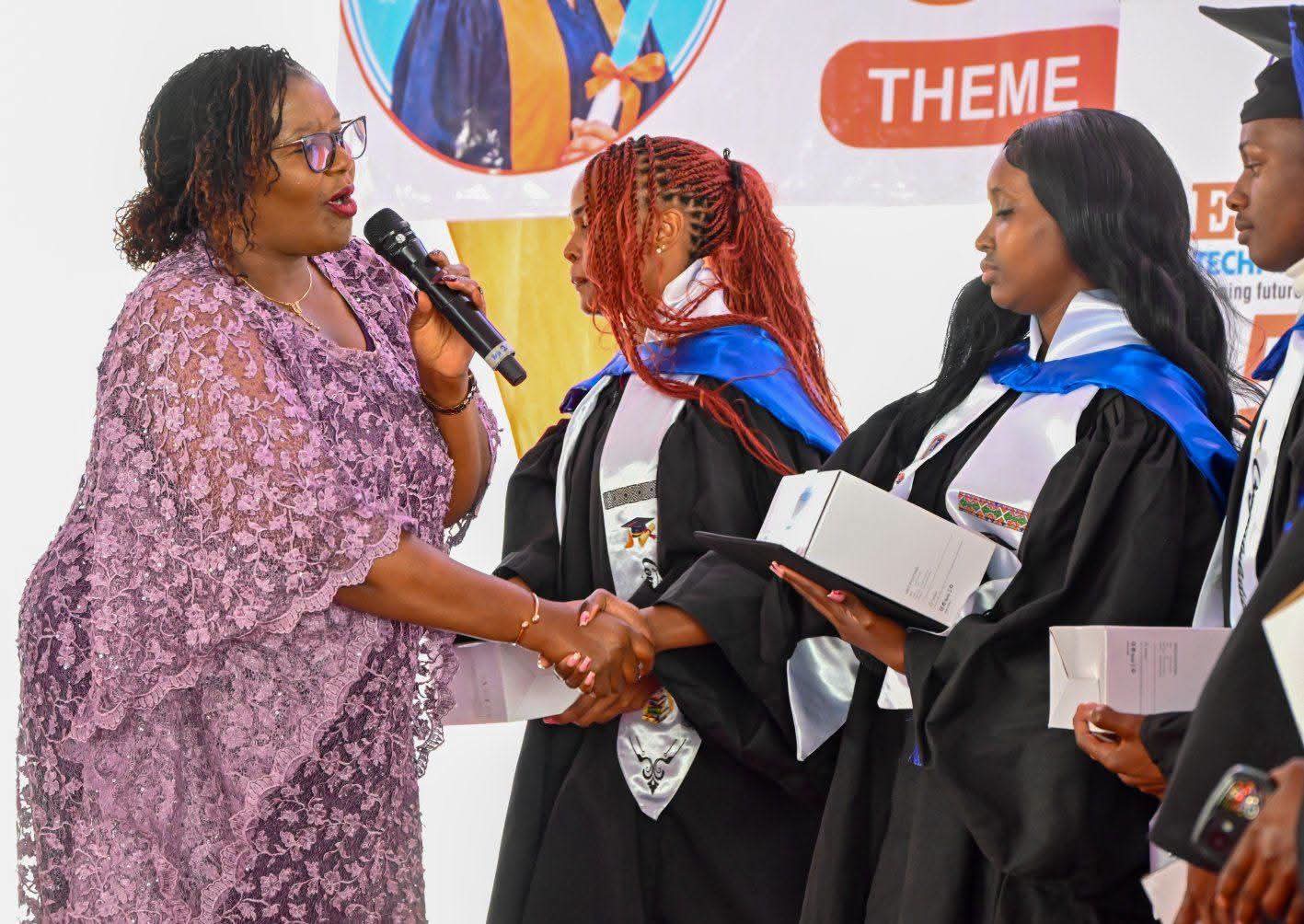
At the fifth graduation ceremony of Petanns Technical College at Ndumberi Stadium Grounds, Kiambu County Woman Representative Anne Wamuratha challenged graduates to look beyond formal employment and use their technical skills to create opportunities for themselves and others.
Selected graduates in cosmetology and hairdressing and beauty received hair dryers, blow dryers and UV machines through her office under NGAAF.
The intervention may appear modest, but for a newly trained beautician without capital, a dryer or UV machine can make the difference between remaining unemployed and beginning to earn an income.
It was a graduation ceremony with a message that went beyond academic achievement: skills must ultimately translate into livelihoods.
“Education gives us knowledge. Skills give us the power to create opportunities.”
Wamuratha said the support was intended to give needy graduates a practical foothold as they begin their working lives, rather than leaving them with certificates but without the basic tools required to practise their trades.
Bridging training and economic opportunity
Kenya’s youth employment challenge has increasingly exposed a gap between training and economic opportunity.
Young people can spend months or years acquiring technical skills, only to leave college without the equipment, capital or networks required to establish themselves.
For graduates in beauty, plumbing, fashion, ICT, hospitality and other technical disciplines, the transition from training to employment can therefore be particularly difficult.
The NGAAF intervention seeks to address part of that problem by supporting beneficiaries with productive assets.
During the ceremony, Wamuratha singled out Jacinta Wambui Wathika, who had graduated with distinction, for special recognition.
Wathika received a blow dryer and hair dryer as part of the empowerment support.
Another graduate, Margaret Wanjiru Njoroge, who was initially absent when her name was called, later arrived to receive her equipment.
Other selected beneficiaries received UV machines for beauty and nail services.
The equipment is expected to allow the graduates to begin working from home, provide mobile services or gradually establish their own businesses before they can afford commercial premises.
For many young entrepreneurs, starting small is often the only realistic option.
Wamuratha urged the beneficiaries not to wait until they had perfect conditions before beginning their businesses.
She encouraged them to start with neighbours, friends and home-based clients, gradually building a customer base and reinvesting their earnings.
Her message was particularly directed at graduates entering an increasingly competitive labour market.
“Start with the very first step. Your tomorrow must be better than today.”
The Woman Representative said a graduate does not necessarily need a large shop or substantial capital to begin earning from a technical skill.
A trained beautician, for example, can begin by offering services at clients’ homes, using basic equipment before expanding into a salon.
Such an approach, she said, can enable young people to move from dependence to self-reliance.
The same philosophy, she added, applies to other technical trades.
Graduates trained in areas such as plumbing could also look out for empowerment opportunities through her office when equipment-support programmes become available.
Technical skills and entrepreneurship
The Petanns graduation highlighted the increasingly diverse range of technical skills being pursued by Kenyan youth.
The graduates trained in cosmetology, hospitality, journalism and mass communication, hairdressing and beauty, fashion and design, tourism, engineering, ICT and health sciences.
The breadth of the courses reflects a labour market in which young people are seeking alternatives to traditional academic pathways.
Technical and vocational training is increasingly being positioned as a route not only to employment but also to entrepreneurship.
For policymakers, the challenge is ensuring that investment in training does not stop at the classroom door.
A graduate who has mastered a trade but lacks the tools to practise it remains locked out of the economic opportunities that training was supposed to create.
That is why equipment support, entrepreneurship training, access to finance and market linkages are becoming increasingly important components of youth empowerment.
NGAAF-backed interventions such as the one showcased at Ndumberi are aimed at helping bridge that final but critical gap.
The empowerment programme also raises a wider question about the nature of government support for young people.
Rather than focusing only on short-term assistance, productive assets can give beneficiaries an opportunity to generate income repeatedly.
A hair dryer can be used to serve dozens of clients.
A UV machine can support a nail technician in serving a growing customer base.
Tools given to a plumber can enable the graduate to undertake jobs and earn income long after the graduation ceremony is over.
The expectation is that beneficiaries will use the equipment as a starting point, grow their enterprises and eventually employ others.
That creates the possibility of a multiplier effect in which one empowered graduate becomes a source of opportunity for other young people.
‘My tomorrow must be better than today’
Wamuratha turned the message into a collective commitment during the ceremony, asking the graduates to repeat after her: “My tomorrow must be better than today.”
It was more than a ceremonial slogan.
For graduates entering an uncertain employment market, it was a call to action—to take the first step, however small, and build from there.

She also emphasised that the intervention was being implemented through her office as a government programme under NGAAF.
“This is Mama County’s office. It is a government programme under the National Government Affirmative Action Fund,” she told the gathering.
Her emphasis was that the programme was intended to support needy students and graduates who had completed their training but required basic tools to begin working.
The initiative therefore places the focus on what happens after graduation.
As the applause faded and graduates left the Ndumberi grounds carrying certificates and equipment, the real test began.
Can the new skills translate into businesses?
Can those businesses generate sustainable incomes?
Can the beneficiaries employ others?
And can technical training become a reliable route out of unemployment and economic dependence?
Those questions will determine whether the investment in skills produces the intended results.
For the Petanns graduates who received equipment, however, the first barrier has been lowered.
READ ALSO: Tea earnings squeeze leaves parents struggling with education costs
They now have not only the skills acquired in college but also some of the tools needed to put those skills to work.
By Felix Njenga
Get more stories from our website: Education News
To write to us or offer feedback, you can reach us at: editor@educationnews.co.ke
You can also follow our social media pages on Twitter: Education News KE and Facebook: Education News Newspaper for timely updates.
>>> Click here to stay up-to-date with trending regional stories