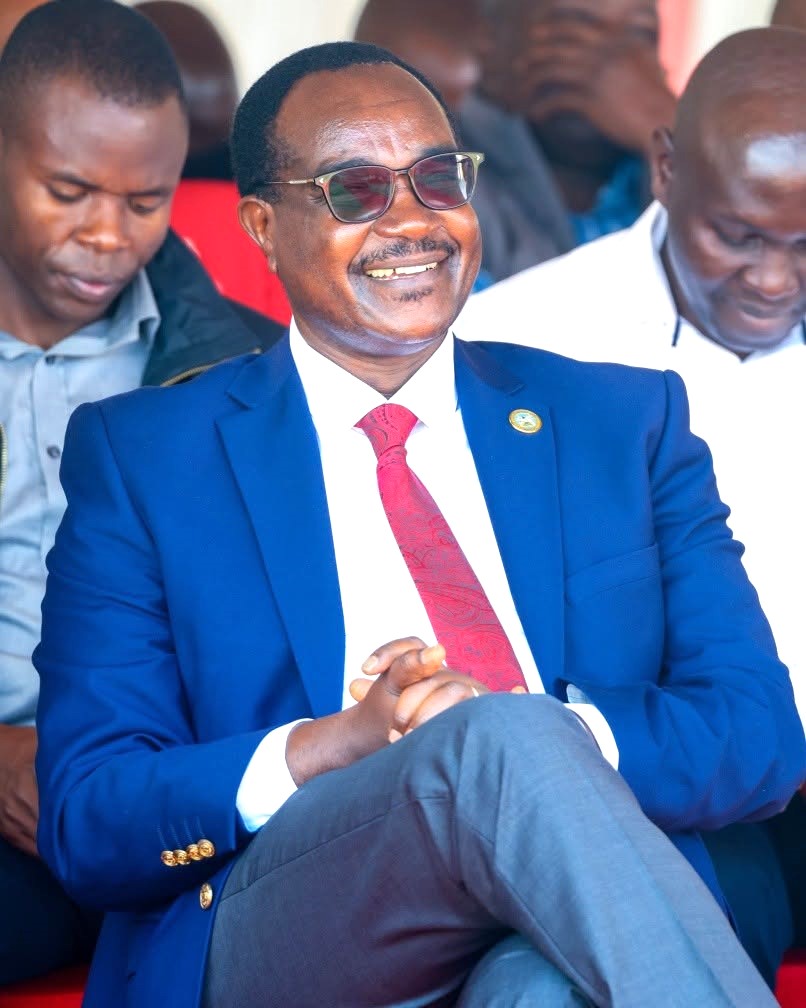
- Hillary Muhalya examines Education CS Julius Migos Ogamba’s emerging approach to education financing and human capital development.
- He argues that educating young Kenyans should be treated as a national investment rather than primarily a parental burden.
- Government, families and the private sector must share responsibility for developing the skilled workforce Kenya’s economy requires.
For years, Kenya has approached education financing as though its central challenge were straightforward: parents have children, children attend school, and parents are expected to shoulder the financial burden.
Education Cabinet Secretary Julius Migos Ogamba is increasingly associated with a different framing of the issue — one that challenges the long-held assumption that educating a Kenyan child is primarily a private family responsibility.
The more transformative proposition is this: Kenya is not merely educating children; it is investing in the human capital upon which its future economy will depend.
If that is the case, then placing the overwhelming cost of education on parents becomes economically and structurally questionable.
Why should the family of a future doctor bear nearly the entire cost of producing a professional who will serve thousands of citizens?
Why should parents finance the training of an engineer whose work will support national infrastructure and economic growth?
Why should the family of a future teacher be treated as the primary investor in a profession that underpins the entire education system?
This is where Ogamba’s emerging education-financing philosophy becomes significant.
It suggests that the primary beneficiary of education is not only the individual learner, but society as a whole.
That argument warrants serious consideration.
A country does not build a modern economy solely through roads, factories, and digital infrastructure. It also requires a skilled population capable of designing, operating, maintaining, and improving those systems.
In this sense, human capital is the ultimate infrastructure.
A laboratory without scientists is merely a structure. A hospital without doctors and nurses cannot deliver care. A school without qualified teachers cannot transform learners. A technology firm without skilled developers cannot innovate.
Education financing, therefore, is fundamentally an investment in national capacity.
This is where the private sector becomes an essential part of the conversation.
Kenyan businesses cannot continue to lament skills shortages while leaving the responsibility for producing skilled labour entirely to government and households.
If industry requires engineers, technologists, accountants, scientists, technicians, agricultural experts, health professionals, and other skilled workers, then it has a direct economic incentive to participate in developing that talent pipeline.
Ogamba’s philosophy could thus serve as a bridge between public education financing and private-sector investment in human capital development.
One can envision a financing ecosystem in which government identifies strategic skills priorities, families contribute according to their means, financial institutions provide sustainable education financing, training institutions deliver quality graduates, and employers invest in the talent pipeline on which they ultimately depend.
This would mark a decisive shift from the traditional model of relying almost exclusively on parental fees and then reacting to dropout rates and access gaps.
It would reposition education as a deliberate investment in national productivity.
State must remain the anchor investor
However, there is an important risk.
If education financing becomes overly driven by immediate private-sector demand, Kenya risks producing graduates tailored only to current market needs, rather than future national priorities.
That would be a strategic misstep.
Markets cannot be allowed to fully determine a country’s intellectual and developmental direction.
Who, for instance, would invest in disciplines whose economic returns may take decades to materialise?
Who funds the scientist whose breakthrough is uncertain but potentially transformative?
Who supports the teacher whose most profound impact may only be visible years later in the lives of their students?
Who invests in basic research when commercial returns are not immediate or guaranteed?
This is precisely why the state must remain the anchor investor in education.
The private sector can complement public investment, but it cannot replace it.
At its strongest interpretation, Ogamba’s argument should not be seen as a withdrawal of government responsibility or a transfer of education to corporate interests.
Rather, it should be understood as a more ambitious proposition: Kenya must distribute the responsibility for developing human capital across the entire economy.
Parents should not be overwhelmed by unsustainable education costs.
Students should not be denied opportunity due to their socioeconomic background.
Government should not be expected to finance every aspect of higher and technical education alone.
And businesses should not expect a highly skilled workforce to emerge without contributing to its development.
All stakeholders have a role to play.
Education financing as economic strategy
This debate is particularly important in the Kenyan context.
The country has thousands of capable young people whose education is constrained not by ability, but by financial limitations. When such students are excluded from the education pipeline, the loss is not individual alone.
It is a national loss of future doctors, engineers, teachers, scientists, entrepreneurs, innovators, and skilled professionals.
That represents a direct economic cost.
The effectiveness of any new financing model should therefore be assessed against a central question: Does it expand access while producing the diverse skills required for national development?
If the answer is yes, then education financing moves beyond social support.
It becomes economic strategy.
That is perhaps the most important dimension of the Ogamba debate.
The issue is not simply about who pays school fees.
It is about what kind of economy Kenya intends to build.
The private sector, in turn, must recognise that today’s student is tomorrow’s workforce — and potentially the engineer, doctor, scientist, entrepreneur, teacher, or technologist who will drive its growth.
Parents, on the other hand, deserve relief from the unrealistic expectation that they must individually finance the country’s entire human capital pipeline.
The question Kenya should therefore move beyond is:
“How much can the parent afford?”
The more fundamental question is:
“How much is Kenya willing to invest in the people who will build its future?”
That is the real test of Ogamba’s education financing philosophy.
Because ultimately, a nation that underinvests in its people will eventually find that all other investments have a ceiling.
READ ALSO: A father’s letter to adult children: Come home, call us and listen while we are still here
Fund the student. Build the professional. Strengthen the economy.
That is the broader education conversation Kenya must now have.
By Hillary Muhalya
You can also follow our social media pages on Twitter: Education News KE and Facebook: Education News Newspaper for timely updates.
>>> Click here to stay up-to-date with trending regional stories
>>> Click here to read more informed opinions on the country’s education landscape