- The High Court has declared Ambira High School’s KSh33,000 readmission levy unconstitutional, saying it amounted to collective punishment.
- Justice D.K. Kemei ruled that the Board of Management lacked the legal authority to impose the mandatory payment without approval from the County Education Board.
- The court found that denying learners readmission until they paid the levy violated their constitutional right to education and due process.
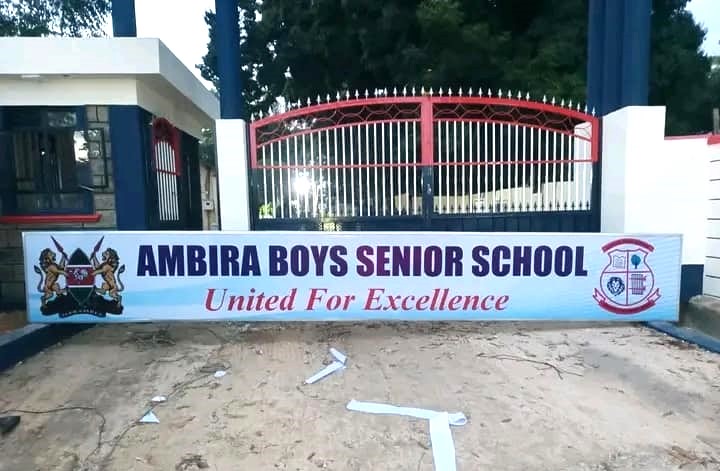
The High Court in Siaya has struck down Ambira High School’s decision to require every learner to pay KSh33,000 before being readmitted following a student unrest, ruling that the levy was unconstitutional because it imposed collective punishment and violated learners’ constitutional rights.
In a judgment delivered by Justice D.K. Kemei, the court ruled that the school’s Board of Management lacked the legal authority to introduce the mandatory payment without approval from the County Education Board, the body legally mandated to determine conditions for the readmission of students following cases of mass indiscipline.
The petitions were jointly filed by Michael Oluoch, Sylvester Oloo and several other parents after the school directed each of its approximately 1,515 learners to contribute KSh33,000 towards repairing infrastructure damaged during unrest on the night of May 18, 2026.
The school made payment of the levy a mandatory condition for learners to resume classes.
Representing the petitioners, advocate Sylvester Odhiambo argued that the Board imposed the levy without following the law, conducting public participation or observing due process.
He maintained that requiring every learner to pay the same amount, regardless of whether they participated in the destruction, violated constitutional provisions on equality, fair administrative action, due process and the right to education.
Collective punishment declared unconstitutional
The court agreed with the petitioners, noting that the respondents admitted they were unable to identify the actual perpetrators of the destruction and instead sought to recover the repair costs from the entire student population.
Justice Kemei found that the decision amounted to unconstitutional collective punishment, observing that the inability to establish individual responsibility could not justify penalising innocent learners.
The judge further held that although the school described the payment as compensation for damaged property, it effectively became punitive because students were denied readmission until they paid.
He ruled that making a child’s return to school conditional upon payment infringed the constitutional right to education and violated Articles 27, 29, 47 and 50 of the Constitution.
Court faults public participation process
The court also dismissed the school’s assertion that parents had been adequately consulted before the levy was introduced.
It found that the final amount was agreed upon during a meeting that neither parents nor their representatives attended.
Justice Kemei held that the process fell short of the constitutional requirements of meaningful public participation and procedural fairness, rendering the Board’s decision legally defective.
The judgment emphasised that access to education cannot depend on a family’s ability to raise money for an arbitrary levy, adding that public educational institutions have a constitutional obligation to promote, rather than impede, children’s access to learning.
The dispute arose after widespread destruction of school facilities during the unrest, with damage estimated at approximately KSh50 million. Following the incident, the Board of Management resolved that every learner would contribute KSh33,000 towards repair costs before being allowed back to school.
READ ALSO: Itigo Girls depart for Thika in pursuit of KSSSA national rugby sevens title
In allowing the petitions, the High Court declared the levy unlawful and reaffirmed that disciplinary measures in educational institutions must comply with the Constitution and cannot subject all learners to punishment where the actual offenders have not been identified.
By Joseph Mambili
You can also follow our social media pages on Twitter: Education News KE and Facebook: Education News Newspaper for timely updates.
>>> Click here to stay up-to-date with trending regional stories
>>> Click here to read more informed opinions on the country’s education landscape
>>> Click here to stay ahead with the latest national news.