Actually, the Competency-Based Education (CBE) System, in its impressive implementation of Competency-Based Curriculum (CBC), has seen current secondary schools evolve into Senior Schools (Grade 10-12) in 2026 and onwards.
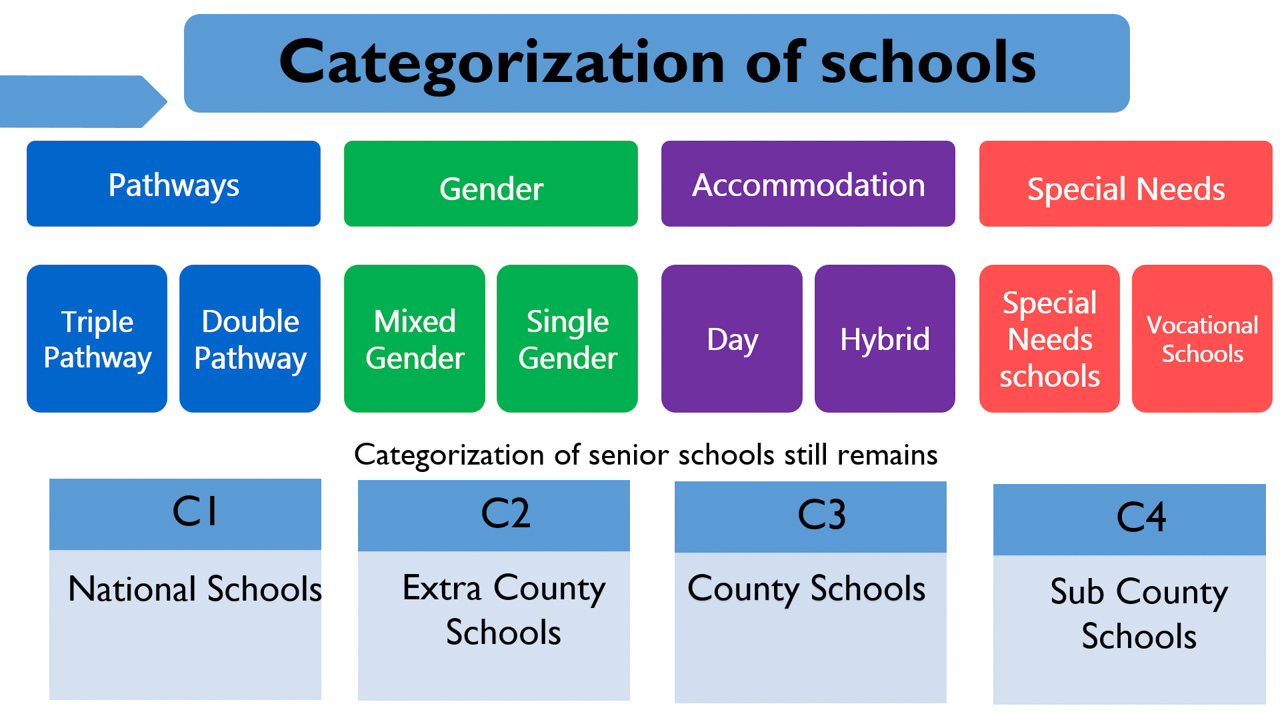
In the recent past, secondary schools featured as national, extra-county, county and sub-county. But in the new education dispensation, they are categorised as C1, C2, C3 and C4 Senior Schools. National schools are now C1, extra-county are C2, county are C3, and sub-county are C4 schools. This is in line with the policy document titled Guidelines on Selection and Placement of Learners to Senior School (2025).
Key Considerations in Categorisation
Now, Senior Schools (Grades 10-12) are categorised by sex, pathways, accommodation, and special needs. This categorisation abuts on effective management of learners transitioning from Junior to Senior Schools, equitable allocation of resources, and impressive implementation of education programmes, practices and policies. As spelt out in the policy document titled Guidelines for Selection and Placement for Learners in Senior Schools (2025).
Factors Influencing Categorisation
Ideally, mandarins at the Ministry of Education (MoE) consider three important factors while categorising Senior Schools. The first factor is flexibility; allowing learners to transfer between various Career Pathways in case they experience changes in aspirations, interests and abilities. The second factor is partnerships; focusing on collaboration with industry and tertiary institutions; enhancing career and technical education in Senior Schools.
ALSO READ:
That is, Senior Schools should have the freedom and volition to develop puissant partnerships with other institutions. More so, post-Senior School institutions. The third factor is infrastructure; ensuring that each category has necessary resources such as laboratories, workshops, studios, et cetera; for optimal development of learners.
Sex, Accommodation and Pathways
Ideally, in categorisation of Senior Schools based on sex, there are mixed-sex and single-sex schools. Most of the boarding schools are single sex schools, either for girls or boys. However, we also have some boarding schools that are mixed. But most day schools are mixed setups. Meaning, categorisation by accommodation type, there are also Day Schools and Hybrid Schools (Day and Boarding Schools). There are 3 Career Pathways at Senior School, which include: Arts and Sports Science, Social Sciences and STEM (Science, Technology, Engineering and Mathematics).
Consequently, there are Triple and Dual Pathway Senior Schools. Triple means all the aforesaid 3 Career Pathways are offered. Whereas in Dual Pathway Senior Schools, only two Career Pathways are offered, which are STEM and any other Career Pathway.
All C1 Senior Schools alongside some C2, C3 and 4 Senior Schools are Triple Pathway Senior Schools. This explains the reason STEM is taking care of 60% of learners in Senior Schools. Social Sciences Career Pathway takes care of 25% of learners. Then, the Arts and Sports Science Pathway takes care of 15% of learners. The percentile allocations do not portray superiority or inferiority of any Career Pathway per se. Instead of this, it focuses on what most Senior Schools can offer.
Therefore, regarding the Dual Pathway Senior Schools, we have either STEAMS or STEMS. That is, STEAMS: STEM and Arts, Sports Science. Then, STEMS: STEM and Social Sciences. Withal, Day Schools are institutions where learners commute daily from their homes, not residing in schools. About the Hybrid Schools (Day and Boarding Schools); these are institutions where some learners commute daily from their homes and do not reside in schools. Likewise, in the same institutions, they are provided with on-school residential facilities where they stay, study and participate in extra-curricular activities.
ALSO READ:
MoE issues guidance to schools facing KEMIS registration challenges
So, there are Triple Pathway Day Schools, which are institutions offering the 3 Career Pathways for learners attending school during the day and returning home in the evening. There are Dual Pathway Day Schools, which are institutions offering 2 Career Pathways for learners attending school during the day and returning home in the evening. Triple Pathway Hybrid Schools offer the 3 Career Pathways, with some learners attending school during the day and returning home, while others reside in school. Dual Pathway Hybrid Schools offer 2 Career Pathways with some learners attending school during the day and returning home in the evening, while others reside in school.
Special Needs and Vocational Schools
Finally, under the categorisation based on Special Needs, there are Special Needs Schools, which offer education to learners who experience difficulties within the mainstream education system. These are learners abled differently; with hearing, visual or physical impairment. Then, there are Vocational Schools, which offer vocational education to learners who are following the Stage-Based Education Pathway. This is designed to equip special needs learners with practical skills and technical knowledge; envisioned to prepare them for various Career Pathways. This system is integrated into CBC to churn out holistic graduates ready for the demands of the modern and dynamic world of work.
By Victor Ochieng’
Victor Ochieng’ is a Career Educator. He guides learners in Junior School (Grade 7-9) on Selection of Senior Schools, Subject Combinations, Career Choices, Pathways, Study Skills and Proper Preparation for KJSEA Assessments.
vochieng.90@ggmail.com. 0704420232
You can also follow our social media pages on Twitter: Education News KE and Facebook: Education News Newspaper for timely updates.
>>> Click here to stay up-to-date with trending regional stories
>>> Click here to read more informed opinions on the country’s education landscape