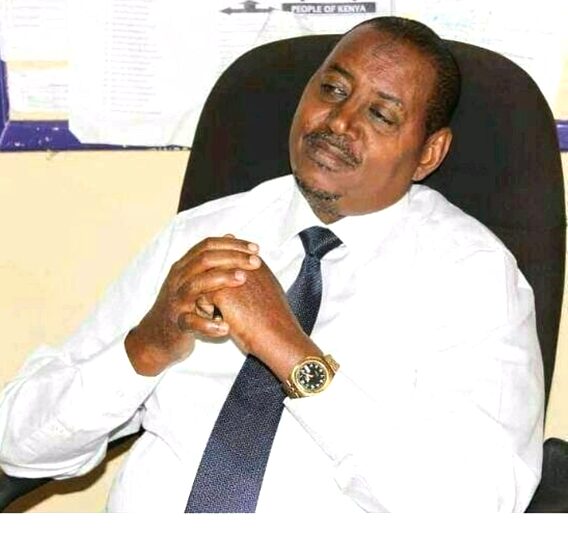
- John Lekakeny Ololtuaa assumes the Basic Education docket after nearly three decades of service as a teacher, principal and education administrator.
- His experience comes at a critical moment as Kenya implements the Competency-Based Education transition and reforms learner data management.
- The new Principal Secretary now faces the task of strengthening school leadership, capitation accountability and collaboration with TSC.
When President William Ruto reshuffled his Principal Secretaries in June 2026 and posted John Lekakeny Ololtuaa to the State Department for Basic Education, the appointment achieved something rare in Kenyan public administration: it matched a docket in distress with an administrator whose working life has been a rehearsal for it.
Most senior officials reach Jogoo House through the policy door — the university, consultancy or diplomatic circuit. Ololtuaa came through the classroom door. Born in Trans Mara West, Narok County, he attended God-Ngoche Primary School, Sosio Secondary School and Narok High School before earning a Bachelor of Education (Arts) and a Master’s degree in Education Administration from Kenyatta University. His first posting was as a teacher at Olalui Secondary School, the lowest rung of the delivery chain, where policy either works or quietly dies.
From there, his career followed an unbroken path: teacher, principal, District Education Officer, County Director of Education and Regional Director of Education, overseeing, at different times, the Eastern, Nairobi, Rift Valley and Central regions during nearly three decades of continuous service inside the machinery he now commands. His 2022 appointment as Principal Secretary for Tourism later added experience in inter-ministerial coordination, national planning and Treasury discipline.
This is what sets him apart. His authority rests on four foundations rarely found in one administrator: classroom experience, operational depth in the field, national policy leadership and the technocratic rigour to build the data systems on which all three depend. He has signed class registers, chaired Boards of Management, reconciled school capitation accounts and supervised entire regions. None of these processes is new to him.
He inherits arguably the heaviest in-tray in government. The Competency-Based Education (CBE) transition has entered its most delicate phase, with the pioneer cohort now in Grade 10, while infrastructure, staffing, learning materials, student unrest and funding bottlenecks continue straining the system. Stakeholders — from the Kenya Private Sector Alliance to KUPPET and the National Parents Association — have welcomed him for one reason above all: he knows the terrain from the inside. Ordinary Kenyans, too, trust that a man who has managed schools rather than merely theorised about them will help see the reform through.
Senior school implementation requires pathway placement, laboratory provision, teacher retooling and community sensitisation to proceed in tandem — a choreography of field operations Ololtuaa has conducted at district, county and regional levels. He now holds the national baton.
Nowhere is his mandate as Accounting Officer more consequential than in the learner data crisis. The nationwide School Data Verification exercise revealed alleged enrolment inflation and under-reporting: primary schools carried far more learners on the National Education Management Information System (NEMIS) than could be physically counted; secondary schools allegedly listed ghost learners; junior schools under-reported more than 543,000 genuine learners; and 27 non-operational institutions, many in insecurity-prone ASAL counties, continued to draw capitation. The cost was estimated at Sh912 million in a single term, with cumulative losses running into billions of shillings.
The scandal cuts both ways. Every shilling paid for a ghost learner is taken from a real one, while every child missing from the register — often for want of a birth certificate — is a child the state has failed to see. Because capitation is disbursed strictly per learner, the integrity of the register is the integrity of education financing itself. One of his most urgent assignments is to close funding gaps created by data validation failures and duplicate learner records.
This is where his career becomes a strategic asset. Personally answerable for every shilling of capitation, he understands where the data chain breaks, having supervised the very officers and head teachers responsible for capturing it.
The opportunity before him is to complete the migration from the discredited NEMIS to the Kenya Education Management Information System (KEMIS) and transform it into a watertight, one-stop system of record: verified enrolment from ECDE to senior school, integrated with KNEC, TSC and civil registration databases, ensuring every learner exists only once under a unique identifier and every shilling can be traced to a real child at a real desk. Properly implemented, such a system would become the engine of value-for-money education by projecting teacher demand, flagging under-enrolled schools, tracking the CBE cohort and providing Parliament, the Auditor-General and parents with a live, auditable picture of where education resources go and what they achieve.
There is a second relationship he is uniquely positioned to strengthen. Throughout his field career, Ololtuaa implemented the intersecting policies of the Ministry of Education and the Teachers Service Commission (TSC) at the very point where their mandates converge: the school. He now has an opportunity to translate that experience into stronger collaboration between the two institutions so that teacher deployment, retooling and staffing norms move in step with curriculum rollout, infrastructure and capitation. With senior school pathways demanding specialised teachers in the right subjects, in the right schools and at the right time, such inter-agency coordination could determine whether the reform succeeds.
That vision demands technical expertise to design the system, administrative memory to anticipate how it can be manipulated and field credibility to secure compliance from more than 30,000 school heads. On all three counts, Ololtuaa is arguably among the best-prepared Principal Secretaries ever to hold the docket.
READ ALSO: Kisumu Boys challenge Yala’s Nyanza football title over player eligibility
Celebration, however, must be earned in office rather than conferred at the swearing-in. Teachers’ unions, parents and taxpayers who welcomed him will judge him by outcomes: a successful senior school transition, timely capitation, reliable learner data and an education system that delivers value. Yet if experience and institutional memory still matter in public administration — and in education they matter enormously — Kenya has placed at the apex of basic education a man who has climbed every rung beneath it.
The classroom made him. He must now remake the system for the classroom.
By Ibrahim Adan
You can also follow our social media pages on Twitter: Education News KE and Facebook: Education News Newspaper for timely updates.
>>> Click here to stay up-to-date with trending regional stories
>>> Click here to read more informed opinions on the country’s education landscape