Kenya is currently on heightened national alert following a growing wave of concern over the safety of school going children, as reports of minors disappearing during daily commutes to and from school continue to rise across the country. What were once treated as isolated incidents are now increasingly being viewed as part of a wider and more disturbing child protection crisis affecting both urban and rural communities.
Parents, teachers, transport operators, and security agencies are all expressing deep concern that the daily journey between home and school has become one of the most vulnerable moments in a child’s routine. The sense of safety that once surrounded school travel is gradually eroding, forcing families to rethink how children move through public spaces. This shift has created growing national anxiety over child protection systems.
Rising child protection cases
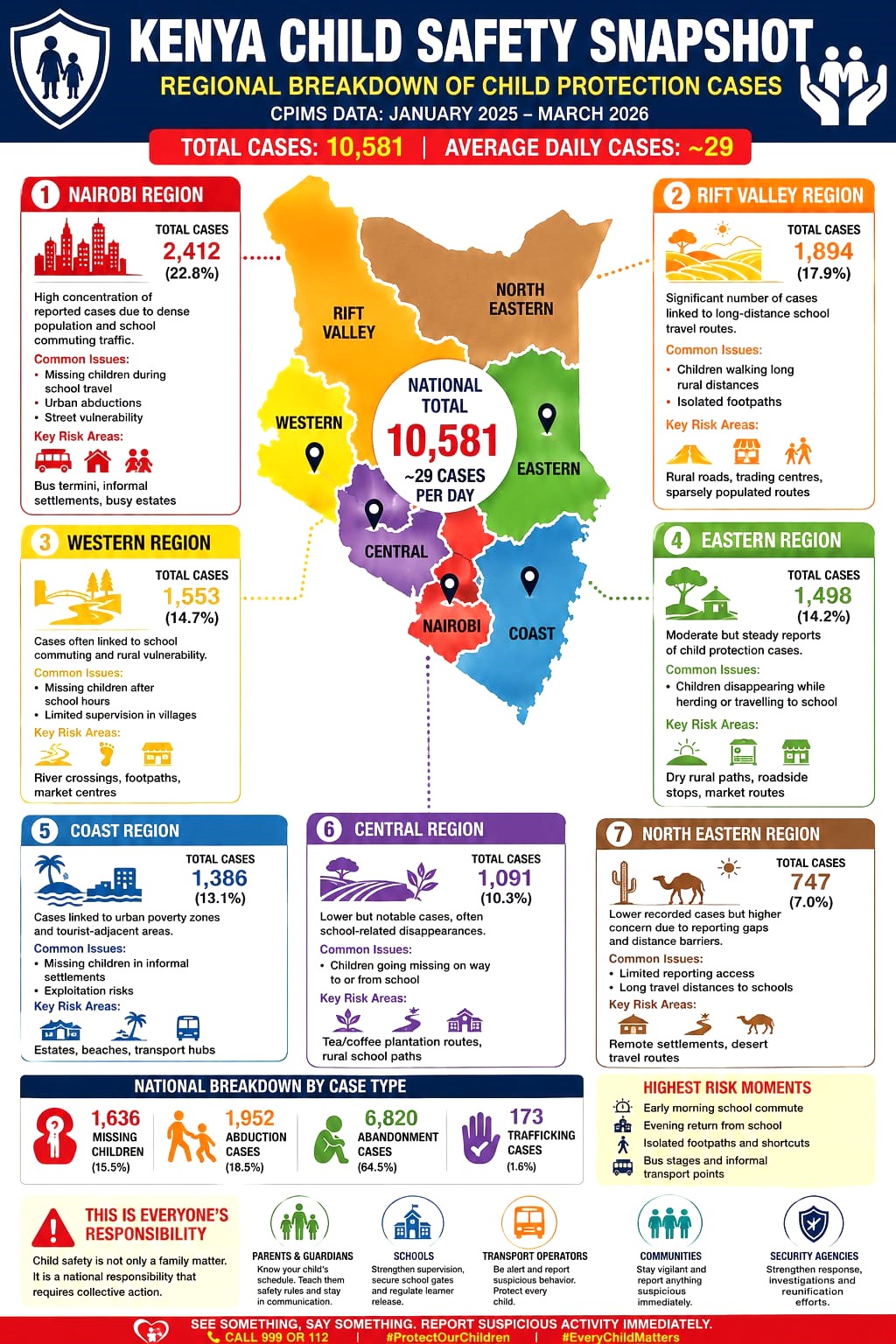
According to official data from the Child Protection Information Management System (CPIMS), Kenya recorded a total of 10,581 child protection cases between January 2025 and March 2026. This translates to approximately 29 reported cases every day during that period. Out of these cases, 1,636 involved missing children, 1,952 were abduction cases, 6,820 involved child abandonment, and 173 were linked to trafficking incidents.
Authorities caution that these figures may still be an underestimation due to underreporting. Many cases in remote and informal settlements go unreported or are delayed. The statistics therefore point to a deeper and possibly more widespread crisis.
The same concerns have been echoed in national leadership discussions, including by Cabinet Secretary for Gender, Culture and Children Services Hannah Wendot Cheptumo, who has emphasized the urgency of strengthening child safeguarding systems. She has consistently called for improved coordination between government agencies, schools, and communities in addressing child vulnerability.
Her remarks underline that child protection is not the responsibility of one institution alone. It requires a unified national response that includes families and local communities. Without collaboration, existing gaps continue to widen, leaving children more exposed to daily risks.
School commute increasingly becoming risky
Reports indicate that many child disappearance and abduction cases occur during peak school commute hours in the early morning and evening. These are the times when children are most exposed while travelling to and from school. Learners often pass through footpaths, estate roads, bus stages, rural shortcuts, and isolated routes.
These areas are frequently poorly supervised and lack adequate security presence. As a result, they have increasingly been described as vulnerable corridors. These movement patterns create opportunities for exploitation.
Security agencies and child protection stakeholders have raised concern over tactics allegedly used to target children. In some cases, strangers approach minors using vehicles or motorcycles offering lifts or assistance. Others attempt to lure children with sweets, food, money, or gifts. There are also instances where individuals falsely claim to know a child’s parent or guardian. These strategies are designed to build false trust and manipulate children. Experts classify them as deliberate exploitation tactics that rely on deception.
Causes of child disappearances
Experts attribute the rising cases to several contributing factors, including trafficking networks targeting children for forced labour and illegal activities. Opportunistic kidnappings are also common in areas with weak supervision. Inadequate monitoring along school routes further increases vulnerability. Family disputes and custody conflicts also contribute to some missing cases. Emotional distress and neglect can also lead to runaway situations among children. Lack of safety awareness remains a major contributing factor.
The scale of the issue reflected in CPIMS data shows a serious national concern. The 10,581 reported cases within a short period highlight a persistent challenge. The 1,636 missing children cases and 1,952 abductions are particularly alarming. The 6,820 abandonment cases reveal deep social and economic pressures, while the 173 trafficking cases point to organised criminal activity. Together, these figures reflect a complex and multi layered crisis.
Child safety is therefore no longer a private family matter but a national concern affecting entire communities. Every missing child case triggers emotional, social, and institutional disruption. Schools and neighbourhoods often become involved in search efforts. Fear and uncertainty spread quickly across communities, gradually weakening trust in public safety systems.
Security experts emphasize that criminal activity often depends on opportunity rather than specific targets. Any child can be at risk regardless of background or location. Weak community vigilance increases exposure significantly, while silence and delayed reporting allow offenders to operate more freely. Even small lapses in supervision can create serious consequences. This makes awareness and vigilance critical at all levels.
The issue also reflects systemic gaps in transport safety and school supervision systems. Many areas lack structured safety protocols during school transitions. Coordination between parents, schools, and transport operators remains inconsistent. Rapid response mechanisms are sometimes delayed or under resourced. These gaps reduce the effectiveness of preventive measures. Strengthening coordination is therefore essential for long term safety.
Remain vigilant
Parents and guardians are being urged to take an active role in educating children on personal safety. Children are advised never to accept lifts, food, or gifts from strangers. They should avoid entering unknown vehicles under any circumstances. Walking in groups is strongly encouraged for safety, while isolated routes and shortcuts should be avoided. Immediate reporting of threats or danger is also essential.
Parents are encouraged to closely monitor daily routines and ensure clear communication on departure and arrival times. Any delay should be treated as urgent and followed up immediately. Children should memorise at least one emergency contact number.
Schools are urged to strengthen supervision at entry and exit points. Release procedures must be properly regulated and monitored, while coordination with parents should also be strengthened.
Transport operators, including boda boda riders and public service vehicle operators, are being reminded of their responsibility in safeguarding children. They must avoid suspicious interactions involving minors and observe safe transport practices at all times.
Community members are also being urged to report suspicious activity around schools and residential areas. Community policing structures should be strengthened, as public vigilance remains a key defence mechanism.
Government response systems
Government agencies, including the Directorate of Children’s Services and the National Police Service, continue to coordinate investigations and reunification efforts. However, officials acknowledge that the increasing number of cases is straining existing systems. Resources and response mechanisms require strengthening, while faster coordination between institutions is urgently needed.
Child protection experts emphasize that while not all missing child cases involve abduction, the overall trend remains alarming. The rising numbers signal deep systemic and social challenges. Prevention must therefore become a national priority because reactive responses alone are not enough. Sustained awareness and coordination are required, while long term solutions must address root causes.
Ultimately, child safety depends on collective responsibility across families, schools, communities, and government institutions. Every report, warning, and intervention plays a crucial role in prevention. Weakness in one link increases overall risk, while strong coordination significantly reduces vulnerability. Continuous vigilance remains necessary at all times.
READ ALSO: KUPPET threatens strike over Siakago Girls High School principal row
It may seem like an ordinary report today, but the reality of these numbers becomes clear only when it affects a personal life. Every statistic represents a child, a family, and a disrupted future. Delay in action increases exposure to risk. Prevention is always more powerful than response. Awareness saves lives, and vigilance protects communities.
By Hillary Muhalya
You can also follow our social media pages on Twitter: Education News KE and Facebook: Education News Newspaper for timely updates.
>>> Click here to stay up-to-date with trending regional stories
>>> Click here to read more informed opinions on the country’s education landscape