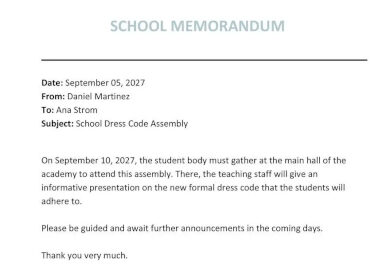
A school memo is supposed to be one of the simplest and most powerful tools of leadership communication. It should clarify expectations, align staff, and maintain order within an institution. Yet in many schools, memos are quietly ignored, skimmed, misunderstood, or completely set aside.
This is rarely just a problem of staff discipline. In most cases, it reflects a deeper breakdown in communication practice at leadership level. When memos stop functioning as clear guidance and begin to feel like emotional reactions or routine formalities, their authority weakens.
Understanding why this happens is essential for strengthening professionalism, trust, and efficiency in school management.
When tone overrides content
The first reason memos are disregarded is not what is said, but how it is said.
A memo that carries anger, sarcasm, blame, or indirect threats immediately changes how it is received. Staff stop reading for instruction and start reading defensively. Once emotions are triggered, clarity is lost.
A professional memo should correct without humiliating, guide without attacking, and inform without provoking fear. Tone determines whether a message is accepted or resisted.
Lack of clarity makes people switch off
A memo must clearly answer three questions:
What is required?
Who is responsible?
When is it expected?
When instructions are buried in long paragraphs or vague language, staff struggle to interpret meaning. In busy school environments, unclear communication is not debated—it is ignored.
Clarity is not about using complex language; it is about precision and structure.
ALSO READ:
Poor timing undermines good intentions
Even a well-written memo can fail if it is issued at the wrong time.
Communications released during examinations, marking periods, or peak teaching workloads are often viewed as unrealistic or insensitive. When leadership appears disconnected from school pressure points, compliance naturally drops.
Timing reflects awareness, and awareness strengthens leadership credibility.
Inconsistency creates confusion
When memos frequently change direction or contradict earlier instructions, staff begin to lose confidence in them.
Over time, they stop acting immediately and begin waiting for clarification or reversal. This hesitation slows down operations and weakens institutional discipline.
Consistency builds trust. Inconsistency builds doubt.
Lack of ownership reduces commitment
People are more likely to support what they feel part of.
When memos are purely top-down, especially on issues affecting workload, routines, or discipline procedures, staff may comply outwardly but disengage internally. Even minimal consultation or departmental input can significantly improve acceptance and ownership
Memo fatigue is real
When every small issue becomes a memo, communication loses its importance.
Staff begin to filter messages automatically, treating most of them as routine noise. As a result, critical instructions get buried among minor reminders.
A memo should communicate importance—not routine repetition.
No follow-up weakens authority
A memo without follow-up is a statement without weight.
When staff observe that previous memos were ignored without feedback or consequences, they learn that compliance is optional. Over time, even serious instructions lose authority.
Communication gains strength when it is consistently followed by action, monitoring, and accountability.
ALSO READ:
Usawa Agenda report: More boys than girls missing out on school
Trust defines reception
At the centre of memo effectiveness is trust.
Where staff feel respected and valued, even firm instructions are accepted professionally. Where trust is weak, even well-written memos are questioned or resisted.
Trust does not remove authority—it makes authority acceptable.
The importance of professional writing support
In many cases, the problem is not intention but expression.
When a principal is unsure of how best to craft a memo or official letter, the services of a qualified teacher of English should be sought. Clear, accurate, and well-structured communication is not a luxury in school leadership—it is a necessity. Poorly written memos can distort meaning, weaken authority, and create unnecessary confusion among staff, while well-edited communication enhances clarity, professionalism, and compliance.
The memo is a reflection of leadership culture
Ultimately, a memo is not just a document—it reflects the communication culture of an institution.
Where leadership is thoughtful, structured, and respectful, memos become effective tools of coordination. Where communication is rushed, inconsistent, or emotional, memos lose meaning and are easily ignored.
When staff disregard memos, it is rarely an act of defiance alone. It is often a response to how communication is designed, delivered, and followed through.
A memo should not compete for attention—it should command it through clarity, timing, respect, and consistency.
Leadership is not measured by the number of memos issued, but by the number that are understood, accepted, and acted upon.
At the end of the day, people do not ignore memos—they respond to how those memos make them feel, think, and trust.
By Hillary Muhalya
You can also follow our social media pages on Twitter: Education News KE and Facebook: Education News Newspaper for timely updates.
>>> Click here to stay up-to-date with trending regional stories
>>> Click here to read more informed opinions on the country’s education landscape