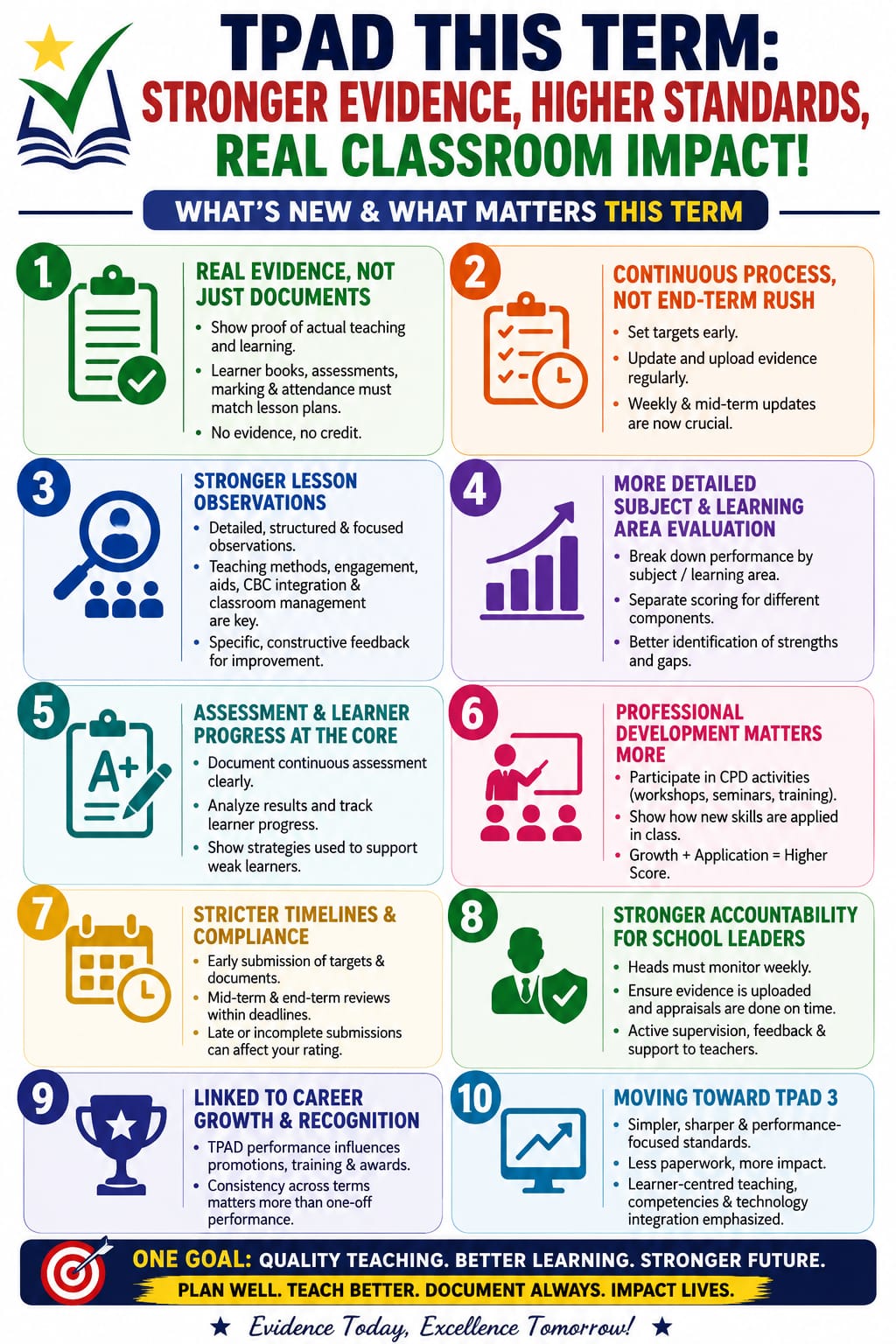
This term, the implementation of TPAD is undergoing a deeper refinement that is reshaping how teaching is evaluated, documented and improved across schools. While the system itself is not new, the way it is being enforced has become more focused, disciplined and demanding in terms of evidence and accountability.
The shift is clear: TPAD is no longer about routine compliance — it is about proving real teaching impact inside the classroom.
At the heart of this transformation is a stronger demand for authentic classroom evidence. Teachers are now expected to demonstrate, beyond doubt, that learning is actually taking place. This means that lesson plans alone are not enough; they must be matched with learner exercise books, marked assignments, assessment records and clear tracking of learner progress. The expectation is that every documented activity must reflect what is genuinely happening during instruction. Schools are increasingly moving away from “paper TPAD” toward “evidence TPAD,” where every claim must be backed by verifiable classroom output.
Lesson planning and delivery have also become more closely monitored. Teachers are expected to ensure that schemes of work, lesson plans and actual classroom delivery are fully aligned. Any gap between what is planned and what is taught is now more easily detected through observation and evidence checks. This has pushed many educators to become more deliberate in their preparation, ensuring that teaching is structured, purposeful and aligned with curriculum goals.
Another major change this term is the tightening of lesson observation standards. Heads of institutions and senior teachers are now required to conduct more detailed and structured classroom observations. These observations are no longer general or subjective; they are guided by specific criteria such as teaching methodology, learner engagement, use of teaching aids, classroom management and integration of competency-based approaches. The feedback given after observation is expected to be specific, constructive and focused on improvement rather than general remarks. This has made classroom supervision more professional and less arbitrary.
The appraisal cycle itself has also changed in practice. TPAD is now firmly being treated as a continuous process rather than an end-term activity. Teachers are expected to set their performance targets at the beginning of the term and update evidence regularly throughout the term. This means that documentation is no longer something rushed at the end of the term but a continuous reflection of ongoing teaching practice. Weekly and mid-term updates are becoming more important in ensuring that appraisal records remain current and accurate.
Professional development has also gained greater weight in the system. Teachers are now required to demonstrate active participation in Continuous Professional Development (CPD) activities. These include workshops, seminars, peer learning sessions and subject-based training. However, the emphasis is not just on attendance but on application. Teachers must show how the skills and knowledge gained from training are being applied in the classroom to improve learner outcomes. This has strengthened the link between teacher growth and classroom performance.
This term also reflects a gradual transition toward the principles of TPAD 3, even though it is not fully implemented yet. The direction is toward a simpler but more performance-focused system. The aim is to reduce unnecessary paperwork while increasing emphasis on actual teaching effectiveness. The system is slowly shifting toward evaluating teachers based on impact, not volume of documents. This means that quality of teaching, learner progress and instructional effectiveness are becoming more important than the quantity of uploaded materials.
Another important shift is the increased focus on subject-specific and learning area evaluation. Teachers are now expected to break down their performance more precisely across different components of their subjects. This is particularly important in integrated learning areas where multiple competencies are taught together. By doing this, schools can better identify specific strengths and weaknesses in teaching and provide targeted support where needed.
Learner assessment has also become a central pillar of TPAD this term. Continuous assessment records must be detailed, well-analyzed and properly documented. Teachers are expected to show not only marks but also interpretation of results, identification of learner gaps and strategies used to support struggling learners. The emphasis is on using assessment as a tool for improvement rather than just grading.
School leadership accountability has also been strengthened. Heads of institutions now carry greater responsibility in ensuring that TPAD is implemented effectively. They are expected to monitor teacher progress regularly, provide feedback and ensure that all appraisal activities are completed within set timelines. Their role has shifted from passive reviewers to active supervisors of teacher performance and professional growth. This has increased the level of seriousness with which TPAD is being handled in many institutions.
In addition, compliance requirements have become stricter. Timelines for submission of targets, mid-term reviews and end-term evaluations are being enforced more firmly. Delays or incomplete submissions are now more likely to affect appraisal outcomes. This has created a stronger culture of discipline and time management among teachers, as TPAD is now closely tied to professional progression and institutional evaluation.
Importantly, TPAD is increasingly linked to career progression and recognition. Teacher promotions, training opportunities and professional advancement are now more directly influenced by performance records captured in the system. This has made consistency in performance across terms very important. Teachers are now encouraged to maintain steady improvement rather than focusing only on short-term performance spikes.
READ ALSO: TPAD: The ruthless TSC scorecard where Deputy Principals shape careers and promotions are won or lost
Despite these changes, challenges still exist. The increased documentation requirements can sometimes be overwhelming, especially in schools with limited digital infrastructure or high teacher workloads. However, the overall direction of the system is clear: to ensure that teaching is not only done but also proven, measured and continuously improved.
In conclusion, TPAD this term represents a stronger push toward discipline, accountability and real classroom impact. It is shaping a teaching environment where evidence matters, performance is continuously tracked, and professional growth is closely linked to actual classroom practice. The system is evolving from a compliance-based framework into a performance-driven culture that prioritises learner outcomes and teacher effectiveness.
By Hillary Muhalya
You can also follow our social media pages on Twitter: Education News KE and Facebook: Education News Newspaper for timely updates.