The duration of admission and the timely completion of university courses in Kenya present a clear contrast between public and private universities, shaped by differences in cost, administrative efficiency, academic stability, and the level of interference in training programmes.
In public universities, admission is largely centralised through the Kenya Universities and Colleges Central Placement Service (KUCCPS). This system ensures fairness in placement, but it often results in a slow and congested admission process. After placement, students report during fixed academic calendars, usually once per year. However, the journey into full registration can be delayed by large student populations, bureaucratic procedures, and administrative bottlenecks. Fee clearance, registration, and orientation may take time, making the transition into university life less smooth for many students.

Private universities, in contrast, operate a more flexible and continuous admission system. They admit students in multiple intakes throughout the year, commonly in January, May, and September. This allows learners to join soon after application and fee payment. Administrative processes are generally faster and more streamlined, enabling students to settle into their studies without long delays. This efficiency at the entry level sets the foundation for a more predictable academic journey.
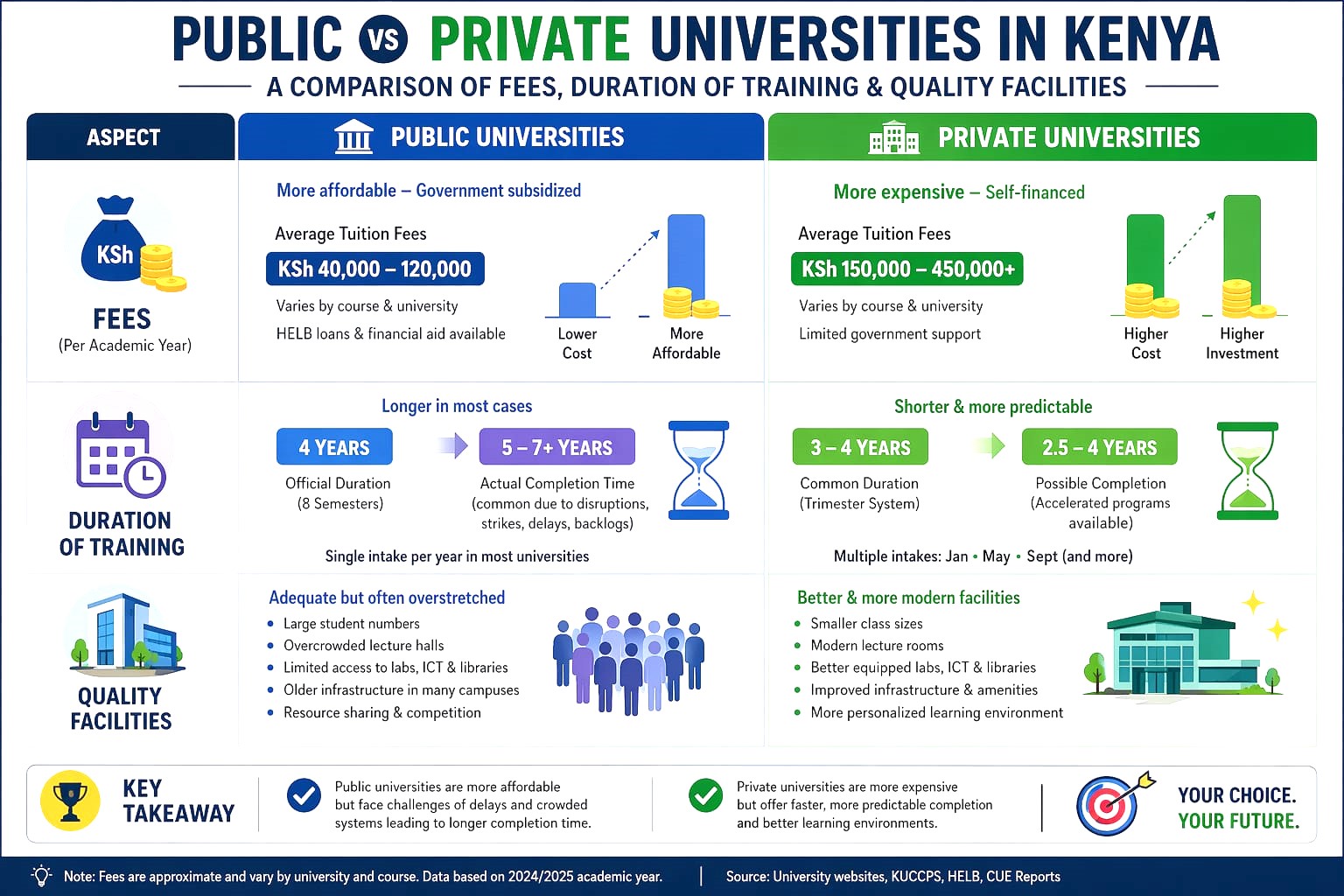
In terms of programme duration, most undergraduate degrees in Kenya are designed to take about four academic years in public universities, equivalent to eight semesters. Private universities also offer similar qualifications, but many operate on trimester systems that allow continuous learning throughout the year. This structure enables some students to complete their studies in three to four years, and in certain accelerated programmes, even in as little as two and a half years.
However, the actual completion time differs significantly between the two systems. In public universities, although the official duration is four years, many students take five to seven years—or even longer—to graduate. This delay is mainly caused by repeated interruptions in the academic calendar. Strikes, funding challenges, overcrowded lecture halls, delays in marking and releasing results, and a backlog in academic supervision all contribute to extended study periods. These disruptions create an environment where timely graduation becomes difficult to achieve.
A key factor behind this difference is the level of interference in training programmes. In public universities, teaching and learning are frequently disrupted. When strikes occur or administrative processes stall, lectures are suspended, examinations are postponed, and academic calendars are pushed forward. These interruptions accumulate over time, leading to significant delays in course completion.
In private universities, interference in training programmes is minimal. Academic calendars are more stable and strictly followed. Teaching, assessment, and examinations proceed without frequent stoppages. This stability is supported by smaller student populations, more structured management systems, and employment arrangements that reduce the likelihood of industrial action. As a result, learning continues consistently, allowing students to complete course content on schedule.
Because interruptions are rare, private universities maintain smooth academic progression. Examinations are conducted on time, marking is completed promptly, and results are released without delay. Students are able to move from one academic level to another without unnecessary waiting periods or accumulation of backlog units. This continuity plays a major role in ensuring timely graduation.
Cost is another major point of difference between the two systems. Public universities are generally more affordable because they are heavily subsidised by the government. Students placed through KUCCPS benefit from lower tuition fees and, in many cases, access to government loans and financial support systems such as HELB. Despite recent adjustments in fees, public universities remain the more affordable option for most households.

Private universities, on the other hand, are the most expensive institutions in Kenya’s higher education system. They rely mainly on tuition fees to sustain operations, including staff salaries, infrastructure, and academic resources. As a result, students pay significantly higher fees, sometimes several times more than in public universities. Professional courses such as medicine, law, business, and engineering are especially costly. However, this higher cost is often justified by faster academic progression, smaller class sizes, more personalised teaching, and minimal disruption of learning programmes.
READ ALSO: KUCCPS rolls out nationwide drive to guide Form Four leavers on university, college admissions
In summary, public universities offer more affordable education but face challenges of congestion, interruptions, and delayed completion. Private universities, while more expensive, provide stability, flexibility, and a more predictable academic calendar that supports timely graduation.
Ultimately, the timely completion of university education in Kenya is closely linked to both cost and institutional stability. Where funding is lower, but systems are congested and frequently disrupted, delays become common. Where costs are higher but academic programmes run smoothly with minimal interference, students are more likely to graduate on time.
By Hillary Muhalya
You can also follow our social media pages on Twitter: Education News KE and Facebook: Education News Newspaper for timely updates.
>>> Click here to stay up-to-date with trending regional stories
>>> Click here to read more informed opinions on the country’s education landscape