






In order to effectively critique the primary, junior and senior school systems, one must first clearly understand the flow of the syllabus across these three levels. Education is not a collection of isolated stages operating independently of one another; it is a continuous, carefully sequenced process designed to respond to the developmental, cognitive and emotional growth of learners. Any criticism that fails to appreciate this progression risks being superficial, reactionary or rooted in personal experience rather than informed analysis. Understanding syllabus flow is, therefore, the foundation of meaningful educational critique.
Syllabus flow refers to the logical progression of learning from one level to the next. It explains how knowledge, skills, values and competencies are introduced, reinforced, expanded and eventually mastered. Under the Competency-Based Education (CBE) framework, this flow moves deliberately from foundational learning in primary school to exploration and transition in junior school, and finally to specialisation and career preparation in senior school. Each level exists not to compete with the others, but to prepare learners for what follows.
At the primary school level, the syllabus flow begins with exposure and foundation. Learners are introduced to basic literacy, numeracy, communication skills, environmental awareness and moral values. The content is intentionally broad and simple, focusing on equipping learners with the tools of learning rather than subject mastery. Children at this stage think concretely and learn best through experience, repetition and guided instruction. Teaching methods therefore emphasise play, storytelling, songs, practical activities and close teacher supervision.
Critiquing primary education for lacking academic depth often reflects a misunderstanding of its role in the syllabus flow. Primary school is not meant to produce experts in science, mathematics or literature. Its purpose is to ensure that learners can read fluently, express themselves clearly, count accurately, interact positively with others and develop a positive attitude towards learning. Without these foundational competencies, progression to junior school becomes difficult and frustrating. Effective critique must therefore ask whether primary education is laying strong foundations, not whether it resembles later stages.
ALSO READ:
https://educationnews.co.ke/moe-releases-2026-academic-calendar-for-schools-and-teacher-training-colleges/
The transition from primary to junior school marks a significant shift in the syllabus flow. Junior school is designed as a bridging and exploratory stage, where learners begin to connect foundational knowledge to real-life applications. Concepts introduced in primary school are expanded and deepened, and learners are encouraged to think critically, ask questions and explore relationships between ideas. The syllabus becomes more structured and analytical, but still retains flexibility to accommodate diverse abilities and interests.
Many criticisms directed at junior school arise from failure to understand its transitional nature. Some view it as too demanding for learners, while others argue that it lacks the seriousness of senior school. Both perspectives miss the point. Junior school is neither an extension of primary education nor a reduced version of senior school. It serves a unique purpose in the syllabus flow by nurturing independence, identity and informed choice. Learners are introduced to more specialised subjects such as Integrated Science, Social Studies and Pre-Technical Studies, allowing them to discover talents and inclinations.
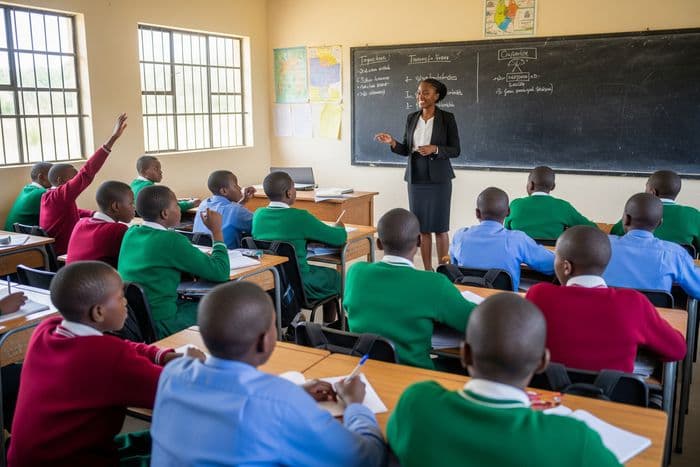
Teaching approaches at the junior level shift from teacher-centred instruction to inquiry-based learning, group work, projects and simple research. Teachers act increasingly as facilitators rather than sole sources of knowledge. At the same time, learners are developing emotionally and socially, navigating adolescence, peer influence and self-identity. The syllabus, therefore, integrates competencies such as collaboration, communication, decision-making, ethical reasoning and emotional intelligence. Critiquing junior school without acknowledging these developmental realities leads to misplaced expectations and unfair judgments.
Senior school represents the final stage in the syllabus flow and the point at which learning becomes focused, demanding and purposeful. By this stage, learners are expected to have acquired strong foundational skills and developed the capacity for independent thinking. The senior school syllabus is therefore built around specialisation, depth of understanding and preparation for post-school pathways. Learners select subjects aligned with specific career tracks such as STEM, Arts and Sports Science, or Social Sciences.
As CBE is now being implemented at the senior school level, teachers at this stage will experience the true practical expression of the curriculum. Unlike earlier levels where foundational and exploratory competencies dominate, senior school requires full integration of knowledge, skills, values and real-world application. Teachers will no longer focus on content delivery alone, but on designing learning experiences that assess what learners can do with what they know.
ALSO READ:
https://educationnews.co.ke/day-schools-in-malava-to-fully-benefit-from-ng-cdf-bursary-allocation/
At this level, teachers are compelled to align instruction, assessment and learner outcomes more deliberately. Research projects, advanced practicals, fieldwork, community engagement and mentorship become central to teaching and learning. Senior school, therefore, offers educators the clearest opportunity to engage with CBE not as a policy concept, but as a lived classroom reality. It is at this stage that the strengths and weaknesses of CBE will become most visible.
Criticism of senior school often focuses on workload, pressure and assessment demands. While these concerns may be valid, they cannot be examined in isolation. Senior school depends heavily on the effectiveness of primary and junior education. Weak literacy skills, poor critical thinking habits or inadequate emotional support in earlier stages inevitably surface as struggles at the senior level. Understanding syllabus flow helps critics identify whether challenges at senior school are truly systemic or are symptoms of earlier gaps.
The flow of the syllabus also clarifies the progression of competencies. In primary school, competencies focus on basic skills and values. In junior school, they expand to include critical thinking, creativity and collaboration. In senior school, they become specialised, analytical and career-oriented. Each stage builds upon the previous one, ensuring continuity and coherence. When competencies are introduced too early, learners become overwhelmed; when introduced too late, learners are underprepared. Effective critique must therefore examine whether this progression is balanced and well-timed.
Understanding syllabus flow is also essential for evaluating assessment practices. Continuous assessment in primary and junior school supports learning and growth, while more structured and standardised assessment in senior school ensures accountability and readiness for external pathways. Criticising assessment methods without considering their place in the syllabus flow often leads to calls for uniformity where differentiation is required.
Moreover, understanding syllabus flow enables stakeholders to pinpoint implementation challenges. Issues such as teacher preparedness, resource availability, class size and parental understanding affect different levels in different ways. Blaming the syllabus alone ignores the realities of implementation. A well-designed flow can still fail if teachers are inadequately trained or schools are under-resourced. Meaningful critique, therefore, distinguishes between flaws in design and weaknesses in execution.
In conclusion, effective critique of the primary, junior and senior school systems must be grounded in a clear understanding of how the syllabus flows across the three levels. Primary education lays the foundation, junior school bridges and expands learning, and senior school sharpens focus and prepares learners for life beyond school. With senior school now fully embracing CBE in practice, teachers stand at the centre of its success or failure. Viewing the three stages as interconnected rather than competing allows for informed, constructive and solutions-oriented criticism that ultimately strengthens education and national development.
By Hillary Muhalya
You can also follow our social media pages on Twitter: Education News KE and Facebook: Education News Newspaper for timely updates.
>>> Click here to stay up-to-date with trending regional stories
>>> Click here to read more informed opinions on the country’s education landscape
>>> Click here to stay ahead with the latest national news.

Reader Discussion (0)
Sign in to comment