Kenya’s education system is not the product of a single policy moment, nor the achievement of one administration. It is a layered national construct—built gradually, revised repeatedly, and reimagined across different political eras.
Each presidency inherited a system with gaps, pressures, and possibilities, then reshaped it according to the needs and ambitions of the time. When viewed collectively, these contributions form a continuous chain of reform, with each leader adding a distinct influence to the evolving architecture of learning.
Kenyatta and the Harambee foundation
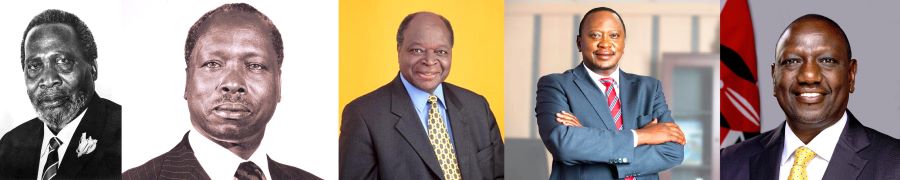
The earliest and foundational influence came under Jomo Kenyatta, whose era accounts for approximately 15% of the modern education system’s structure and philosophy.
In the immediate post-independence period, Kenya faced the urgent task of expanding access to education for a rapidly growing population while operating with limited infrastructure inherited from the colonial system.
The response was the Harambee philosophy, a powerful national call for collective responsibility.
Under this model, communities mobilized resources to build schools, employ teachers, and expand learning opportunities where the state could not immediately reach. Education became a shared national project rather than a purely government-driven service.
This era witnessed the rapid emergence of Harambee primary and secondary schools, particularly in rural areas, which became critical access points for millions of learners.
Although challenges in quality, staffing, and resources were significant, the foundation laid during this period permanently established education as a central pillar of national development and social mobility.
Moi and the 8-4-4 revolution
The next major structural transformation occurred under Daniel arap Moi, whose contribution is estimated at 25% of the current system’s evolution.
His administration introduced one of the most significant education reforms in Kenya’s history: the 8-4-4 system in 1985. This reform replaced the earlier 7-4-2-3 structure and redefined the architecture of learning.
The 8-4-4 system extended basic education to eight years of primary, four years of secondary, and four years of university education.
Its core philosophy emphasized practical skills and self-reliance, introducing vocational subjects such as agriculture, home science, woodwork, and metalwork into mainstream education.
The intention was to produce learners who were not only academically competent but also equipped with practical skills relevant to the job market and self-employment.
A defining, though sometimes less emphasized, aspect of this era was teacher welfare. The Moi administration is widely associated with one of the most significant improvements in teachers’ remuneration at the time, strengthening morale within the profession and reinforcing the role of teachers in implementing national reforms.
Despite its challenges, the 8-4-4 system became deeply entrenched in Kenya’s educational identity, shaping generations of learners and educators.
Kibaki and the expansion of access
A further 20% of the system’s evolution is attributed to Mwai Kibaki, whose tenure is most strongly associated with the democratization of access to education.
His administration’s most defining policy was the introduction of Free Primary Education in 2003, a move that transformed Kenya’s education landscape almost overnight.
With the removal of primary school tuition fees, millions of children who had previously been excluded because of financial constraints entered classrooms.
Enrolment surged dramatically, marking one of the largest expansions of access in the country’s history.
However, this rapid growth also exposed structural weaknesses. Classrooms became overcrowded, teacher-to-student ratios increased, and learning materials were stretched.
Despite these challenges, the policy fundamentally redefined education as a right accessible to all children regardless of economic background.
Uhuru and the shift to digital learning
The next major phase of transformation came under Uhuru Kenyatta, whose contribution is estimated at 25% of the system’s evolution.
His administration focused on modernization, technological integration, and curriculum transformation, marking a philosophical shift in how education was conceptualized and delivered.
One of the flagship interventions during this period was the Digital Literacy Programme, which introduced ICT devices into primary school classrooms.
The initiative sought to equip learners with foundational digital skills and integrate technology into everyday learning.
Even more significant was the rollout of Competency-Based Education (CBE), which represented a major departure from the examination-oriented 8-4-4 system.
CBE emphasized skills development, creativity, critical thinking, and learner-centred instruction. Instead of focusing primarily on memorization and final examinations, the system aimed to assess learners continuously based on competencies and practical application of knowledge.
While implementation presented challenges, the reforms placed Kenya on a new educational trajectory focused on skills, innovation, and adaptability.
Ruto and reform consolidation
The most recent and still evolving phase is being shaped under President William Ruto, whose contribution is now estimated at 20%, reflecting his growing influence on system stabilization and reform consolidation.
His administration has focused on strengthening Competency-Based Education at the junior secondary level, expanding infrastructure, and ensuring that the system is supported through increased teacher deployment and funding adjustments.
A defining achievement of this period has been the employment of more than 100,000 teachers, a major intervention aimed at addressing staffing shortages and improving teacher-to-learner ratios across the country.
Alongside workforce expansion, the government has pursued reforms in higher education financing through a new funding model designed to align student support with household capacity and programme costs.
Technical and Vocational Education and Training (TVET) has also received renewed attention as a strategic pathway for skills development, entrepreneurship, and youth employment.
Despite these gains, challenges remain, including funding constraints, infrastructure pressure, and uneven resource distribution.
A continuous chain of reform
Viewed holistically, Kenya’s education evolution reflects a continuous chain of leadership-driven reform.
Kenyatta expanded access through Harambee mobilization. Moi restructured the system through 8-4-4. Kibaki democratized access through Free Primary Education. Uhuru modernized learning through digital integration and Competency-Based Education. Ruto is now consolidating reforms, expanding staffing, and reshaping financing systems.
These contributions do not compete; they connect, forming a single evolving story of national education development across generations.
READ ALSO: TSC denies viral claims on principals, headteachers being exempted from classroom teaching
Ultimately, Kenya’s education system is a living institution shaped by successive presidential decisions that continue to influence what happens in every classroom—from access and curriculum to opportunity and outcomes.
By Hillary Muhalya
You can also follow our social media pages on Twitter: Education News KE and Facebook: Education News Newspaper for timely updates.
>>> Click here to stay up-to-date with trending regional stories
>>> Click here to read more informed opinions on the country’s education landscape