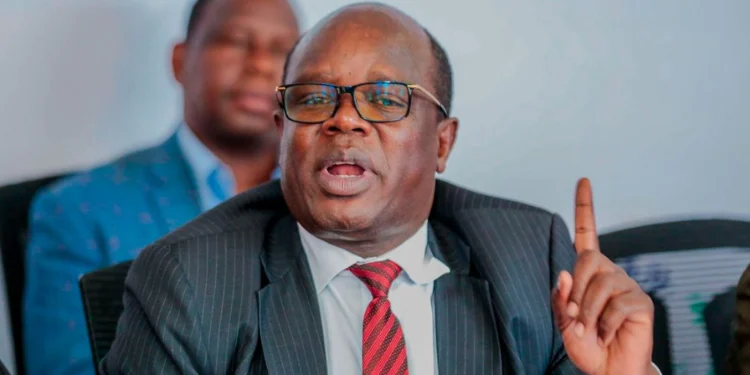
- UASU Secretary-General Constantine Wasonga has given the Government and IPUCCF until October 18, 2026, to sign the 2025–2029 CBA or face a seven-day strike notice.
- The union has cited unresolved disputes over salary increments, staffing shortages, part-time lecturer arrangements and retirement age provisions as key sticking points.
- UASU has argued that university staff salaries should be funded through the Exchequer rather than student fees
Kenya’s public university system has been given a one-month window to avoid another potentially costly shutdown, with failure to conclude and sign the new Collective Bargaining Agreement (CBA) threatening to disrupt lectures, examinations and graduations while piling fresh pressure on universities already grappling with funding, staffing and workload challenges.
Universities Academic Staff Union (UASU) Secretary-General Dr Constantine Wasonga has given the Government and the Inter-Public Universities Councils Consultative Forum (IPUCCF) until October 18, 2026, to negotiate, sign, register and implement the 2025–2029 CBA. He said that if the agreement is not concluded within the one-month window, the union will issue a seven-day strike notice.
The ultimatum comes against a backdrop of unresolved disagreements over what the new CBA should deliver and how its financial obligations should be met. UASU says negotiations have stalled partly because it is yet to receive what it considers a substantive financial counter-offer from the Government side, raising the possibility that the dispute could once again move from the negotiating table to university campuses.
At the centre of the negotiations is pay. UASU’s proposals for the 2025–2029 period include annual basic-salary increments averaging six per cent, alongside proposed changes to house, commuter, car and other allowances. The union’s earlier proposal also set out higher salary levels across academic grades, meaning the financial component is likely to remain one of the most difficult areas for the two sides to reconcile.
ALSO READ:
But the dispute is not simply about salaries. Lecturers have also raised concerns over promotions and career progression, with UASU arguing that some academic staff remain in the same grade for prolonged periods. The union wants the new agreement to address career progression alongside recruitment, particularly as universities continue to handle growing student populations with inadequate numbers of full-time academic staff.
Staffing and workload have consequently become another contested area. UASU says increasing enrolment has not been matched by recruitment, leaving some lecturers handling very large classes and universities increasingly dependent on part-time academic staff. The union has argued that the new CBA should support recruitment and address the working conditions created by these staffing gaps. The status of part-time lecturers is also part of the wider dispute, with UASU calling for greater attention to their employment arrangements and linking the issue to the broader question of whether universities have enough permanent academic staff to sustain quality teaching, research and supervision.
Another sensitive issue is retirement age. UASU has objected to changes affecting academic staff and wants provisions contained in registered CBAs to be respected, arguing that academic work extends beyond classroom teaching to research and community service, making the question of retirement particularly contentious.
There is also a fundamental disagreement over who should finance university staff salaries. UASU has argued that lecturers, as public employees, should have their salaries adequately funded through the Exchequer rather than universities being left to depend heavily on student fees while simultaneously being expected to expand access. The union has linked the funding question to the broader financial crisis facing public universities.
The shadow of previous CBA arrears further complicates the negotiations. The 2025 lecturers’ strike was partly driven by demands over outstanding obligations under earlier agreements, as well as the negotiation and implementation of the 2025–2029 CBA. That history helps explain why UASU is now pressing for the new agreement to be negotiated, signed, registered and implemented, rather than allowing another prolonged period between negotiations and implementation.
ALSO READ: Former Chief Justice Willy Mutunga urges universities to integrate AI in legal training
For students, the stakes are immediate. A fresh strike could interrupt lectures, examinations, research and graduation schedules, with effects extending beyond individual campuses to the entire public university academic calendar. The 2025 strike demonstrated how quickly a labour dispute can translate into widespread disruption of university learning.
For the Government, the challenge is therefore not confined to finding money for a salary agreement; it must help bridge disagreements over pay, allowances, promotions, staffing, workload, retirement, employment arrangements and the sustainable financing of public universities. The one-month window allows the parties to settle those questions before the dispute escalates, but if the deadline passes without a signed and implementable agreement, UASU has already indicated that a seven-day strike notice will follow.
By Hillary Muhalya
Get more stories from our website: Education News
To write to us or offer feedback, you can reach us at: editor@educationnews.co.ke
You can also follow our social media pages on Twitter: Education News KE and Facebook: Education News Newspaper for timely updates.
>> Click here to stay up-to-date with trending regional stories