

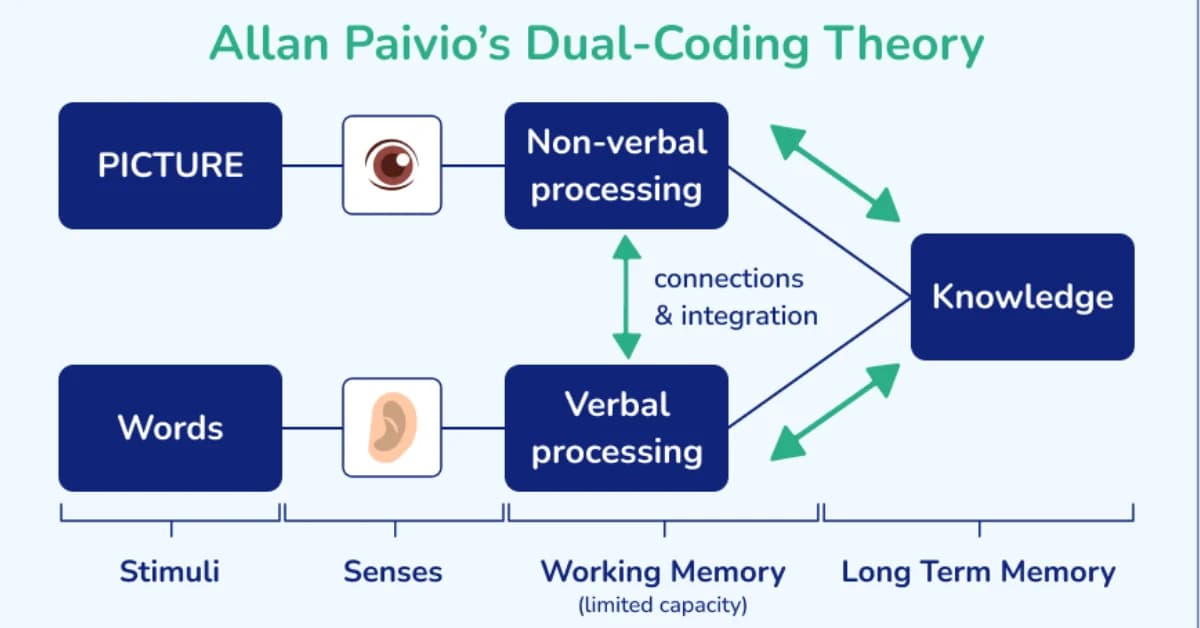







Dual-coding is a study strategy that combines words with visual representations to help learners understand, remember and recall information. It encourages students to process material in two ways: verbal coding, which uses words, written notes, definitions, descriptions and spoken explanations, and visual coding, which uses pictures, diagrams, charts, symbols, maps and other visuals.
Students can use the technique while making notes and when revising for examinations. The key principle is to combine meaningful words with useful visuals, so it is not about decorating notes with pictures. This is why a learner studying Geography should use an atlas as a reference book. A learner studying the mammalian heart in Biology, for example, can read notes on its functions and adaptations, and gain a deeper understanding by studying a labelled diagram of the organ. The written explanation provides the verbal information, and the diagram provides the visual one.
Used well, dual-coding helps learners to understand and simplify complex concepts, retain information, take an active part in learning, improve the revision process, spot gaps in their learning, build personal organisation skills and improve academic performance.
Origin of Dual-Coding
The strategy is based on Dual-Coding Theory, developed by Canadian psychologist Prof Allan Paivio (1925–2016) at the University of Western Ontario. Paivio used the idea that forming mental imagery aids learning through the Picture Superiority Effect, a cognitive phenomenon in which people remember pictures and visual information better than written or spoken words. According to the author, after three days people typically remember only about 10 per cent of written or verbal information, but the figure rises to 65 per cent when a relevant image is added. Paivio published the book Mental Representations: A Dual-Coding Approach in 1986.
Paivio proposed that human thinking involves two interconnected systems: a verbal system, which processes and represents language, and a non-verbal or imagery system, which processes and represents images and other non-verbal information. The two can work independently but also depend on each other. When a learner reads the word "elephant", for instance, they process the word verbally and may also form a mental image of an elephant, and the link between the two makes the information easier to remember. This is also why a typical classroom displays drawings and diagrams as teaching aids.
Variety of Visuals Used in Dual-Coding
Foremost, diagrams are visuals showing parts of an object, structure or system. Secondly, mind-maps are used by learners to organise information around a central topic, with branches showing related ideas. Thirdly, flowcharts show steps, sequences or processes. For instance, in Chemistry, there can be flowchart of Solvay Process in the topic or strand Carbon and its Compounds.
Additionally, tables and charts are used in organising information for easy comparison. Furthermore, timelines show events in a chronological order. Moreover, maps represent geographical locations, boundaries and spatial relationships. Also, symbols and icons represent ideas or processes in simple forms. For example, using a leaf symbol to represent environmental conservation. Withal, drawings and illustrations provide visual representations of objects, events or concepts. Likewise, graphs display numerical information visually. By the same token, it is worth using annotated pictures to combine images with labels; arrows and brief explanations.
Principles of Dual-Coding
The first principle is combining words with visuals, so that written or spoken explanations are linked to relevant diagrams, drawings, pictures or symbols. The second is complementary representation: the visual must help explain the verbal information, since a picture with little link to the topic distracts the learner rather than helping them.
The third is active learning, in which students create and interpret visuals instead of merely looking at them. Drawing the digestive system from memory, for example, makes the learner retrieve and work with the information. The fourth is organisation of information, since flowcharts, timelines and mind-maps help learners see how concepts relate and make complex ideas easier to follow.
The fifth is making meaningful connections between new and existing knowledge. A learner studying electricity can compare an electric circuit to a water system, remembering that the comparison is only an analogy. The sixth is simplicity and clarity. Visuals should not be complicated, because overcrowded diagrams, too many colours and poor illustrations make study harder.
Application of Dual-Coding
Finally, students can follow these elaborate steps while applying dual-coding: Choose a topic you yearn to learn. Read avidly, and understand information about the topic. Summarise most salient ideas in few words. Select an appropriate visual to use: diagram, flowchart, picture, et cetera. Combine words with visuals by using labels and arrows to show relationships between different components. It’s important to ensure that the written and visual representations are supporting each other. Explain the visual in your own words. How? Study the diagram, and explain the process without copying the textbook. Mine information from valuable vaults of memory by closing the notes and trying to re-draw the diagram. Revise the information repeatedly. That is, use retrieval practice to test your level of understanding instead of simply re-reading wads of notes.
Victor Ochieng’ rolls out talks and training services in schools. He speaks to students about useful Study Strategies, Skills, Methods, habits, and Techniques. vochieng.90@gmail.com. 0704420232




Reader Discussion (0)
Sign in to comment