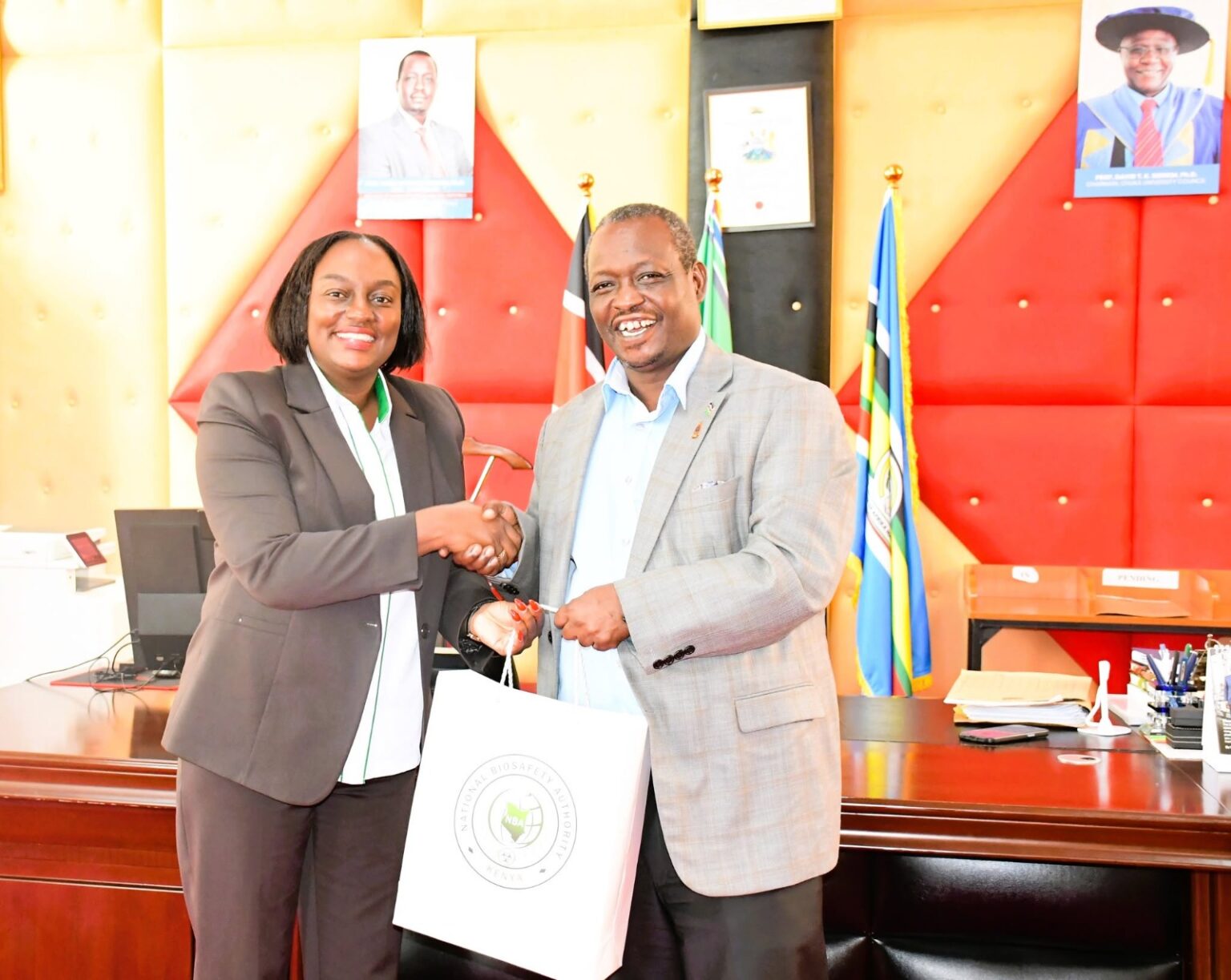
- The partnership will expand opportunities for joint research, professional training and curriculum development in biosafety.
- Students will benefit from internships, industrial attachments, mentorship, summer schools and collaborative research initiatives.
- The institutions also plan to strengthen public awareness and national capacity in modern biotechnology and regulatory compliance.
The National Biosafety Authority (NBA) has signed a Memorandum of Understanding (MoU) with Chuka University to strengthen collaboration in biosafety education, research, innovation and capacity building.
The agreement was signed at Chuka University by NBA Acting Chief Executive Officer Dr Ann Karimi and the University’s Vice-Chancellor, Prof Henry Mutembei. The MoU establishes a framework for long-term collaboration aimed at advancing biosafety knowledge, promoting innovation and strengthening institutional capacity.
Through the partnership, the two institutions will collaborate on joint research projects, curriculum development, grant proposal development, professional training and public awareness initiatives. The collaboration will also create valuable opportunities for students and staff through internships, industrial attachments, mentorship programmes, biosafety summer schools and collaborative research initiatives that strengthen linkages between academia and industry.
Students to benefit from partnership
Speaking during the signing ceremony, Dr Karimi commended Chuka University for its commitment to advancing biosafety and biotechnology through strategic partnerships. She noted that the Authority remains committed to working with institutions of higher learning across the country to strengthen Kenya’s biosafety regulatory framework, promote scientific innovation and build national capacity in biosafety.
Prof Mutembei described the partnership as a significant milestone for the University, noting that it will enhance research and innovation, strengthen practical training for students and foster closer collaboration between academia, industry and regulatory institutions.
He expressed confidence that the MoU would contribute to the development of skilled professionals capable of addressing emerging biosafety challenges.
The partnership underscores the shared commitment of the National Biosafety Authority and Chuka University to promoting safe biotechnology practices, advancing scientific research and supporting sustainable national development through knowledge generation and innovation.
“There is so much we can achieve together, and we look forward to expanding our engagement with institutions of higher learning across the country. The Authority’s expertise and resources are available for the benefit of all Kenyans, and we are working with stakeholders to address misinformation and disinformation that could hinder the adoption of genetically modified organisms (GMOs) and other modern biotechnology innovations in the country,” said Dr Karimi.
Research, training and attachments
Under the MoU, the two institutions will collaborate in several key areas, including training and capacity building; supervision of students and trainees; industrial and field attachments; short-term professional courses; exchange of internal and external examiners and part-time lecturers; development of capacity-building programmes on biosafety and modern biotechnology; and the development of training modules on biosafety and regulatory compliance.
In research and publication, the partnership will focus on collaborative research projects for technology generation, demonstration and transfer; joint publications; information sharing through libraries, journals and electronic databases; sharing of research and training facilities; and curriculum development and review in biosafety, biotechnology and emerging technologies.
The collaboration is expected to benefit, among others, students pursuing Bachelor of Science programmes in Biosafety and Biosecurity, which are designed to meet the growing demand for qualified biosafety and biosecurity professionals to support national and global health preparedness and response.
The National Biosafety Authority is already collaborating with several institutions, including Masinde Muliro University of Science and Technology (MMUST), the Kenya Agricultural and Livestock Research Organization (KALRO), the International Livestock Research Institute (ILRI), Kenyatta University and the International Centre of Insect Physiology and Ecology (icipe).
Under the Biosafety Act, Cap. 320, the National Biosafety Authority is mandated to exercise general supervision and control over the transfer, handling and use of genetically modified organisms (GMOs) to ensure the safety of human and animal health and provide adequate protection of the environment.
READ ALSO: Teachers raise alarm over limited SHA medical services in Webuye
Other universities offering programmes in biosafety, biotechnology and related fields include Jomo Kenyatta University of Agriculture and Technology (JKUAT), the University of Eldoret, Moi University, Kisii University, the Technical University of Kenya, Kenyatta University, the University of Nairobi and Maseno University, among others.
By Joseph Mambili
Get more stories from our website: Education News
To write to us or offer feedback, you can reach us at: editor@educationnews.co.ke
You can also follow our social media pages on Twitter: Education News KE and Facebook: Education News Newspaper for timely updates.
>>> Click here to stay up-to-date with trending regional stories