










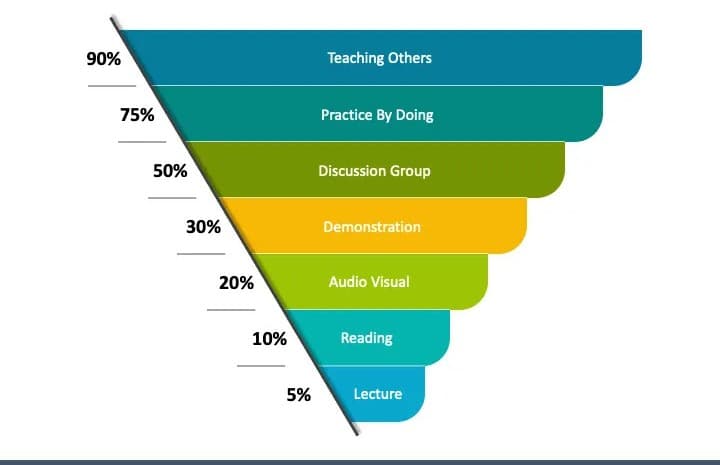
The Learning Pyramid shows why active learning methods such as discussion, practice, and teaching others help students understand and retain knowledge better than passive learning.
The Learning Pyramid, also known as the Cone of Learning, explains methods sedulous students should use to attain and retain knowledge. Or contain content taught. The model shows that active learning leads to better understanding and long-term retention as compared to passive learning. It was proposed by Edgar Dale. So also called Dale’s Cone of Experience.
The Learning Pyramid focuses on levels of learning from top to bottom. More so, how students master and memorise the content taught. By distributing percentages, this is how it cascades: Lecture 5percent, reading 10percent, audio-visual 20percent, demonstration 30percent, group discussion 50percent, practice by doing 75percent and teaching others 90percent. Active learning is powerful. So, students should enhance retention through practise, discussion and teaching others. Too true, variety makes learning enjoyable. Therefore, it’s important to merge many methods. Then, the more senses involved, the stronger the encoding.
In the levels of learning, some are passive, whereas others are active. Passive ones include: Lecture, reading and audio-visual. In the three, the learner is less involved. Therefore, retention is low. No wonder, it’s only suitable for a basic introduction. Conversely, active learning methods include: Demonstration, group discussion, practice by doing and teaching others. In those three, there’s high learner-involvement. Hence, enhancing long-lasting-learning.
- Lecture — 5 percent Retention
At the top of the pyramid is the traditional lecturing or passive listening. It’s when students listen to a teacher explicate a certain concept without note-taking or discussion. When students only listen to teachers talk — like in a classroom or seminar — they remember very little. This is because their brains aren’t actively processing or applying information.
- Reading — 10 percent Retention
Ideally, reading improves the level of learning and understanding, but it’s still a passive activity. Without interaction or practise, students forget the content taught or read. Therefore, to improve levels of mastery, they should take notes, highlight key concepts and summarise information through top tips such as text-marking and text-annotation.
- Audio-Visual — 20 percent Retention
Visuals such as videos, charts and diagrams: Assist students in connecting dots and gel ideas. They also pique interest and stimulate memory. In laws of mastery and memory, there’s the Law of Senses, where involvement of multiple senses enhances massive powers of memory. Combining sight and sound engages more senses. No wonder it’s important to integrate ICT into teaching and learning. So, students can watch educational documentaries or animated explainer videos.
- Demonstration — 30 percent Retention
When students see a concept demonstrated — such as a teacher performing a certain Science experiment — ostensibly, they understand the process better. Meaning, demonstration helps them bridge theory and practice by showing how something works. Instead of just explaining stuff. This underscores the essence of having more practical lessons in Sciences — Biology, Chemistry and Physics.
Discussion Group — 50percent Retention
Actually, when students discuss, they solidify their understanding of concepts. Then, discussion is a form of collaborative and interactive learning. When students sit to discuss, they process, analyse and explain ideas. So, they comprehend and attain retention.
- Practise by Doing — 75percent Retention
Active participation — like solving Mathematical problems, building projects, or performing tasks — enhances learning. Broadly, when students “learn by doing”, they apply knowledge, correct mistakes made, and remember learning experiences lucidly and vividly. They can engage in a project in Applied Sciences, such as Computer Studies and Agriculture. Or practise a new language, coding or cooking after watching a particular tutorial.
Teaching Others — 90percent Retention
Finally, at the base of the pyramid, is teaching others or peer teaching. For instance, teaching a friend. Or mentoring others. It assists students in attaining and retaining content because explaining concepts to peers requires complete understanding and organisation of knowledge. It reinforces learning. It reveals glaring gaps in understanding. It’s anchored on the Feynman Technique, and it assists students in understanding concepts deeply by explaining and expounding knowledge. It’s named after Richard Feynman, a top-flight Nobel Prize–winning physicist. It’s an effective study method that focuses on learning by teaching and simplifying concepts, leading to deeper understanding. It helps students to attain more mastery, identify gaps in knowledge, improve clarity and attain long-term retention.
READ ALSO: This is what entails effective study skills
How does it work? Select a topic. Write the name of the concept at the top of a page. Explain it simply as if teaching a child, newbie, novice or beginner. Use simple language, not technical terms. Identify gaps. Notice areas where the explanation is obscure. Revisit books or notes to revise those parts. Simplify and review. Rewrite the explanation in even simpler words. Use examples and analogies.

Review until the concept is crystal-clear. The idea is: in case you cannot explain it simply, then it eludes your good grasp. Learning improves through teaching. Simplicity leads to mastery. So, this method improves conceptual clarity. Helps in long-term memory. Encourages active learning. Reduces rote memorisation.
By Victor Ochieng’
Victor Ochieng’ rolls out academic talks in schools. vochieng.90@gmail.com. 0704420232
You can also follow our social media pages on Twitter: Education News KE and Facebook: Education News Newspaper for timely updates.
>>> Click here to stay up-to-date with trending regional stories
>>> Click here to read more informed opinions on the country’s education landscape



Reader Discussion (0)
Sign in to comment