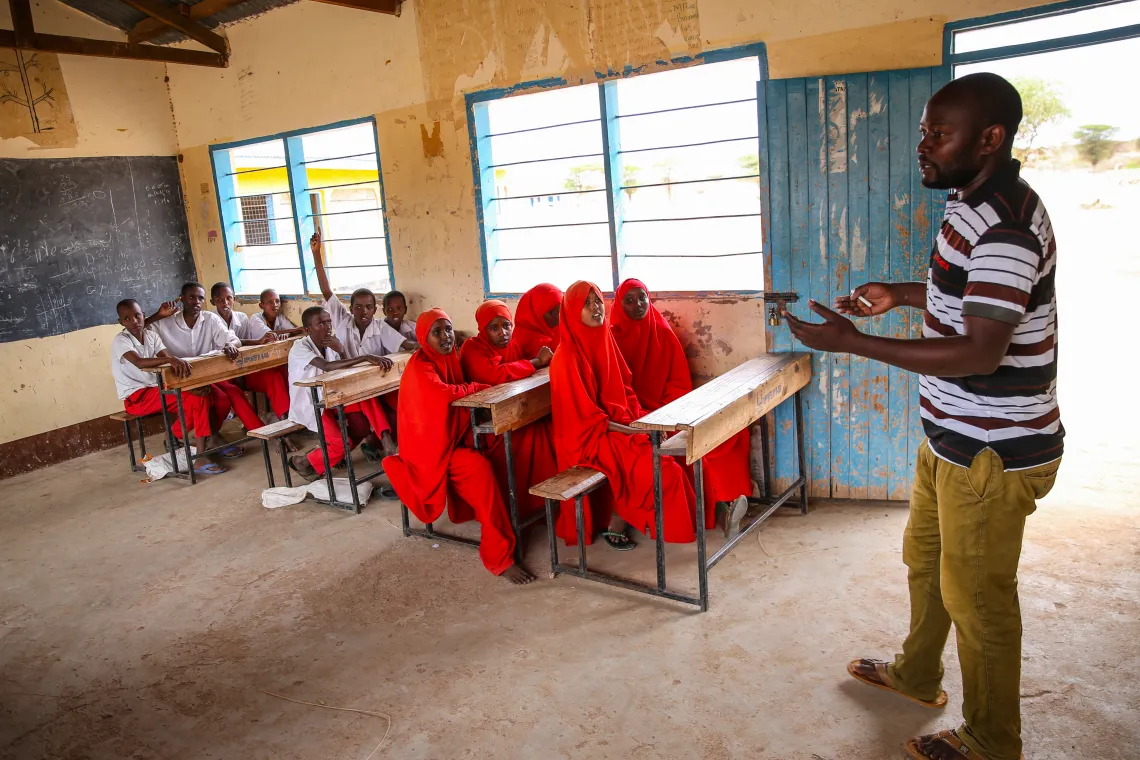
- Hillary Muhalya argues that pastoral education should become a structured part of learner development in Kenyan schools.
- He says counselling, mentoring and early intervention can strengthen behaviour, resilience, character and learner wellbeing.
- Muhalya maintains that Kenya already has a legal foundation for pastoral programmes and should now focus on implementation.
Kenya’s education debate has invested enormous attention in curriculum reforms, examinations, infrastructure, technology, teacher recruitment and academic performance. Yet beneath all these conversations lies a fundamental question:
Who is deliberately preparing the learner to deal with life itself?
The answer lies partly in a component of education that has existed in Kenya’s legal framework but has arguably not received the attention, structure and prominence it deserves: pastoral education and learner welfare.
Pastoral care is not simply an occasional assembly talk, a religious activity or something teachers undertake when they have spare time. Properly understood, it is a structured approach to developing the whole learner — emotionally, socially, morally and academically — while providing guidance, counselling, character formation, resilience, responsible behaviour and support when learners face difficulties.
And this is not merely an argument for creating something outside the education system.
Kenya’s law already provides a foundation.
The Basic Education Act, 2013 expressly recognises pastoral programmes. Section 2 defines “pastoral programmes” as the curriculum designed by different Christian churches. More significantly, Section 95(2)(e) empowers the Cabinet Secretary to make regulations providing for the integration of Madrassa, Duksi and pastoral programmes of instruction into the formal education system, where appropriate, to improve access and retention.
This provision was subsequently reinforced by the Basic Education Regulations.
Regulation 65 requires every institution to provide guidance services to learners, counselling services as an essential corrective measure, and spiritual development services focusing on moral values and character formation. It also requires anyone providing professional counselling services to be appropriately qualified and registered.
The significance is profound.
Pastoral support is therefore not something schools should dismiss as an optional extra. There is already a statutory framework recognising the importance of guidance, counselling, spirituality, moral values and character formation.
Indeed, the Presidential Working Party on Education Reform recommended that the Ministry operationalise Section 95(2)(e) by integrating Madrassa, Duksi and pastoral programmes into formal education to improve access, retention and moral development.
The challenge, therefore, is no longer simply whether pastoral education belongs in schools.
It is how Kenya can make it meaningful, professional, inclusive and effective.
The learner is more than a mark
Every learner enters school carrying a life beyond the classroom.
Behind a seemingly confident child may be anxiety. Behind declining performance may be a family difficulty. Behind persistent indiscipline may be an unmet emotional or social need. Behind withdrawal may be bullying, loneliness or fear.
Pastoral education gives schools a framework for recognising these realities.
It enables schools to deliberately cultivate self-awareness, confidence, resilience, empathy, communication, responsibility, integrity and positive relationships.
That makes pastoral care particularly relevant to Competency-Based Education (CBE). Education cannot claim to develop the whole learner while neglecting the learner’s emotional, social, moral and personal development.
A learner cannot fully demonstrate competence if the education system has concentrated exclusively on academic scores.
One of pastoral education’s greatest strengths is early intervention.
Teachers interact with learners every day. They can notice changes in behaviour, attendance, motivation, relationships and classroom participation.
A properly organised pastoral system creates mechanisms for responding to warning signs before they become major crises.
Instead of waiting until a learner drops out, becomes severely disruptive or reaches an emotional crisis, schools can intervene earlier.
The philosophy should be simple:
Identify. Understand. Support. Correct. Restore.
That is more constructive than waiting for a problem to become so serious that punishment becomes the school’s only response.
Pastoral education can transform how schools understand discipline.
The traditional question is often:
“What punishment does this learner deserve?”
A stronger pastoral approach asks another question:
“What happened, why did it happen, what does the learner need to understand, and how can the behaviour be corrected?”
This does not mean abandoning discipline.
It means making discipline developmental.
Counselling, mentoring, reflection, restorative conversations, behaviour support and appropriate consequences can help learners understand the impact of their actions and take responsibility for changing them.
The ultimate objective should be self-discipline, not permanent dependence on external punishment.
Every learner needs an adult who knows them
One of the most powerful elements of pastoral care is the relationship between a learner and a trusted adult.
A teacher, class teacher, mentor, pastoral coordinator or counsellor can become the person who notices when something has changed.
That relationship can make the difference between a learner suffering silently and a learner seeking help.
For some children, school may provide the most stable environment they experience. Pastoral structures can therefore ensure that vulnerable learners are not lost within large classes and complicated school systems.
A society does not only need people who can calculate, memorise, analyse and pass examinations.
It needs people who can be trusted.
It needs citizens who understand responsibility, honesty, perseverance, compassion, respect, self-control and ethical decision-making.
These qualities cannot simply be left to chance.
They must be deliberately cultivated.
The legal requirement for spiritual development services focusing on moral values and character formation provides an important foundation for this conversation.
Pastoral education can turn these ideals into daily practice.
A response to modern learner pressures
Today’s learner faces pressures that schools cannot afford to ignore.
Peer pressure, bullying, cyberbullying, social media, academic expectations, substance-abuse risks, family difficulties, relationship challenges and uncertainty about the future can directly affect attendance, concentration, behaviour and academic performance.
Schools cannot simply say these problems are outside education.
They are part of the learner’s educational reality.
Pastoral education gives schools a structured avenue through which these pressures can be addressed safely and responsibly.
Who should teach pastoral education?
The answer should not be one teacher.
Pastoral education should be a whole-school responsibility, but with clearly defined leadership and professional boundaries.
Every teacher has a pastoral role because teachers interact with learners daily. They can reinforce responsibility, positive behaviour, resilience, values and healthy relationships through ordinary classroom interactions.
However, schools should designate a pastoral coordinator or pastoral teacher to lead the programme and ensure that it does not become everybody’s responsibility in theory but nobody’s responsibility in practice.
The class teacher should ordinarily be the first point of contact for many learner concerns.
Professional counsellors should handle matters requiring specialised counselling. The Regulations are clear that professional counselling should be undertaken by appropriately qualified and registered personnel.
The headteacher or principal should provide overall institutional leadership, ensuring that pastoral care is incorporated into school policies, safeguarding arrangements and learner-support systems.
Deputy principals, senior teachers, heads of departments, house leaders and other designated personnel can coordinate different aspects in larger institutions.
Parents and guardians must also be partners.
Where a learner’s needs exceed the school’s capacity, appropriate external professionals should be involved.
Perhaps the greatest mistake would be to confine pastoral education to occasional assemblies.
If it is important enough to influence learner wellbeing, behaviour, character and life skills, it deserves planned and protected time.
The programme should have objectives, age-appropriate content, trained personnel, monitoring mechanisms and clear referral pathways for complex cases.
Assemblies can reinforce pastoral messages, but they cannot replace a structured programme.
Kenya should now move from recognition to implementation
The legal foundation already exists.
Section 95(2)(e) of the Basic Education Act provides for the integration of pastoral programmes into formal education, while Regulation 65 requires guidance, counselling and spiritual-development services focused on moral values and character formation.
What Kenya needs now is deliberate implementation and modernisation.
The country should develop a coherent pastoral framework that defines what learners should receive at different stages, who should provide different services, how teachers should be trained, when specialist referral is necessary and how schools should monitor learner wellbeing.
It should also avoid confusing pastoral care with religious indoctrination.
A modern pastoral programme should respect Kenya’s constitutional and educational principles while providing appropriate space for moral development, values, spirituality where applicable, counselling, wellbeing, relationships, resilience and responsible citizenship.
The bigger question
Kenya’s education system is becoming increasingly sophisticated. The country is investing in infrastructure, technology, teacher development and curriculum transformation.
But educational reform should not only ask whether learners are learning more.
It should ask whether they are becoming better equipped to live, work, relate to others and make responsible decisions.
That is where pastoral education becomes indispensable.
A school can teach mathematics without teaching a learner how to cope with failure.
It can teach science without teaching responsibility.
It can teach languages without teaching healthy relationships.
It can enforce rules without helping learners develop self-discipline.
That would leave an important part of education unfinished.
The future school must therefore recognise a simple truth:
Academic excellence and pastoral excellence are not competing priorities. They are two sides of the same educational mission.
The classroom develops the mind.
Pastoral education develops the person.
And the ultimate measure of a successful education system should not only be how well learners perform in examinations, but how well they are prepared to navigate life after the examination is over.
READ ALSO: Two women arrested at JKIA over alleged 658g gold smuggling attempt
Kenya has already written part of this ambition into law.
The next step is to make it work in every school.
By Hillary Muhalya
Get more stories from our website: Education News
To write to us or offer feedback, you can reach us at: editor@educationnews.co.ke
You can also follow our social media pages on Twitter: Education News KE and Facebook: Education News Newspaper for timely updates.
>> Click here to stay up-to-date with trending regional stories