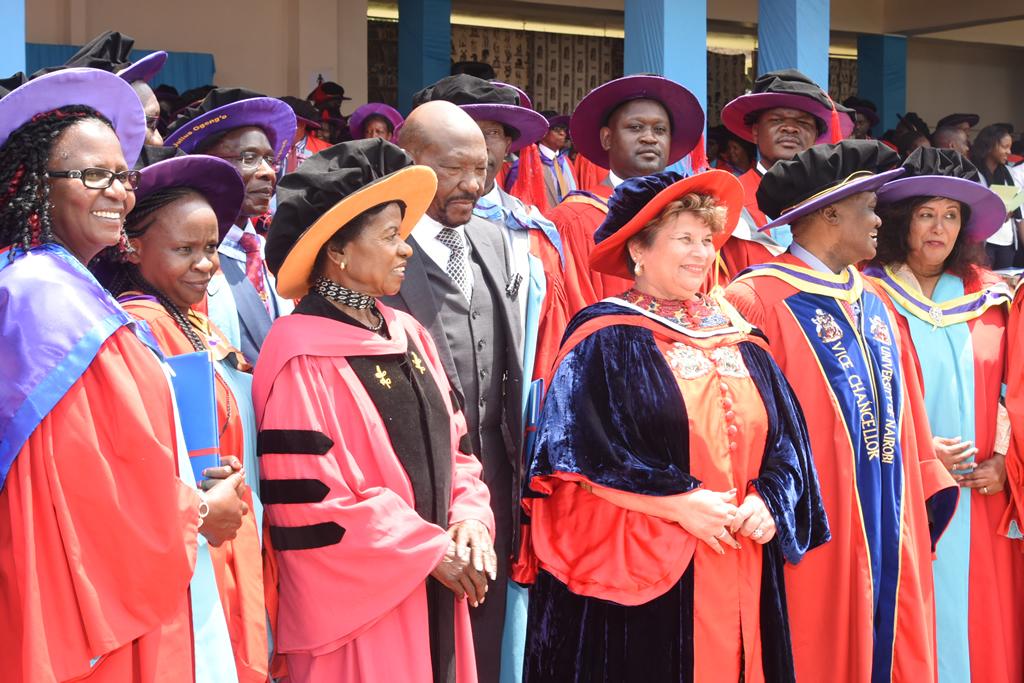
- Hillary Muhalya examines why Kenya’s substantial pool of doctorate holders has not translated into a similarly large professoriate.
- He highlights research funding, workload, mentorship and promotion structures as critical influences on academic progression.
- Drawing lessons from four countries, he argues that Kenya needs a clearer and better-supported academic career ladder.
Kenya has built a substantial pool of doctorate holders, but the journey from PhD to professor remains a much narrower passage — raising questions about research funding, workload, mentorship, promotion systems and whether the country is doing enough to keep its academic ladder open.
Kenya’s universities employed 15,383 teaching staff in 2024, according to the Commission for University Education (CUE). Of these, 6,627 were lecturers, 2,144 senior lecturers, 919 associate professors and only 551 professors. Professors therefore represented about 3.6 per cent of the university teaching workforce.
A separate CUE dataset for 2022/23 recorded 6,318 university staff with doctorates, alongside 5,798 with master’s degrees and 2,257 with bachelor’s degrees.
The figures are from different reporting years and should not be treated as a same-year ratio. But they expose a question that goes deeper than arithmetic.
What happens between earning a PhD and reaching the professoriate?
That question matters because a doctorate is a qualification, while professorship is a senior academic rank. The possession of one does not automatically confer the other.
The real story is therefore about academic mobility — how effectively a university system moves people from one level of expertise and responsibility to the next.
CUE’s 2024 figures show a university workforce heavily concentrated in the middle.
There were more than 6,600 lecturers but fewer than 1,000 associate professors and 551 professors. At the lower end, tutorial fellows stood at 3,119 and graduate assistants at 604. CUE also recorded a rise in adjunct academic staff from 379 to 758 between 2023 and 2024.
The commission itself notes that lecturers remain the largest academic rank and describes the decline in tutorial fellows and graduate assistants as a potential concern for future academic talent and succession planning.
That is important.
A university cannot think only about today’s professors. It must continuously develop the academics who will become tomorrow’s professors, researchers, supervisors and academic leaders.
The pipeline therefore matters as much as the destination.
The bottleneck begins after the doctorate
The assumption that a PhD should naturally lead to professorship misses how academic careers actually work.
Across established university systems, senior academic rank normally requires a sustained record of research, peer-reviewed publication, teaching, postgraduate supervision, academic leadership and wider scholarly contribution.
The doctorate proves advanced academic training.
It does not, by itself, prove that an individual has built the body of scholarship and academic leadership normally expected of a professor.
That distinction explains why thousands of doctorate holders can coexist with a much smaller professoriate.
But it does not answer the more difficult question: whether talented academics are being given adequate opportunities to progress.
That is where Kenya needs to look more closely.
America: the ladder is explicit, but it is still competitive
The United States provides one of the clearest examples of a structured academic ladder:
Assistant Professor → Associate Professor → Professor.
The American academic system has historically been closely associated with tenure-track appointments. Early-career academics are expected to build records in areas such as research, teaching and service before undergoing rigorous review.
Importantly, reaching associate professor does not automatically mean reaching full professor.
The American system therefore recognises academic progression as a sequence of milestones rather than treating the PhD as the final qualification needed for senior academic leadership.
That distinction is relevant to Kenya.
If the country wants more professors, simply producing more PhD holders is insufficient. The system also needs the conditions under which doctorate holders can build the research, teaching and leadership records required for advancement.
Britain: contribution matters, not simply seniority
Britain takes a more institution-specific approach.
Universities establish their own promotion frameworks, with academic careers commonly moving through positions such as lecturer, senior lecturer or reader, associate professor and professor.
The crucial point is that progression is based on evidence of contribution.
At UCL, for example, academic promotion considers areas including education, research, enterprise and external engagement, and institutional citizenship.
This makes an important argument for Kenya.
Years spent holding a PhD cannot by themselves be a substitute for academic achievement.
But the reverse is equally important.
If universities demand increasingly sophisticated research and scholarly output, they must provide academics with reasonable access to the time, facilities, mentorship and funding required to produce that output.
A promotion system without an enabling research environment can become a gate rather than a pathway.
Singapore: different academics can follow different tracks
Singapore offers another lesson.
The National University of Singapore operates Tenure Track, Educator Track and Practice Track appointments. NUS describes these as different pathways supporting research, education and professional or leadership expertise.
This matters because not every excellent academic is identical.
One scholar may excel primarily in research.
Another may have exceptional teaching expertise.
Another may bring extensive professional and industry experience.
Instead of forcing every academic into exactly the same model of success, differentiated pathways can allow institutions to recognise different forms of contribution.
NUS also advertises tenure-track appointments with fixed contracts of up to seven years and, in some programmes, start-up research support for new faculty establishing independent research programmes.
The lesson for Kenya is not that Singapore’s system should simply be copied.
It is that career architecture matters.
A young academic needs to know which road leads where, what is expected along the way and what institutional support exists to make the journey possible.
Finland: make the route demanding but predictable
Finland provides perhaps the clearest illustration of this principle.
The University of Helsinki has a four-level academic career model beginning with doctoral researchers and postdoctoral researchers and extending through university lecturers, researchers and tenure-track assistant and associate professors to professors and research directors.
Its tenure-track system has three principal stages:
Assistant Professor → Associate Professor → Full Professor.
Assistant and associate professorships are normally fixed-term positions of three to five years, with defined reviews before progression. The university describes the model as providing a clear and predictable route towards professorship.
The assessment is comprehensive.
It includes research qualifications, publications, teaching and supervision, academic engagement and competitive research funding. For full professorship, the university also considers research leadership, doctoral supervision, international scholarly work and academic leadership.
That offers Kenya a useful distinction:
A difficult ladder is not necessarily a bad ladder; an unclear ladder is a different problem.
Academic standards should remain high. But academics should also understand what the institution expects and how they can progress.
Kenya’s real problem is bigger than 551 professors
The temptation is to look at the 551 professors and conclude that Kenya simply needs more people at the top.
That would be too simplistic.
The more important question is whether the entire academic ecosystem is functioning well enough to convert qualifications into knowledge, research, innovation and leadership.
Are young academics being mentored?
Do they have access to research grants?
Do universities have adequate laboratories, databases and research facilities?
Can lecturers balance teaching and research?
Are postgraduate supervisors adequately supported?
Are publication requirements realistic in fields where research is expensive or slow?
Are promotion criteria transparent and consistently applied?
Are universities developing researchers early enough to create a sustainable succession pipeline?
These questions go beyond titles.
They go to the productive capacity of the university itself.
The research-time paradox
The academic is expected to teach.
The academic must assess students.
The academic may supervise master’s and doctoral candidates.
The academic may serve on committees.
The academic may carry administrative responsibilities.
And at the same time, the academic is expected to publish research, attract grants, build international networks and establish a scholarly reputation.
That produces an obvious tension.
The university needs the lecturer’s time for teaching, while promotion requires the lecturer’s time for research.
If teaching and administration consume most of an academic’s working time, research can become something pursued after everything else has been completed.
But research rarely works that way.
Serious research requires uninterrupted time, resources, collaboration and repeated intellectual effort.
This is one reason differentiated academic tracks can matter.
Singapore’s NUS explicitly separates tenure, educator and practice tracks, recognising different forms of academic contribution.
Finland’s Helsinki model, meanwhile, explicitly builds research into its tenure-track pathway while assessing teaching and supervision alongside research.
Kenya can therefore ask a difficult but necessary question:
Does its academic career structure give researchers enough room to become researchers?
The pipeline begins in primary school
The professoriate cannot be separated from the education system below it.
The future professor begins as a child learning to read, write, count, question and investigate.
The pathway is cumulative:
Foundational learning → secondary education → undergraduate study → master’s → PhD → early academic career → senior academic ranks → professoriate.
Failure at one level reduces the pool available at the next.
A learner who does not acquire strong foundational skills may struggle later.
A secondary school student who does not progress to university cannot enter the academic research pipeline.
A university graduate who cannot access postgraduate education cannot become a doctoral researcher.
A master’s graduate who cannot secure funding, supervision or an appropriate research environment may never reach the PhD stage.
And a PhD holder who cannot secure research opportunities, publication support or a viable academic position may never reach the professoriate.
This means the 551 professors should not be viewed in isolation.
They are the final visible point of a much larger human-capital pipeline.
This is where upward mobility becomes important
There is also a broader social argument.
Upward mobility is often described as though individual ambition alone determines how far someone rises.
It does not.
Ambition matters. Ability matters. Discipline matters.
But opportunity matters too.
So do institutions, mentorship, networks, capital, access to information and the availability of positions.
This applies to both wealth and academia.
A person who has risen from modest circumstances to extraordinary wealth may have travelled through opportunities that were unavailable to others.
Likewise, a professor who has successfully navigated the academic system possesses experience, networks and institutional knowledge that a junior lecturer may not yet have.
That does not justify assuming that wealthy people lack empathy or that professors disregard junior academics.
The more defensible argument is structural:
People at the top have a greater capacity to influence whether the ladder remains open.
That is why mentorship matters.
It is why research collaboration matters.
It is why senior scholars supervising doctoral candidates matters.
It is why established researchers helping younger academics understand grant applications, publishing, conferences and international research networks matters.
And it is why universities must build institutions that do not depend entirely on individual goodwill.
A university can have highly qualified people at the top while becoming increasingly difficult for the next generation to enter.
That would create a succession problem.
If junior academics cannot find research opportunities, if postgraduate training becomes unaffordable, if research funding remains scarce, if publication becomes prohibitively expensive or if promotion pathways become opaque, the country risks creating a system in which academic advancement depends increasingly on factors beyond scholarly ability.
That is precisely where the debate should move.
Not:
Why aren’t all PhD holders professors?
But:
What barriers prevent capable PhD holders from progressing, and which of those barriers are necessary standards and which are avoidable institutional constraints?
That is a much more consequential question.
Kenya should learn from the differences, not copy the systems
America, Britain, Singapore and Finland do not offer one perfect model.
They operate in different economies, cultures and higher-education environments.
But their systems demonstrate several principles worth examining.
America shows the importance of clearly defined stages of academic progression.
Britain demonstrates how universities can create structured promotion frameworks around different forms of academic contribution.
Singapore shows the potential of differentiated academic tracks and institutional support for research and teaching.
Finland demonstrates how a demanding academic pathway can be accompanied by explicit milestones, individual criteria and transparent progression towards professorship.
Kenya does not need to reproduce any of these models wholesale.
But it should ask whether its own system is sufficiently clear, adequately resourced and deliberately designed to produce the next generation of academic leaders.
The professor should not be the end of the ladder
The deepest lesson from the numbers is that education policy cannot stop at producing graduates.
Nor can university policy stop at producing PhD holders.
The country needs a continuum.
Children must acquire strong foundational skills.
Schools must prepare learners for advanced study.
Universities must produce strong undergraduate and postgraduate programmes.
Doctoral students must receive quality supervision.
Early-career researchers must obtain opportunities to build independent research profiles.
Lecturers must have reasonable space for research alongside teaching.
Senior academics must mentor those coming behind them.
And promotion systems must reward genuine academic contribution while remaining transparent and rigorous.
Only then does the PhD become more than a certificate.
It becomes part of a national knowledge-production system.
From climbing the ladder to strengthening it
This brings the argument back to the original numbers.
Kenya had 6,318 doctorate holders in the 2022/23 qualification dataset, but the later 2024 workforce data recorded 551 professors. Those figures do not represent a simple failed promotion equation. They represent different stages, different datasets and different concepts.
But together they expose something important.
Kenya has people who have climbed a long way. The question is whether the system beneath them is strong enough to help others climb as well.
That is the real meaning of academic mobility.
A professor should not merely represent the end of one person’s journey.
A professor can also be a bridge for the next generation.
A university should not merely employ academics.
It should cultivate them.
And an education system should not merely produce qualifications.
It should create pathways through which knowledge, opportunity and leadership can be transmitted from one generation to another.
The lesson from America, Britain, Singapore and Finland is not that Kenya needs to manufacture more professors.
It is that academic excellence requires a ladder with visible steps, credible standards, adequate resources and enough room for the next person to climb.
Kenya’s 551 professors therefore tell only part of the story.
The more important statistic may ultimately be how many capable young scholars are coming behind them — and whether the country is building an academic system in which those scholars can realistically rise.
Because education is not only about who reaches the top.
READ ALSO: Parents demand transfer of Cheramgoi Comprehensive School head over alleged mismanagement
It is also about whether the people at the top help keep the ladder standing.
By Hillary Muhalya
Get more stories from our website: Education News
To write to us or offer feedback, you can reach us at: editor@educationnews.co.ke
You can also follow our social media pages on Twitter: Education News KE and Facebook: Education News Newspaper for timely updates.
>> Click here to stay up-to-date with trending regional stories