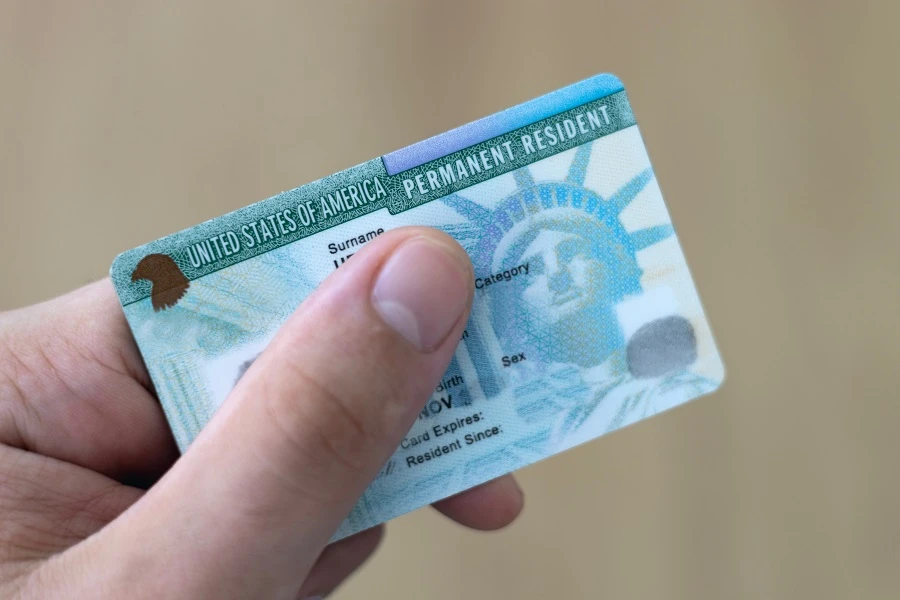
- Green Card holders can petition for spouses and qualifying unmarried children, but their family-sponsorship rights are limited.
- Hillary Muhalya explains why parents, siblings and married children require different immigration circumstances.
- For Kenyan families, understanding the distinction between permanent residence and citizenship can prevent costly assumptions.
For thousands of Kenyans with relatives living in the United States, the Green Card is often viewed as the ultimate ticket to family reunification.
But there is a major catch.
A U.S. Green Card does not give a permanent resident the same family-sponsorship powers enjoyed by an American citizen.
This distinction can come as a shock to families that have spent years planning to move parents, brothers, sisters or other relatives to the United States.
Under U.S. family-based immigration rules, lawful permanent residents that qualifies one for the Green Card have a much narrower group of relatives they can petition for.
And for Kenyans with family members already settled in America, knowing exactly who qualifies—and who does not—can save them from expensive mistakes and unrealistic expectations.
A lawful permanent resident, commonly known as a Green Card holder, can generally petition for a spouse and qualifying unmarried children.
This includes an unmarried child below the applicable age threshold and an unmarried son or daughter who is 21 or older, although different preference categories and waiting periods apply.
The important point is that marital status and age can affect which immigration category applies.
A Green Card holder therefore cannot simply decide to sponsor any close relative because that person is a member of the immediate family.
The U.S. immigration system draws a sharp line between the rights of permanent residents and those of citizens.
The parents problem
For many Kenyan families, this is where the biggest surprise on the Green Card rules comes.
A Green Card holder cannot ordinarily petition for their parents to obtain permanent residence through the family-based categories available to U.S. citizens.
Parents fall into a category that requires the petitioner to be a U.S. citizen who is at least 21 years old.
This means a Kenyan who has obtained permanent residency cannot simply file a standard family petition and bring their mother or father permanently to America.
For families separated between Kenya and the United States, that restriction can be particularly difficult.
A son or daughter may have established a home, secured employment and obtained permanent residence in America, yet still lack the ability to sponsor their parents for permanent residence.
Another common misconception concerns siblings.
A Green Card holder cannot use their permanent-resident status to petition for a brother or sister for permanent residence.
Sibling immigration falls under a family-preference category available to qualifying U.S. citizens, rather than Green Card holders.
This creates a major difference between having permanent residency and becoming a citizen.
For someone hoping to bring an entire family from Kenya to America, the distinction can therefore be enormous.
Married children face another barrier in Green Card rules
There is another important restriction.
The family-preference categories available to Green Card holders cover unmarried children.
If a child is married, a Green Card holder cannot simply use the same family-based petition category to sponsor that child.
This is why families must examine the beneficiary’s exact circumstances before assuming that a petition can be filed.
Age, marital status and the immigration status of the sponsor can all influence eligibility.
A petition does not mean a Green Card tomorrow
Perhaps the most important message for families is that eligibility to file a petition does not automatically mean immediate immigration to America.
A family petition is only one part of the process.
Depending on the category, applicants may have to wait for an immigrant visa to become available. They must also satisfy other immigration requirements, including admissibility rules and documentation requirements.
Some family-preference categories have substantial waiting periods because the number of visas available each year is limited.
So a family should not interpret approval of a petition as a guarantee that the beneficiary will immediately board a flight to the United States.
This is where the story changes dramatically.
A permanent resident who later becomes a U.S. citizen can gain access to broader family-based immigration categories.
U.S. citizens who meet the applicable requirements can petition for their parents, spouses and qualifying children as immediate relatives. Citizens can also petition for certain other family members under preference categories, including siblings and married children.
That difference makes citizenship enormously important for immigrants whose long-term goal is to reunite with a wider circle of family members.
The Green Card may be a major milestone—but citizenship can open additional family-based immigration doors.
For Kenyans planning to reunite with relatives in America, the biggest mistake would be relying on social-media claims that reduce complicated immigration rules to a single sentence.
A relative saying, “I have a Green Card, so I can bring you to America,” may not have the complete picture.
The first question should be:
What is the sponsor’s immigration status?
Is the person a Green Card holder or a U.S. citizen?
The second question is:
What is the relationship between the sponsor and beneficiary?
Is it a spouse, unmarried child, parent, sibling or another relative?
The third question is whether that relationship falls into an available immigration category and whether other requirements are satisfied.
These details can completely change the outcome.
The big Green Card lesson for families
For families separated by thousands of kilometres, U.S. immigration rules can feel painfully complicated.
But the central distinction is relatively simple.
Green Card holders have family-sponsorship rights, but those rights are limited.
They can generally petition for their spouse and qualifying unmarried children.
They cannot simply use Green Card status to sponsor their parents or siblings, and married children do not fit into the family-preference categories available to permanent residents.
U.S. citizens, however, have significantly broader family-petition options.
That is why families should understand the difference between permanent residency and citizenship before making major financial or migration decisions.
For a Kenyan family separated by the Atlantic, one immigration-status change can determine whether a loved one remains thousands of kilometres away—or whether a legitimate pathway exists to reunite in America.
The Green Card opens the door to permanent residence. But when it comes to bringing the wider family to America, citizenship can open many more doors.
READ ALSO: Nairobi lawyer Joel Kyatha Mbaluka tops The Lawyer Africa’s 2026 commercial law rankings in Kenya
This article provides general information and should not be treated as individual U.S. immigration legal advice. Eligibility depends on the circumstances of each case and current U.S. immigration rules.
By Hillary Muhalya
Get more stories from our website: Education News
To write to us or offer feedback, you can reach us at: editor@educationnews.co.ke
You can also follow our social media pages on Twitter: Education News KE and Facebook: Education News Newspaper for timely updates.
>>> Click here to stay up-to-date with trending regional stories