- Kithinji Njeru traces UASU’s turbulent journey through government resistance, dismissals, strikes and eventual legal recognition.
- The union’s modern struggle intensified in the early 1990s as lecturers demanded collective representation and academic freedoms.
- Its eventual registration in 2003 transformed UASU into a powerful voice for Kenya’s public university academic staff.
For more than three decades, the Universities Academic Staff Union (UASU) has been at the centre of labour relations in Kenya’s public universities, fighting over pay, working conditions, academic freedom and the welfare of university lecturers.
But the union’s journey to becoming a legally recognised organisation was far from easy.
The history of organised representation for university academic staff stretches back to the 1960s, but the modern UASU struggle gathered momentum in 1992, when academic staff began renewed efforts to establish a common organisation through which university lecturers could collectively articulate their grievances.
Academics from Kenya’s pioneer public universities — the University of Nairobi, Moi University, Kenyatta University and Egerton University — became central to the renewed push.
On May 25, 1992, an application to register the Universities Academic Staff Union was submitted to the Registrar of Trade Unions.
Among the academics associated with the early initiative were Prof Korwa Adar, Dr Kilemi Mwiria, Prof Peter Kagwanja, Charles Namachanja, Dr Airo Akodhe, Eric Makokha, Churchill Kibisu and Nyaduwa Odhiambo.
Their attempt to establish the union, however, collided with the political realities of the time.
Government resistance and lecturers’ strike
The government of President Daniel arap Moi declined to recognise the organisation.
On November 24, 1993, the Registrar of Trade Unions formally rejected the application, arguing that the proposed union was being used for unlawful purposes and that its registration could prejudice peace, welfare and good order in the country.
Moi subsequently made it clear publicly that his government had no intention of registering UASU.
The rejection did not end the lecturers’ campaign.
Instead, it triggered one of the most prolonged confrontations between university academics and the government in Kenya’s history.
Academic staff at the four universities went on strike.
The industrial action dragged on for months, disrupting university education across the country and leaving thousands of students caught in the dispute.
The government responded with a hard line.
UASU officials were arrested and harassed, while some lecturers lost their jobs. Among those affected were academics who had been at the centre of the union’s formation.
Salaries were suspended in some cases, while dismissals and disciplinary action further intensified the confrontation.
For university lecturers, the dispute was no longer simply about the registration of a trade union. It had become a broader struggle over the right of academics to organise and negotiate collectively over their working conditions.
By 1994, however, the strike had lost momentum. Although resistance continued in some parts of the universities, the industrial action eventually came to an end.
The end of the strike did not mean the end of the union.
For nearly another decade, its supporters continued to pursue official recognition.
Mwiria pays price for union struggle
A significant figure in this history was Dr Kilemi Mwiria.
Mwiria, who served as UASU’s first Secretary General, paid a personal price for his involvement in the campaign for university staff rights. He lost his job at Kenyatta University after spearheading efforts to defend the interests of university employees.
But history would later take an unexpected turn.
The political transition of 2002 changed the environment in which UASU operated.
The defeat of KANU in the 2002 General Election and the coming to power of the National Rainbow Coalition government opened the way for the long-standing registration dispute to be resolved.
On May 2, 2003, UASU’s constitution was finally registered.
There was an extraordinary twist.
By the time the union received official recognition, Mwiria — once a university lecturer and one of the men at the centre of the original campaign — was no longer simply an academic fighting from outside government.
He was a Member of Parliament and became an Assistant Minister for Education.
The man who had once lost his university job while fighting for the rights of academic staff had eventually found himself inside the government machinery responsible for the education sector.
That development marked a remarkable full circle in the history of UASU.
From resistance to recognition
The universities that provided the foundation for the renewed union movement had produced an organisation that survived rejection, arrests, dismissals, prolonged industrial action and years of political resistance.
Its eventual registration in 2003 transformed UASU from an organisation struggling for government recognition into a legally recognised trade union capable of representing university academic staff through collective bargaining.
The battles, however, did not end with registration.
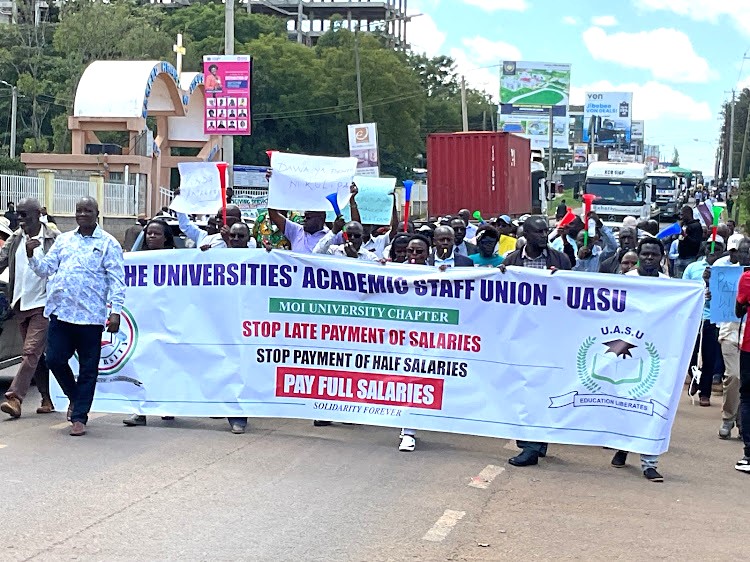
Over the years, UASU has remained a major player in negotiations over salaries and working conditions in public universities, periodically resorting to industrial action when talks with the government and university employers have broken down.
The strikes and negotiations that have characterised university labour relations in recent years therefore have a much deeper history.
Every time university lecturers invoke collective bargaining, negotiate a collective agreement or threaten industrial action, they are operating within a framework whose modern foundations were laid more than three decades ago.
The story of UASU is consequently not just the story of a trade union.
It is also a story of university academics who, in the early 1990s, attempted to create a collective voice at a time when organised labour and academic activism faced significant political restrictions.
Their attempt at recognition was rejected.
Their industrial action was confronted by the State.
Some lost their jobs.
Their leaders faced arrests and harassment.
Yet the idea survived.
Nearly 11 years after the 1992 application, UASU obtained legal recognition.
What emerged from the early 1990s push by academics eventually became one of the most influential voices in Kenya’s university sector.
And perhaps the most striking chapter in that journey remains the story of Mwiria — from a founding union official who lost his university job in the struggle for academic staff rights to an Assistant Minister for Education when the union finally secured recognition.
More than three decades later, the legacy of those early battles continues to shape the relationship between university lecturers, their employers and the government.
READ ALSO: Kapkatet community praised for swift response to Tengecha Boys dormitory fire
UASU’s history is, in many ways, a reminder that some of Kenya’s most consequential labour organisations were built not in boardrooms, but through years of confrontation, sacrifice and persistence.
Kithinji Njeru
Get more stories from our website: Education News
To write to us or offer feedback, you can reach us at: editor@educationnews.co.ke
You can also follow our social media pages on Twitter: Education News KE and Facebook: Education News Newspaper for timely updates.
>> Click here to stay up-to-date with trending regional stories