









In a move poised to reshape the landscape of public service employment in Kenya, Hon. Geoffrey Kiringa Ruku has thrown the weight of his office behind a bold proposal to transition public servants from the familiar terrain of permanent and pensionable employment to a system of renewable, performance‑based contracts. What began in bureaucratic corridors as a policy discussion has now erupted into a national conversation that cuts to the core of labour rights, governance reform, fiscal discipline, and professional security.
For generations, entering the Kenyan public service — whether as an administrator, accountant, health worker, engineer, or educator — meant something deeply reassuring: a permanent job safeguarded by statutory protections and a pension awaiting retirement at age 60.
This model was embedded not just in law, but in the psyche of public servants, offering stability, insulation from political interference, and predictability that allowed civil servants to plan their financial futures. In the education sector, for example, teachers have long relied on permanent terms as a foundation for stable lives — buying homes, supporting families, and securing retirement. That sense of security now appears set for a dramatic shift.
Hon. Ruku announced the proposal in late February 2026, during the launch of the Public Service Commission Strategic Plan 2025–2029. He revealed that his ministry is finalising a Public Service Transformation Policy that would see all civil servants employed on fixed‑term contracts — typically three to five years — with renewal tied to individual performance. Those who meet their contractual obligations would be offered renewed terms; those who fail to deliver would be required to exit the public service.
“What we’re proposing is a shift to contractual terms where employees must perform to expectations,” Ruku said. “If you perform properly, you get another contract. If you don’t meet the contractual basis, you look for another job.”
Ruku argues that the long‑held permanent and pensionable model has, over time, fostered a culture of entitlement, impunity, and laxity in several government units.
He pointed specifically to concerns such as absenteeism — noting that interns and younger civil servants often arrive promptly for work, while some senior officers do not. This, he suggested, is evidence of complacency arising from job security. For Ruku, a contract system tied to clear performance benchmarks would strengthen discipline, improve service delivery, and make government operations more responsive to citizens’ needs.
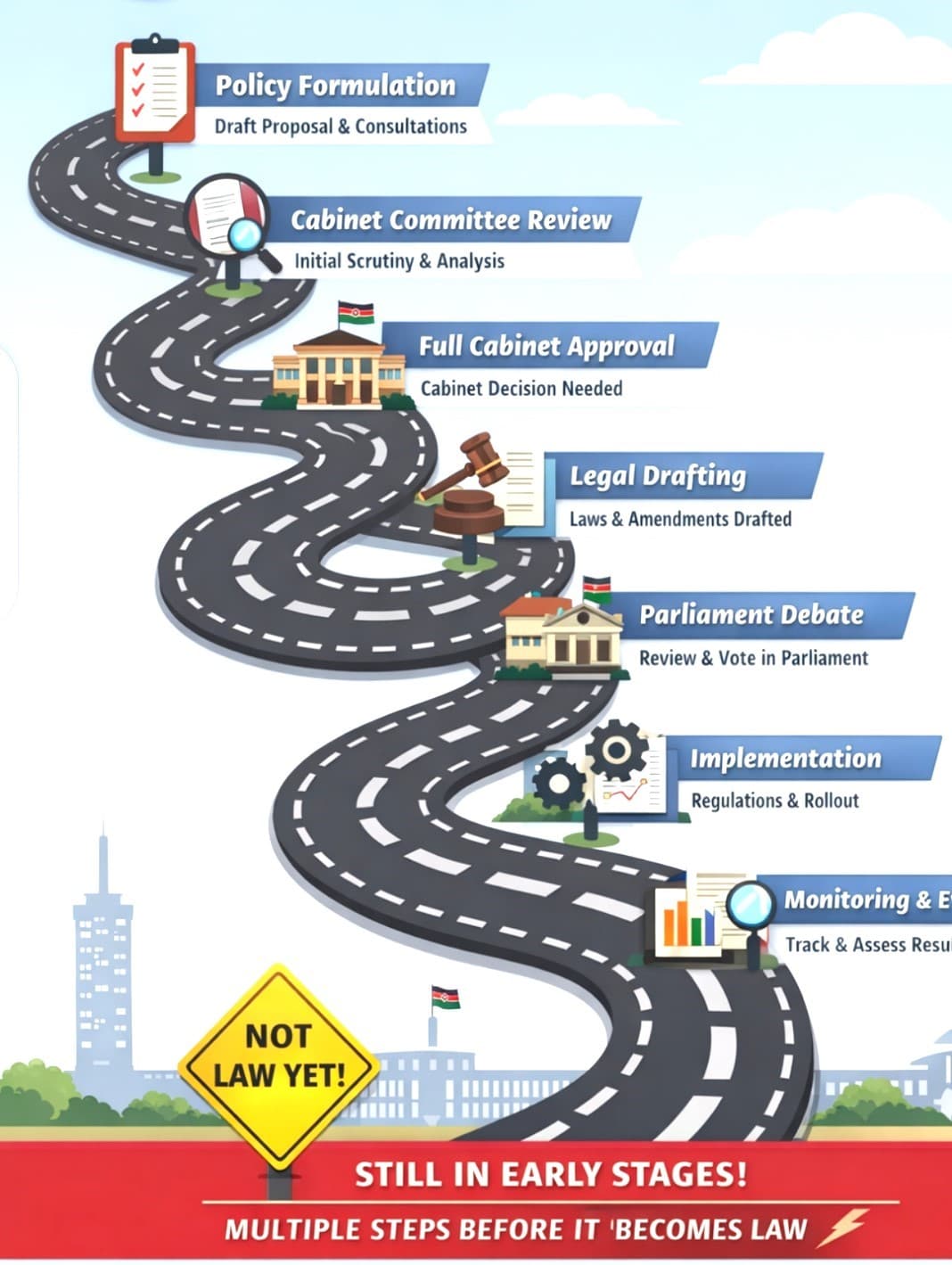
Yet, it is important to underscore that Ruku’s initiative is not yet law. As of early 2026, the proposal remains at the policy and consultative stage within the executive branch. First, the draft framework must pass through internal government review — beginning with technical assessments by a Cabinet committee tasked with scrutinising feasibility, legal implications, and alignment with existing public service and labour statutes. Ruku has confirmed that he will present the policy to this committee, with a view to then taking it before the full Cabinet for deliberation and approval.
Only after Cabinet approval can the policy proceed toward legal vetting and potential legislative action. This would involve drafting amendments to the Public Service Act and related employment laws to create legal authority for contract‑based terms.
Parliamentary committees — including those on public service, labour, and constitutional affairs — would then examine the proposed changes, hold public hearings, and determine whether to recommend the bill for full House consideration. The transition from policy proposal to enacted law — complete with regulations governing implementation, oversight, and dispute resolution — would likely take many months, if not longer, depending on political will, stakeholder engagement, and the state of public debate.
The proposal immediately raises complex legal questions. Under Kenya’s 2010 Constitution, all workers are entitled to fair labour practices, reasonable working conditions, and protection from arbitrary dismissal.
The Employment Act of 2007 allows fixed-term contracts but requires clear terms and safeguards, while the Public Service Act of 2019 entrenches permanent and pensionable employment for civil servants. Teachers, healthcare workers, and administrators currently rely on these protections not only for financial security but to exercise independent professional judgment. Any wholesale transition to contract terms would therefore require careful legal amendments and robust dispute-resolution mechanisms.
Globally, Kenya is not alone in grappling with the tension between permanent and contract employment. Countries in Europe, Australia, and North America have introduced fixed-term or performance-based contracts for select public service roles, though usually limited to senior, managerial, or specialist positions.
In the European Union, directives ensure that contract employees cannot be treated less favourably than permanent staff, and repeated renewals do not circumvent tenure protections. Many EU countries maintain permanent status for the majority of public servants while allowing contracts for leadership or project-based roles. For example, in Germany, public service contracts are often used for temporary specialist roles, while permanent employment remains the default for career civil servants.
In Australia and New Zealand, reforms have created performance-linked contracts for executives and heads of departments, but permanent status is maintained for most employees to protect job security. Public service commissioners oversee strict guidelines to ensure fairness in performance assessments, protecting employees from arbitrary dismissals.
International lessons on managing public servants
In Canada, permanent federal employees form the bulk of the public service, with contractual appointments used primarily for project-specific or short-term roles. Legislation ensures that contract workers enjoy comparable rights, including grievance mechanisms and employment standards.
In the United States, federal agencies employ a mix of permanent (tenured) civil servants and term or “at-will” appointments, particularly for policy advisors or special projects. While flexibility is prioritised for certain roles, permanent positions remain central to ensuring institutional knowledge and protecting against political influence.
Across Asia, countries like Japan and South Korea have introduced contract positions in administrative and technical roles, but tenure protections for core public service positions remain strong. Contract systems are usually framed as temporary solutions to manage workload surges or pilot new programs.
The International Labour Organisation (ILO) emphasises that flexibility should never undermine basic protections: workers on contract must enjoy comparable rights to permanent employees, including fair termination processes, benefits, and social protections. Kenya’s potential shift mirrors global debates on balancing flexibility, accountability, and job security. Lessons from abroad suggest that broad-based, blanket transitions from permanent to contract employment are rare; instead, most countries combine contracts with permanent employment, creating performance incentives while maintaining security for career staff.
Though public commentary has focused broadly on civil servants, reactions from Kenya’s teacher community are already emerging as a central battleground in the debate. Teachers — particularly those represented by the Kenya National Union of Teachers and the Kenya Union of Post-Primary Education Teachers — have long viewed permanent and pensionable employment not only as a job condition but as a critical professional safeguard. Unions have historically fought to secure permanent terms for teachers and have successfully negotiated significant gains, including improved salary scales under the Collective Bargaining Agreement 2025–2029.
Union leaders have previously pushed for converting long-standing contract teachers — including interns — into permanent roles, highlighting the importance of stability for educators tasked with shaping the nation’s future. Teachers have voiced anxiety over delayed promotions and systemic delays in contract renewals and confirmations, viewing these as ongoing stressors that undermine morale. Against this backdrop, the idea of a wholesale shift to renewable contracts has stirred unease. Many educators question whether performance evaluations can adequately measure the multifaceted work of teaching, which often cannot be captured in narrow quantitative metrics. They fear that contract renewals might be influenced by administrative or political pressures, rather than objective assessment. The prospect of losing permanent status — and with it long-earned benefits — has raised concerns about job security, pension rights, and the professional dignity of teachers who have dedicated decades to classroom service.
Union leaders have yet to release detailed responses specifically on Ruku’s contract proposal, but past engagements with the government reveal a pattern of resistance to arrangements perceived as eroding tenure protections. Whether through collective action, legal challenges, or political negotiation, teachers are preparing to assert their interests as the debate intensifies.
Supporters of Ruku’s proposal point to systemic challenges in the public sector that they argue demand a rethink of employment terms. They contend that renewable contracts, linked to measurable performance targets, would stimulate accountability and reduce inefficiencies that have plagued certain government units. From this perspective, contract-based employment could encourage a results-oriented culture rather than one anchored in tenure alone, enable the government to reward excellence and address chronic underperformance, and provide opportunities to restructure and modernise the workforce to respond to technological and demographic changes.
Proponents also cite fiscal pressures. Kenya’s public wage bill and pension obligations consume a significant portion of national revenue. A shift to renewable contracts, they argue, could offer flexibility in workforce planning and potentially reduce long-term pension liabilities, freeing resources for service delivery and infrastructure. Senators, economists, and some policy analysts have noted these concerns, suggesting that addressing inefficiencies should be part of a broader governance strategy.
Opposition to the proposal has also arisen from various quarters, based largely on fears that contract terms could undermine job security, weaken institutional independence, and expose civil servants to arbitrary dismissal. Critics argue that security of tenure is a constitutional right embedded in labour law, and that eroding this principle could set a dangerous precedent. For teachers in particular, permanent employment has offered not just economic stability but a guarantee of independent professional judgment. There are concerns that contractual evaluations could disproportionately emphasise short-term outcomes over long-term educational impacts, penalising experienced educators for factors beyond their control — such as classroom size, resource shortages, or socioeconomic barriers affecting student performance.
Legal scholars and union leaders have hinted that any attempt to circumvent existing protections without broad consultation and statutory clarity could face constitutional challenges. The requirement for consultations, transparent performance criteria, and independent dispute-resolution mechanisms will be crucial to prevent the misuse or abuse of the new system.
Ruku’s proposal is not an isolated idea. Similar discussions have surfaced in past administrations, and debates around contract employment versus permanent terms have periodically emerged in public policy circles. In 2024, a previous government effort to introduce contract terms for civil servants sparked significant pushback from county leaders and worker representatives, who described the proposal as a threat to labour rights. What sets the current proposal apart is its scale and timing. With over one million civil servants in the national workforce, any shift in employment terms would be consequential. The debate has quickly drawn attention from civic organisations, economists, legal experts, and ordinary citizens, each weighing the trade-offs between security and performance.
As the policy navigates through Cabinet review, legal vetting, and potentially parliamentary scrutiny, the key question will be whether reforms can strike a balance that preserves core protections while enhancing accountability. Hon. Ruku has sought to frame the conversation not as an attack on workers but as an evolution of governance. Yet the proposal’s success will depend on robust public engagement, clear definitions of performance standards, independent oversight, and legal safeguards that protect civil servants from capricious dismissal or unfair evaluation.
READ ALSO: Government announces civil servants’ pay rise under new SRC framework
For teachers and other civil servants, the months ahead are a test of collective voice, negotiation, and informed advocacy. The contours of this debate will shape not only employment terms but the very ethos of public service in Kenya. Whether the contract model ultimately becomes law or remains a contested vision, one fact is clear: Hon. Geoffrey Ruku’s initiative has ignited a critical national discourse on the future of public service — a discourse that must navigate constitutional guarantees, labour law protections, and global best practices to balance flexibility, efficiency, and fairness.
By Hillary Muhalya
You can also follow our social media pages on Twitter: Education News KE and Facebook: Education News Newspaper for timely updates.
>>> Click here to stay up-to-date with trending regional stories
>>> Click here to read more informed opinions on the country’s education landscape




Reader Discussion (0)
Sign in to comment