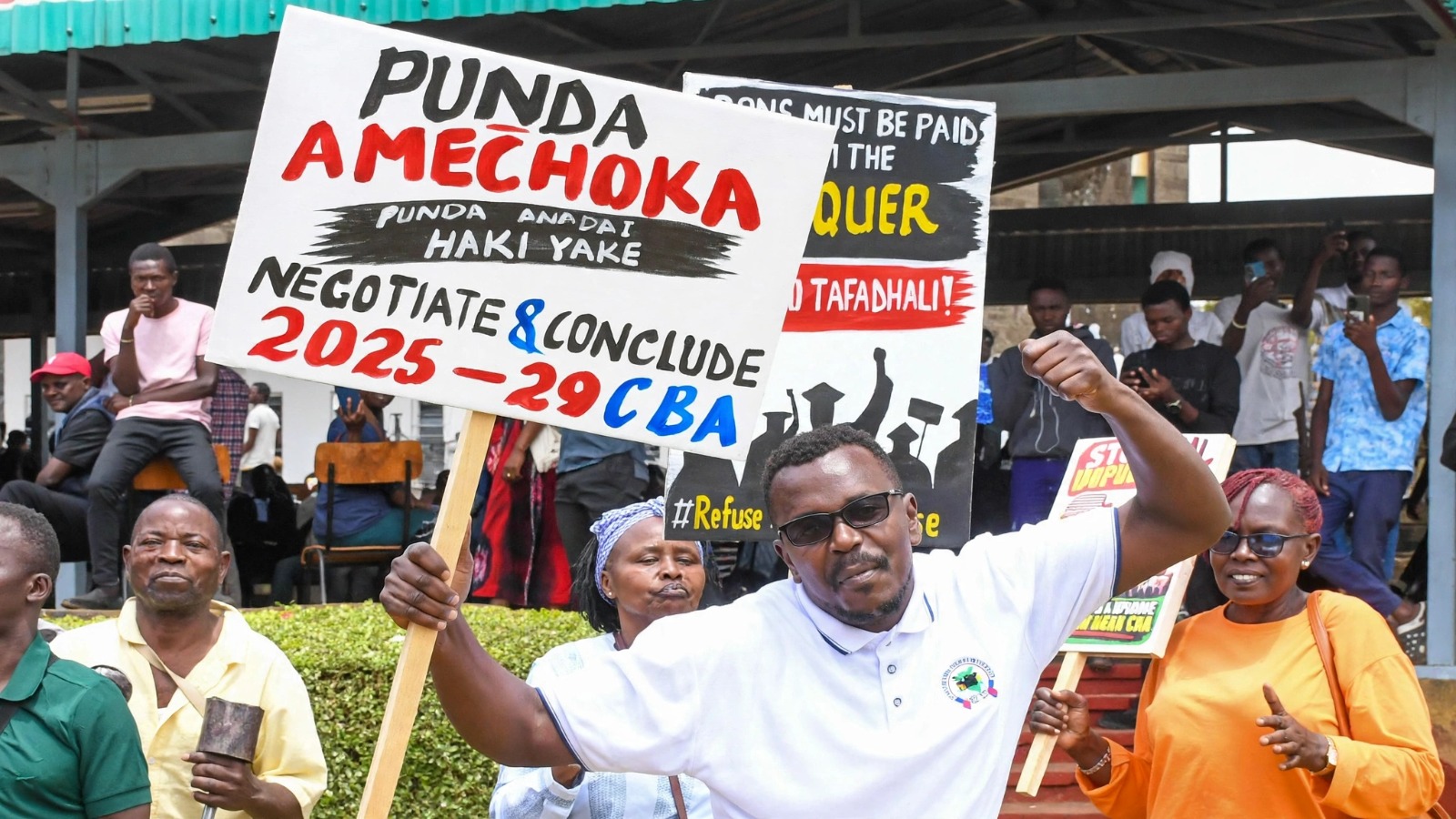
- Less than a year after ending a 49-day strike, public university lecturers have returned to industrial action.
- Hillary Muhalya examines previous CBA commitments, the billions involved and lecturers’ latest salary and allowance demands.
- At the heart of the dispute is whether negotiated agreements can be adequately funded and implemented within agreed timelines.
Kenya’s public universities have once again been thrown into an industrial dispute, with lecturers withdrawing their services after negotiations over the 2025–2029 Collective Bargaining Agreement (CBA) failed to produce a settlement.
But the latest strike is about far more than a salary increment. It is a test of whether agreements reached between the Government, university councils and academic staff can move beyond promises and become actual money, benefits and improved working conditions.
The latest strike is particularly significant because it comes less than a year after lecturers ended a 49-day strike following a Return-to-Work Formula signed in November 2025. That agreement was supposed to close old grievances, provide a framework for settling outstanding arrears and open the way for negotiations on the next CBA.
Instead, nearly a year later, lecturers are back on strike.
That raises the most important questions surrounding the dispute: What were lecturers promised, what has actually been delivered, what are they demanding now, and where does the money stand?
When the previous strike ended, one of the major commitments was the payment of approximately KSh7.9 billion in outstanding arrears under the 2017–2021 CBA.
The amount was to be paid in instalments, with the first tranche expected towards the end of 2025 and the balance by the middle of 2026.
The Return-to-Work Formula also provided a framework for negotiations on the 2025–2029 CBA, with the parties agreeing to conclude the negotiations within 30 days.
That deadline passed without a new agreement.
The dispute subsequently shifted from the implementation of the previous settlement to the financing and terms of the new CBA. The Universities Academic Staff Union (UASU) has maintained that the employer side failed to honour important commitments and delayed providing a financial proposal acceptable to the union.
The Government and university employers, however, have not presented themselves as having offered nothing. A financial proposal of approximately KSh9.76 billion has been put forward for the four-year 2025–2029 agreement.
This figure has caused considerable confusion and must be clearly separated from the lecturers’ salary demands.
KSh9.76 billion is not the total amount lecturers are demanding as salaries. It is the reported financial proposal from the employer side for the new CBA, which the union has rejected as inadequate. The lecturers’ demands comprise basic salary adjustments together with housing, commuter, risk, research and other employment benefits.
The salary figures have also been confused because different versions and stages of the proposal have circulated.
For the current 2026 dispute, the figures should be treated as a comparison between the existing salary structure and the latest reported union proposal.
A professor currently has a basic salary ceiling of about KSh345,816 per month, while the latest proposal seeks to push the highest notch to more than KSh580,144 by 2028/29.
For a senior lecturer, the current basic salary ceiling is about KSh238,221, while the proposed ceiling is approximately KSh399,644.
Earlier figures, including a proposed professor ceiling of KSh305,610, came from an earlier salary schedule and should not be mixed with the later 2026 figures without qualification.
It is therefore misleading to place KSh305,610 and KSh580,144 in the same salary table as though they were competing figures from the same current proposal.
The same caution applies to the lower academic grades, where earlier proposal schedules contained figures that should not be presented as the final 2026 demand without qualification.
The current dispute is consequently better understood through the latest reported senior-grade figures rather than by combining different versions of the proposal.
Salaries are only part of the demands
But basic salary is only one part of the lecturers’ demands.
The union is also seeking enhanced housing allowances. Under the latest proposal, housing allowance for professors is placed at approximately KSh116,028 per month, compared with the existing KSh73,715. Associate professors are proposed to receive about KSh104,426, senior lecturers KSh92,822 and lecturers KSh87,020.
The demands also extend to commuter and car-related benefits, risk allowances and research support. A commuter allowance of KSh60,000 per month has been proposed for academic grades, except part-time staff, while lecturers working in environments considered to carry occupational risks have sought additional compensation.
Research is another major component.
University lecturers are not employed merely to teach undergraduate classes. Their responsibilities include postgraduate supervision, academic research, publication, innovation, community engagement, curriculum development and professional service.
The proposal for substantial research grants therefore reflects the union’s broader argument that remuneration must take account of the academic and research responsibilities carried by university staff.
This is where the dispute becomes bigger than a question of whether lecturers deserve a particular percentage salary increase.
It is about how Kenya intends to finance and sustain its public university system.
The Government has to balance employees’ demands against available public resources and competing national priorities. University councils have to manage institutional budgets and employment obligations. The unions have a responsibility to negotiate demands that can ultimately be funded and implemented. And lecturers have a legitimate interest in ensuring that previously negotiated commitments are honoured.
The current confrontation has emerged because those interests have not been successfully reconciled.
There is also an important distinction between arrears from the previous CBA and new remuneration under the 2025–2029 CBA.
The approximately KSh7.9 billion arrears related to obligations under the 2017–2021 agreement. They should not be added to the KSh9.76 billion proposal and presented as though they are one single salary demand under the current CBA.
Similarly, the proposed salary ceiling of more than KSh580,144 for a professor should not be described as the amount the Government is being asked to spend on every professor. It is a monthly basic salary ceiling for an individual employee at the relevant grade and notch.
The total cost of a CBA depends on the number of employees, their grades and notches, allowances, arrears, pension obligations and other benefits included in the agreement.
This distinction matters because public debate over the strike can easily become distorted when individual salary figures, total CBA costs and historical arrears are combined.
Beyond the billions, a question of trust
Yet behind all these numbers lies a much more serious issue: trust.
A Return-to-Work Formula is supposed to restore confidence after industrial action. It should provide a clear path from dispute to implementation. When an agreement is followed by delayed implementation and another unresolved CBA, confidence in the bargaining process inevitably comes under pressure.
That is why the question of “who is failing whom?” cannot fairly be answered by blaming only lecturers or only the Government.
There has been an inability to conclude the new CBA within the timeframe anticipated after the November 2025 settlement. The employer side has a responsibility to provide credible financing and honour negotiated commitments. The unions, on the other hand, have a responsibility to engage constructively and negotiate within the realities of public financing.
The greatest losers are students.
Every prolonged lecturers’ strike disrupts lectures, examinations, research supervision, academic calendars, postgraduate programmes and graduation schedules. Students who have paid tuition, accommodation, transport and other expenses can find themselves unable to progress academically through no fault of their own.
For parents and guardians, another strike creates uncertainty. For universities, it creates administrative and financial pressure. For the country, it raises questions about the stability of an institution expected to produce the professionals, researchers and innovators needed for national development.
Kenya therefore needs to move beyond the recurring cycle of strike, negotiations, promises, return-to-work agreement and another strike.
The solution is not simply to announce another figure.
The parties need a CBA process in which every demand is transparently costed, every commitment has an identified funding source, implementation dates are realistic and both sides can be held accountable for what they sign.
Lecturers need predictable remuneration and working conditions. Universities need sustainable financing. Government needs fiscal discipline. Students need uninterrupted learning.
All four interests have to coexist.
The real test of the 2025–2029 CBA will therefore not be whether one side produces the bigger figure or wins the loudest argument.
It will be whether the final agreement is negotiated, signed, funded and actually implemented.
Until that happens, Kenya’s public universities risk remaining trapped in a cycle where old promises become new grievances, new negotiations become new strikes and students repeatedly pay the highest price.
The fundamental question is no longer simply: How much should a lecturer earn?
READ ALSO: TSC to roll out new CPG in July next year, give teachers classroom or administration career options
It is whether Kenya can build a university labour-relations system in which an agreement means what it says—and is delivered when it is due.
By Hillary Muhalya
Get more stories from our website: Education News
To write to us or offer feedback, you can reach us at: editor@educationnews.co.ke
You can also follow our social media pages on Twitter: Education News KE and Facebook: Education News Newspaper for timely updates.
>> Click here to stay up-to-date with trending regional stories