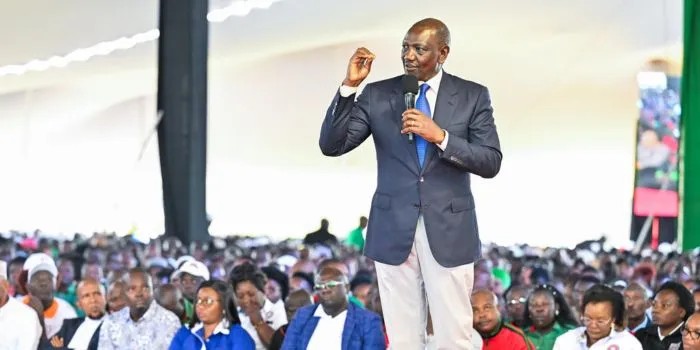
- President William Ruto will address teachers at World Teachers’ Day celebrations amid continuing debate over key welfare commitments.
- Teacher recruitment and promotions have recorded progress, while unions continue pursuing housing, retirement and special-needs teacher commitments.
- Hillary Muhalya examines what teachers will be listening for when the President takes the stage at Kasarani.
President William Ruto will walk into a room of teachers on Monday carrying more than a ceremonial message.
He will be addressing a profession that has benefited from major government interventions in recent years, but which continues to demand answers on promotions, retirement benefits, housing, special-needs teachers and the future of collective bargaining.
The timing could hardly be more significant.
As Kenya prepares to mark World Teachers’ Day on October 5, TSC Acting Chief Executive Officer Evaleen Mitei on Friday brought together the leaders of the country’s major teacher unions to finalise preparations for the national celebrations in Nairobi.
KNUT Secretary General Collins Oyuu, KUPPET Secretary General Akelo Misori and Chairman Omboko Milemba, together with KUSNET Secretary General James Torome, met Mitei at TSC headquarters.
Their immediate task was to coordinate the celebrations.
But Monday’s event is likely to carry a much bigger conversation.
Teachers want their contribution recognised. They also want government commitments translated into tangible outcomes.
The government has several achievements to place on the table.
More than 100,000 teachers have been recruited since 2022, helping expand the teaching workforce and address staffing gaps in public schools.
Funding for teacher promotions has also increased, enabling TSC to undertake promotion exercises involving thousands of teachers who had remained in the same grades for extended periods.
The introduction of a new medical scheme has also changed the welfare landscape, although teachers have expressed differing views about its performance compared with the former AON Minet arrangement.
These are significant developments.
But they do not close the conversation.
For teachers, some of the most consequential questions remain unresolved. Recent reporting on commitments made during Ruto’s September 2025 meeting with teachers shows unions are still seeking implementation of pledges concerning promotions, affordable housing, special-needs teachers and the CBA.
At the centre of the special-needs education debate is the commitment to promote SNE teachers by one grade. KUSNET has continued to pursue the issue, arguing that specialised teaching responsibilities deserve corresponding recognition in career progression.
The CBA remains another point of interest.
A commitment had been made to reduce the implementation period from four years to two. Yet the 2025–2029 CBA remains a four-year agreement, with its second phase implemented in July 2026.
For teachers and unions, the question is therefore whether future negotiations will take place under a shorter and more responsive framework.
Housing is equally important.
Teachers were previously promised that 20 per cent of Affordable Housing units would be allocated to them. The implementation of that commitment remains an issue the profession continues to watch.
Retirement benefits in focus
But perhaps no welfare issue carries greater emotional weight than retirement benefits.
A teacher who has spent decades in the classroom expects retirement to mark the beginning of a new chapter — not a prolonged wait for benefits earned through years of public service.
The President had promised faster processing of retirement benefits. Continued concerns about delays have kept the matter alive within the profession.
This is where Monday’s celebrations acquire their wider significance.
World Teachers’ Day traditionally provides an opportunity to honour educators for their contribution to children, communities and national development.
This year, however, the occasion also places the government’s relationship with teachers under a brighter spotlight.
Ruto is expected to preside over the national celebrations at Kasarani Indoor Arena on Monday, October 5.
The question is not whether the government has done anything for teachers.
It has.
The question is how the progress already made relates to concerns that continue to affect the profession.
Thousands recognised
And that conversation will unfold against a backdrop of recognition.
TSC’s awards framework provides 16,071 award slots across the different stages of the selection process, beginning with 13,728 slots at the sub-county level. The figure does not represent 16,071 separate teachers because successful nominees progressively advance to county, regional and national stages. The awards recognise contributions spanning early-years education, early career development, innovation and ICT integration, sustainable development, inclusive education, school leadership, mentorship, child protection and resilience.
Teachers with disabilities who have demonstrated professional leadership and resilience are also among those targeted for recognition.
The awards send an important message: teaching is not simply about standing before a classroom and delivering a lesson.
It involves mentoring children, protecting learners, embracing technology, supporting vulnerable pupils, leading institutions and continuing to work under difficult circumstances.
Yet recognition cannot substitute for professional welfare.
A trophy cannot replace a delayed retirement benefit. An award cannot resolve an outstanding career-progression issue. A ceremony cannot by itself deliver housing opportunities or change the structure of collective bargaining.
What happens after the speeches?
That is why Mitei’s engagement with union leaders is significant.
The TSC and teacher unions often confront one another over salaries, promotions, working conditions and professional policy. Their cooperation in preparing World Teachers’ Day demonstrates that there are moments when employer and employees can occupy the same platform.
The harder conversation begins when the speeches end.
For Mitei, the immediate responsibility is to deliver a well-organized national celebration that recognises teachers across the country.
For the unions, Monday offers a national platform to keep unresolved issues before government.
For teachers, it offers a chance to listen.
They will hear what has been achieved.
They will hear what government intends to do next.
And, most importantly, they will be looking for clarity on commitments that have yet to reach the classroom or the teacher’s household.
The real measure of World Teachers’ Day may therefore extend beyond the applause, awards and speeches.
READ ALSO: Court orders Maasai Mara University to pay 19 former lecturers Sh10.19 million
It will be measured by what follows after October 5.
By Hillary Muhalya
Get more stories from our website: Education News
To write to us or offer feedback, you can reach us at: editor@educationnews.co.ke
You can also follow our social media pages on Twitter: Education News KE and Facebook: Education News Newspaper for timely updates.
>> Click here to stay up-to-date with trending regional stories