- Kenya must treat AI literacy as a core part of modern education, aligning it with International Literacy Day and UNESCO’s Digital Learning Week 2026.
- MoE should develop a national AI literacy framework aligned with the CBC and UNESCO’s competency frameworks, with strong emphasis on teacher training and equitable access.
By Wafula Meshack
As the world marked International Literacy Day on September 8, another important global conversation was taking place, trying to understand how education must respond to the rise of artificial intelligence. For Kenya, the two conversations should not be separated.
International Literacy Day reminds us that the ability to read, write, understand and communicate is fundamental to human development. But literacy itself is evolving. In an increasingly digital and AI-driven world, being literate must also mean having the ability to understand, question, evaluate and responsibly use the technologies shaping our lives.
That is why Kenya must begin treating AI literacy as a critical component of modern education. The timing could not be more appropriate. From September 8 to 11, UNESCO is hosting Digital Learning Week 2026 at its headquarters in Paris, bringing together education leaders and stakeholders to examine the transformation of education in the age of artificial intelligence. This year’s theme, “Education in the Age of AI: Facts, Frictions, Frontiers,” focuses on the challenges and opportunities AI is creating for education systems around the world.
The Global Employment Stakes
Kenya cannot prepare its children for the future with outdated tools and assumptions. As AI transforms business, government and education, the priority is no longer whether AI will enter classrooms, but whether learners and teachers will be equipped to use it wisely. The global employment landscape makes the urgency even clearer. The World Economic Forum’s Future of Jobs Report 2025, based on more than 1,000 employers representing over 14 million workers across 55 economies, found that 86 per cent of employers expect AI and information-processing technologies to transform their businesses by 2030. AI and big data are also among the fastest-growing skills in demand.
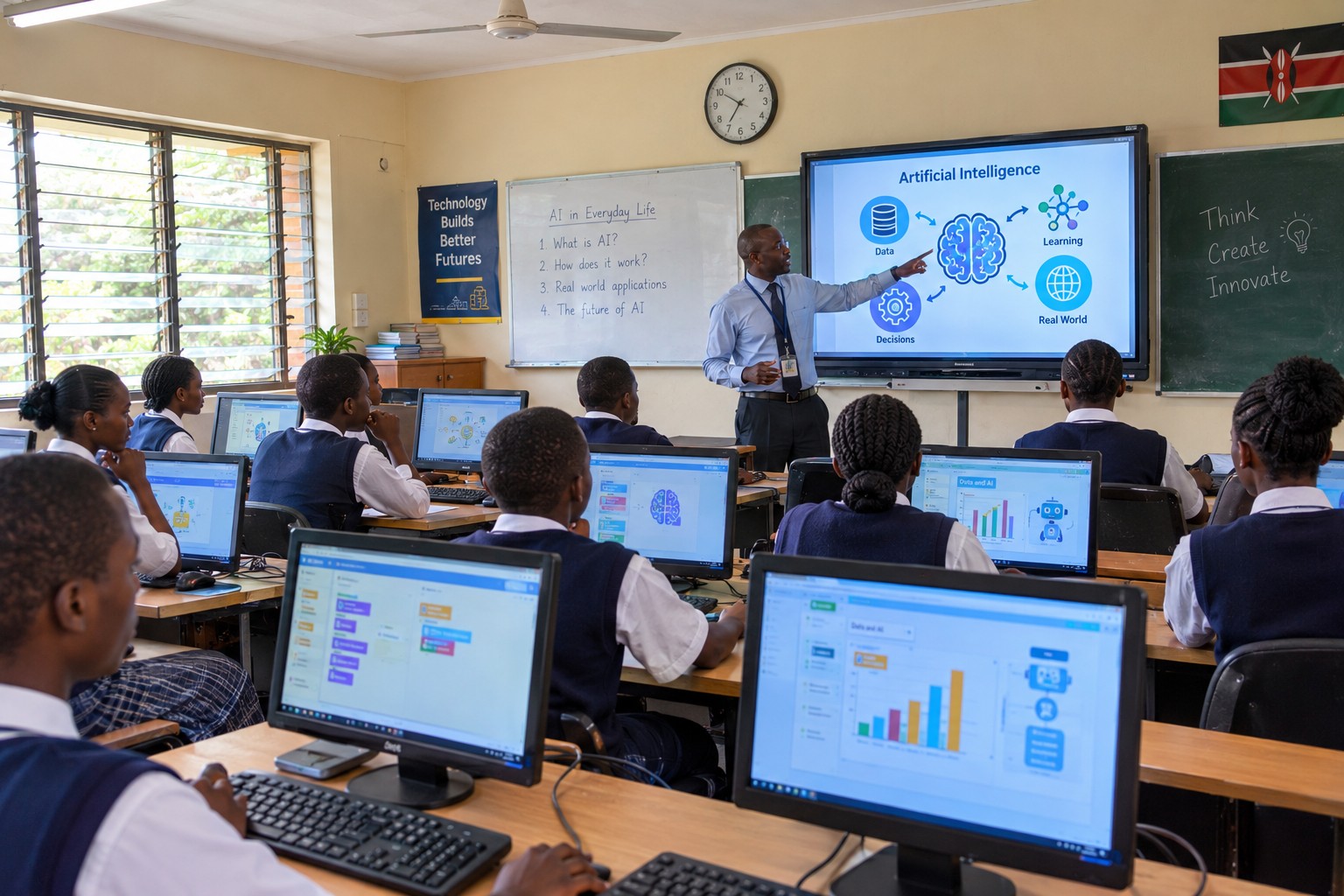
For Kenya, this has profound implications. The jobs our children will compete for are being transformed while they are still in school. AI literacy, however, should not simply mean teaching students how to use ChatGPT or other generative AI tools. An AI-literate learner should understand how AI works at an age-appropriate level, how data influences AI systems, how to recognise inaccurate or biased information, how to protect personal data and how to use AI ethically. Most importantly, learners must retain the ability to think critically rather than accepting an AI-generated answer simply because a machine produced it.
UNESCO has already developed AI competency frameworks for students and teachers, emphasising human-centred thinking, ethics, AI techniques and applications, and AI system design. The teacher framework similarly recognises that educators need the knowledge and skills to use AI effectively while maintaining professional judgement and human agency. This is an important lesson for Kenya. We cannot expect teachers to prepare learners for an AI-powered economy if teachers themselves have not been prepared for the AI-powered classroom.
ALSO READ:
Artificial Intelligence: Did we really need this pervasive technology?
Building a National AI Literacy Framework
Kenya has already taken an important policy step through its National Artificial Intelligence Strategy 2025–2030, which seeks to position the country as a leading AI hub and identifies skills, talent, infrastructure, governance and innovation as important pillars of the country’s AI future. However, our AI ambition will ultimately be measured not by the number of strategies we publish or AI companies we attract; it will be measured by the capabilities of our people.
The Ministry of Education should therefore consider developing a national AI literacy framework aligned with the Competency-Based Curriculum and international frameworks such as those developed by UNESCO. AI competencies should be introduced progressively, beginning with foundational concepts and advancing into practical applications at secondary schools, universities, technical institutions and teacher-training colleges. Teacher training must be central to this effort.
ALSO READ: Britain is rethinking school attendance. Why Kenya should take notes
Kenya must ensure AI education does not widen the digital divide. All learners, including those in rural, public and marginalised communities, should have access to AI skills, supported by investment in connectivity, devices, electricity, teacher training and relevant digital content.
This is precisely why UNESCO’s current global conversation matters. Digital Learning Week 2026 is examining not only what AI can do, but what education systems should do with AI while protecting human agency, equity and the public purpose of education. As Kenya reflects on International Literacy Day, we should therefore expand our understanding of what literacy means.
Wafula Meshack is an AI Researcher and Communication Specialist associated with Kavod
International and DIMLIS Africa, advancing AI and digital literacy
across Africa.
Get more stories from our website: Education News
To write to us or offer feedback, you can reach us at: editor@educationnews.co.ke
You can also follow our social media pages on Twitter: Education News KE and Facebook: Education News Newspaper for timely updates.
>> Click here to stay up-to-date with trending regional stories