- Dora Chepchumba’s Kalenjin poem turned emotional when she told President William Ruto her mother was suffering.
- The President wiped away his tears before comforting the young girl and embracing her before the crowd.
- The encounter became one of the most emotional moments of Ruto’s ongoing South Rift development tour.
A political rally in Bomet took an unexpected emotional turn on Wednesday when a young schoolgirl used poetry to deliver a deeply personal message to President William Ruto.
What began as a poetry recital quickly became one of the most poignant moments of the President’s South Rift tour.
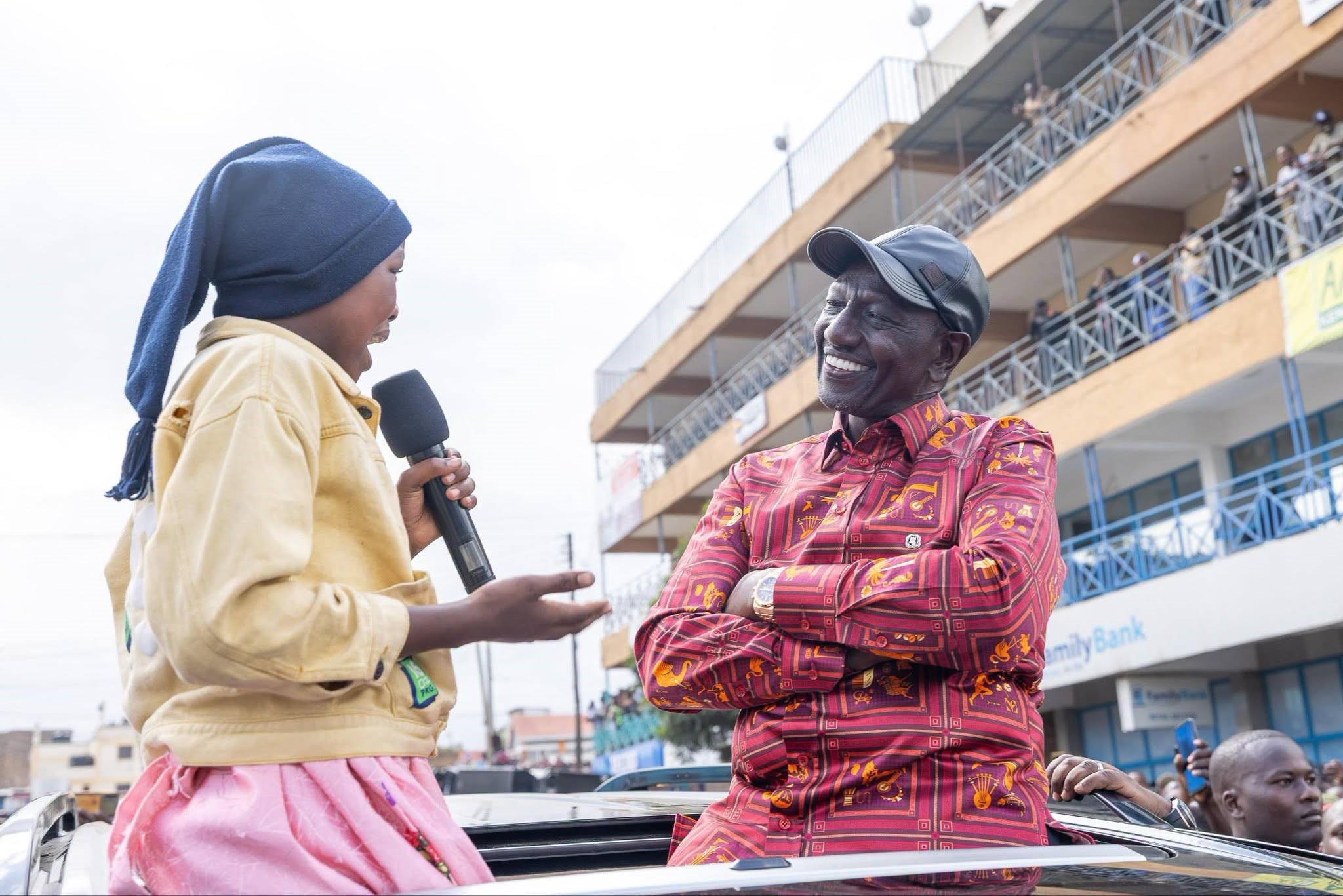
The girl, identified in reports as Dora Chepchumba, was helped onto Ruto’s vehicle as the President addressed residents.
She stood before him and recited a poem in Kalenjin dedicated to the President and his leadership.
For a moment, it was a familiar scene at a public political gathering: a child performing before a national leader, a crowd watching and cameras capturing the occasion.
Then the poem ended.
Dora spoke about her family.
Her voice became emotional before she delivered a short but powerful statement:
“Mama yangu anateseka.”
“My mother is suffering.”
The words appeared to overwhelm her.
She broke down in tears.
The President, visibly moved, reached into his pocket and pulled out a white handkerchief. He wiped his own tears before turning his attention to the crying girl.
He gently wiped her face.
Then he embraced her.
The political spectacle momentarily gave way to a deeply human encounter between a child and the country’s President. Contemporary reports and footage from the event confirm the exchange.
When a poem became a message
The incident illustrated the extraordinary power of poetry as a form of expression.
Dora did not approach the President with a lengthy speech or a prepared political statement.
She came with a poem.
Through the poem, she captured the attention of a President addressing thousands of people.
And when she moved from poetry to the personal reality facing her family, the atmosphere changed completely.
Her words were few, but their emotional impact was immense.
“Mama yangu anateseka.”
Four words that transformed a public performance into what appeared to be a personal appeal.
For the young girl, the poem became more than an artistic presentation. It became a vehicle through which she could communicate something deeply important to her.
The emotional exchange stood out because of Ruto’s response.
The President wiped away his own tears before using the handkerchief to wipe the girl’s face.
He then drew her into an embrace.
It was a striking departure from the speeches, cheers and political messages that normally dominate such gatherings.
For those few moments, the attention of the crowd shifted from development projects and political rhetoric to the distress expressed by one young girl.
Her mother’s suffering had become the centre of the moment.
And the President’s emotional reaction made the encounter even more powerful.
Dora’s age and class remain unclear
Dora has been described in reports as a young schoolgirl.
However, her exact age and class have not been reliably established publicly.
That distinction is important because the emotional significance of the encounter does not require assumptions about her age or educational level.
What matters is what she said and how the President responded.
Her simple statement appeared to resonate with a much broader reality: families across the country continue to face personal and economic difficulties that are often invisible from the political podium.
Dora gave one such struggle a human face.
Ruto’s visit to Bomet is part of a four-day South Rift tour featuring a packed programme of development activities.
The President began the tour in Bomet on Wednesday, where he inspected works at Itembe Airstrip before launching and commissioning a series of projects, including the Kapkwen market, roads and affordable housing.
His programme also includes engagements involving healthcare, roads, affordable housing and other development projects across Bomet and Kericho counties from September 9 to 12.
Yet despite the extensive development agenda, it was a short poem and an emotional confession that captured considerable public attention.
The voice of a child
There is something uniquely powerful about a child speaking openly in a public setting.
Children often lack the political vocabulary of adults.
They do not normally speak in the language of policy documents, budget allocations or development plans.
Instead, they speak from personal experience.
Dora’s words appeared to come from that place.
Her message was not complicated.
Her mother was suffering.
And she wanted the President to know.
The fact that she chose poetry to begin that conversation made the moment even more striking.
Poetry gave her an audience.
Emotion gave her words weight.
And the President’s response turned the encounter into one of the defining images of his Bomet visit.
The moment that will outlive the rally
Political rallies end.
Speeches fade.
Development figures are eventually replaced by new statistics.
But certain moments survive because they connect with something deeper than politics.
Dora’s encounter with Ruto was one such moment.
A young girl climbed onto the President’s vehicle to recite a poem.
She spoke.
She became emotional.
She told him that her mother was suffering.
The President became emotional too.
He wiped his tears, wiped hers and embraced her.
In that brief exchange, poetry became a bridge between a child and the highest office in the land.
And four words became the emotional centre of the day:
“Mama yangu anateseka.”
The President came to Bomet with a development agenda.
But a little girl’s poem reminded everyone watching that behind every development plan are people, families, hopes and struggles.
Sometimes, the most powerful message at a political rally is not delivered from the podium.
Sometimes, it comes from a child holding a poem.
By Hillary Muhalya
Get more stories from our website: Education News
To write to us or offer feedback, you can reach us at: editor@educationnews.co.ke
You can also follow our social media pages on Twitter: Education News KE and Facebook: Education News Newspaper for timely updates.
>> Click here to stay up-to-date with trending regional stories