- The government and TSC should introduce a Special Duty Allowance for teachers handling responsibilities beyond regular classroom duties.
- Teachers have continued to shoulder extra burdens, including boarding supervision, co-curricular coaching, learner welfare and curriculum reform implementation, often without additional compensation.
- Muhalya has argued that hardship postings and expanding social responsibilities among teachers deserve structured policy recognition rather than symbolic praise.
Kenya cannot keep praising teachers as nation-builders while treating their additional responsibilities as if they carry no value
Every year, Kenya praises its teachers. They are called nation-builders, celebrated as mentors, role models and custodians of the next generation. Politicians praise them, parents thank them, society applauds them. But there is a question Kenya must now confront: what happens after the applause? Because a teacher cannot pay rent, feed a family or meet rising living costs with praise. The time has come for the government and the Teachers Service Commission (TSC) to move beyond beautiful speeches and seriously consider a Special Duty Allowance for teachers undertaking responsibilities beyond their core classroom duties. This is not about making teachers more important than doctors, nurses, police officers or other public servants. It is about something simpler: if the responsibility is extra, the recognition should also be extra.
The Hidden Workload Behind the Classroom
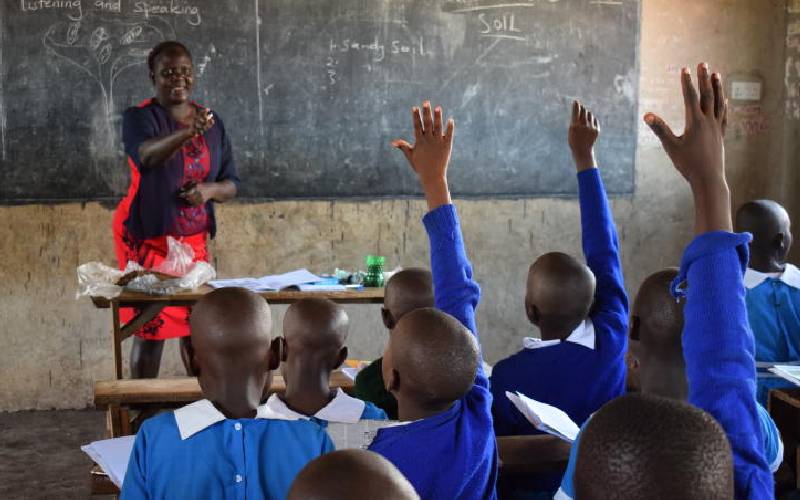
A teacher’s official working day may appear to revolve around classroom instruction, but the reality in many Kenyan schools is dramatically different. The teacher enters class, teaches, assesses learners and manages the learning process, but after the lesson, another job begins: games to coach, clubs to supervise, learners to counsel, records to prepare, examinations to administer, meetings to attend, parents to engage, school activities to organise, emergencies to handle, trips to supervise, and, in boarding schools, children to watch over long after the classroom doors have closed. These duties may be necessary, but necessary does not mean they should become invisible.
For many children, particularly those in boarding institutions, teachers temporarily assume responsibilities that parents normally carry at home. They monitor behaviour, respond to illness, intervene in disputes, provide guidance, watch over vulnerable learners and respond when something goes wrong. In moments of crisis, parents expect the school to act, and when the school acts, teachers are often at the centre of that response. That responsibility deserves serious policy recognition.
ALSO READ:
HELB extends subsequent loan application deadline to September 21
Then there is the enormous burden of implementing education reforms. Whenever Kenya changes its curriculum, assessment system or education policy, teachers are expected to adjust: they attend training, learn new approaches, prepare new materials, change assessment practices and adapt classroom strategies, then are expected to deliver results. The policy may originate at the national level, but its success ultimately depends on what happens inside the classroom. Teachers are where education policy meets reality.
The same teachers are often the ones who nurture talent. The future athlete may be discovered on a school field, the future musician during a music session, the future journalist writing for a school publication, the future debater finding a voice in a school club, and the future scientist first demonstrating curiosity in a classroom. Behind many of these discoveries is a teacher who gave extra time to a learner, and that extra time matters. It is also impossible to ignore the increasingly complex social environment in which Kenyan teachers operate, with schools dealing with bullying, substance abuse, peer pressure, teenage pregnancy, family challenges and other difficulties affecting learners. Teachers are frequently expected to notice problems, counsel learners, involve parents and connect vulnerable children with appropriate support, educators carrying an expanding social responsibility that remains hidden when discussions about teachers’ remuneration take place.
Moving From Praise to Policy
This is precisely why TSC and the government should consider a structured Special Duty Allowance. The allowance need not be indiscriminate; it could be tied to formally assigned responsibilities and objectively defined conditions. A teacher performing ordinary classroom duties would remain on the normal remuneration structure, but where a teacher is formally assigned substantial additional responsibilities, such as boarding supervision, examination administration, intensive co-curricular coaching, specialised learner welfare duties or other recognised assignments, there should be a mechanism for additional compensation.
Hardship environments could also receive special consideration. A teacher working in a remote or difficult area may face challenges entirely different from those encountered elsewhere, with housing, transport, infrastructure, water, security and access to basic services all affecting the working environment. If Kenya wants teachers to remain in such areas and deliver quality education, the compensation framework must acknowledge the conditions under which they work. This is not charity — it is compensation for responsibility and working conditions.
Morale also matters. A teacher who feels recognised is more likely to feel valued, and a teacher who feels valued is more likely to remain committed. A committed teaching workforce is one of the strongest investments Kenya can make in its future. The government does not need to reinvent the wheel; it can begin by engaging TSC, teacher unions, education stakeholders and the National Treasury in a structured discussion on the duties that should qualify for the allowance, the eligibility criteria, the funding implications and mechanisms for accountability. The debate should be evidence-based, sustainable and fair, but most importantly, it should begin.
ALSO READ: The teacher should be saved: The alcohol battle we cannot afford to ignore
Kenya has spent years telling teachers that they are the foundation of the nation’s future. Now the country should demonstrate that belief through policy. Every doctor, engineer, lawyer, pilot, entrepreneur, scientist, journalist, public servant and national leader starts as a learner, and behind that learner is a teacher. That invests in teachers is an investment in virtually every other sector of the economy and society.
Perhaps Kenya should stop asking teachers to be heroes. Heroes are often expected to sacrifice endlessly; professionals deserve something different: fair recognition for the work they actually perform. The real question is not whether Kenyan teachers deserve appreciation; they unquestionably do. The real question is whether appreciation should remain verbal when the additional work is real. The government and TSC should seriously examine the introduction of a Special Duty Allowance for teachers carrying clearly defined additional responsibilities. Teachers have spent generations building Kenya’s human capital. It is time Kenya recognised that extraordinary responsibility requires more than extraordinary praise.
By Hillary Muhalya
Get more stories from our website: Education News
To write to us or offer feedback, you can reach us at: editor@educationnews.co.ke
You can also follow our social media pages on Twitter: Education News KE and Facebook: Education News Newspaper for timely updates.
>> Click here to stay up-to-date with trending regional stories