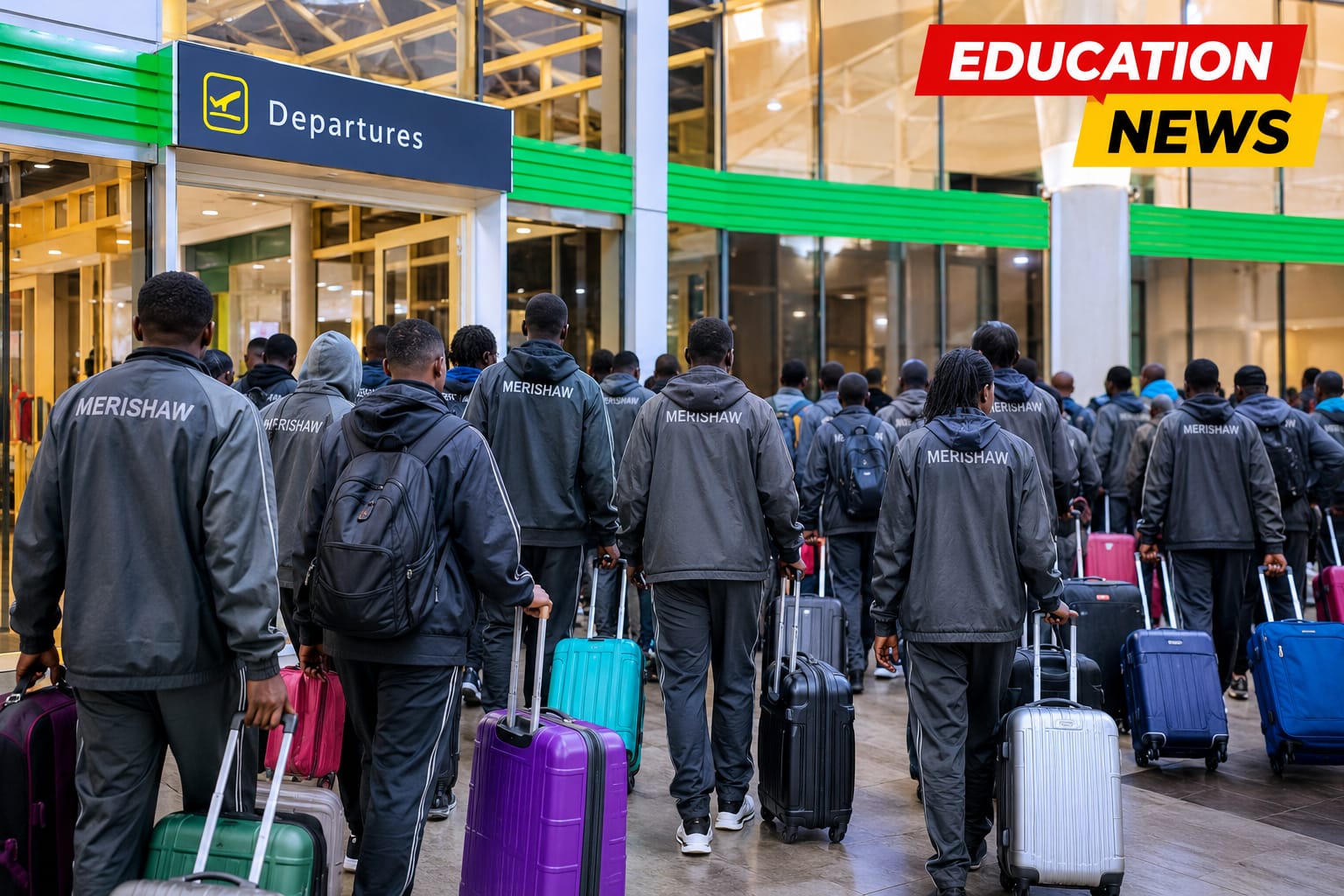
- Grade 8 learners from Merishaw School have travelled to Spain, France and Belgium for an academic tour.
- The trip is designed to expose the boys to different cultures, infrastructure, economies and learning environments beyond the classroom.
- The international excursion has also sparked online debate about educational exposure and the opportunities available to learners from different economic backgrounds.
A school trip that would once have sounded like the preserve of wealthy families has become the latest talking point in Kenya’s education circles after Grade 8 boys from Merishaw School flew out of the country for an academic tour of three European nations.
The students departed from Jomo Kenyatta International Airport on Sunday, August 23, for an educational journey taking them to Spain, France and Belgium — an experience that has generated admiration, amusement and debate among Kenyans online. Reports on the trip confirm that the Grade 8 learners were travelling to the three countries as part of an academic tour.
For the students, however, the journey is more than a holiday abroad.
It is an opportunity to encounter different cultures, education systems, infrastructure, economies and sporting environments beyond the classroom.
One of the students, Nathan, said he was particularly interested in seeing how European countries had developed.
“I want to see how fast the countries are. I want to see the different infrastructure and economy in countries in Europe, and I want to learn more about foreign culture,” he said.
Another student, John, already had his priorities firmly set.
Spain was his favourite destination because of its football culture.
He said he hoped to learn more about the sport and gain football skills during the visit.
Learning beyond the classroom
For the accompanying teachers, the tour provides an opportunity to expose learners to experiences that cannot easily be replicated through classroom lessons.
The teacher accompanying the students said the group would begin in Spain, proceed to France and conclude the tour in Belgium.
The objective, he explained, was to gain experiences outside the classroom, learn about different cultures and interact with people from different backgrounds.
Merishaw School described the initiative as an effort to develop “future-ready minds” and broaden the students’ global outlook.
But the images of the boys preparing to board their flight have also triggered a distinctly Kenyan conversation.
For many Kenyans, school trips during their childhood meant destinations such as the Giraffe Centre, Mamba Village, Kariandusi or Lake Bogoria.
The online reactions were therefore as much about nostalgia as they were about the Merishaw students.
One Kenyan jokingly recalled visiting Kariandusi, while another wondered whether Lake Bogoria was still an option for school excursions.
Others compared the European adventure with their own experiences of visiting local museums, wildlife centres and historical sites. Similar reactions were reported online after videos of the trip circulated.
Trip revives debate about educational exposure
The humour, however, masks a deeper question about inequality in educational exposure.
A school trip is often presented as an extension of classroom learning. Yet the quality and geographical reach of such exposure can vary dramatically depending on the resources available to a school and the families it serves.
For a learner visiting Spain, France and Belgium, the classroom may suddenly acquire a different meaning.
Lessons about European history, architecture, transport systems, football, culture, economics and international relations can be encountered physically rather than only through textbooks, photographs or digital content.
That kind of exposure can influence a child’s ambitions and understanding of the world.
A learner interested in football, for instance, could see professional facilities and training environments in Spain and return with a more practical understanding of what is possible in the sport.
Another learner may develop an interest in architecture after seeing European cities, while another could become fascinated by transport, technology, museums or cultural heritage.
This is the educational value of well-designed study tours.
The challenge is that such opportunities remain beyond the reach of many Kenyan learners.
The reported fees at Merishaw School have also fuelled interest in the institution.
The school’s published 2025 fee structure listed Grade 8 tuition and boarding at Sh159,016 per term, with figures for other classes ranging from Sh157,664 to Sh171,392 before additional charges.
The school’s profile has received additional public attention following the election of Andy Onsarigo, son of journalist Dennis Onsarigo, as the school’s president in July 2026.
His election, coupled with the European trip, has pushed the institution further into the public spotlight.
Experiential learning closer to home
But the bigger story is not simply that a group of Kenyan teenagers has travelled to Europe.
It is what the journey says about the changing nature of education for some sections of Kenyan society.
As Kenya transitions deeper into Competency-Based Education, there is increasing emphasis on practical learning, creativity, collaboration, talent development and preparing learners for a rapidly changing world.
Educational tours can complement that philosophy when they are deliberately designed around learning outcomes.
The concern, therefore, should not be that some Kenyan children are travelling abroad.
Rather, the bigger national question should be how schools can provide meaningful experiential learning opportunities for learners regardless of their economic background.
Kenya has extraordinary educational resources of its own.
National museums, wildlife conservancies, agricultural research centres, universities, industries, historical sites, innovation hubs and cultural institutions can provide powerful learning experiences.
A well-planned visit to such places can be as transformative for a learner as a foreign trip — provided the experience is connected to the curriculum and the learner is encouraged to observe, question and apply what they see.
At the same time, schools with the resources to expose their learners to international environments can provide another dimension of learning.
The ideal education system should ultimately produce learners who understand both their country and the wider world.
The Merishaw boys may return from Spain, France and Belgium with photographs and memories.
But the most important thing they could bring home is a changed perception of what is possible.
And that is perhaps the real power of educational travel.
For many Kenyans watching from home, the trip has revived memories of modest school excursions.
For the students on the aircraft, however, it could become the beginning of much bigger dreams.
The challenge for Kenya is to ensure that those dreams — and meaningful opportunities to pursue them — are not determined solely by the size of a family’s bank account.
By Hillary Muhalya
Get more stories from our website: Education News
To write to us or offer feedback, you can reach us at: editor@educationnews.co.ke
You can also follow our social media pages on Twitter: Education News KE and Facebook: Education News Newspaper for timely updates.
>> Click here to stay up-to-date with trending regional stories