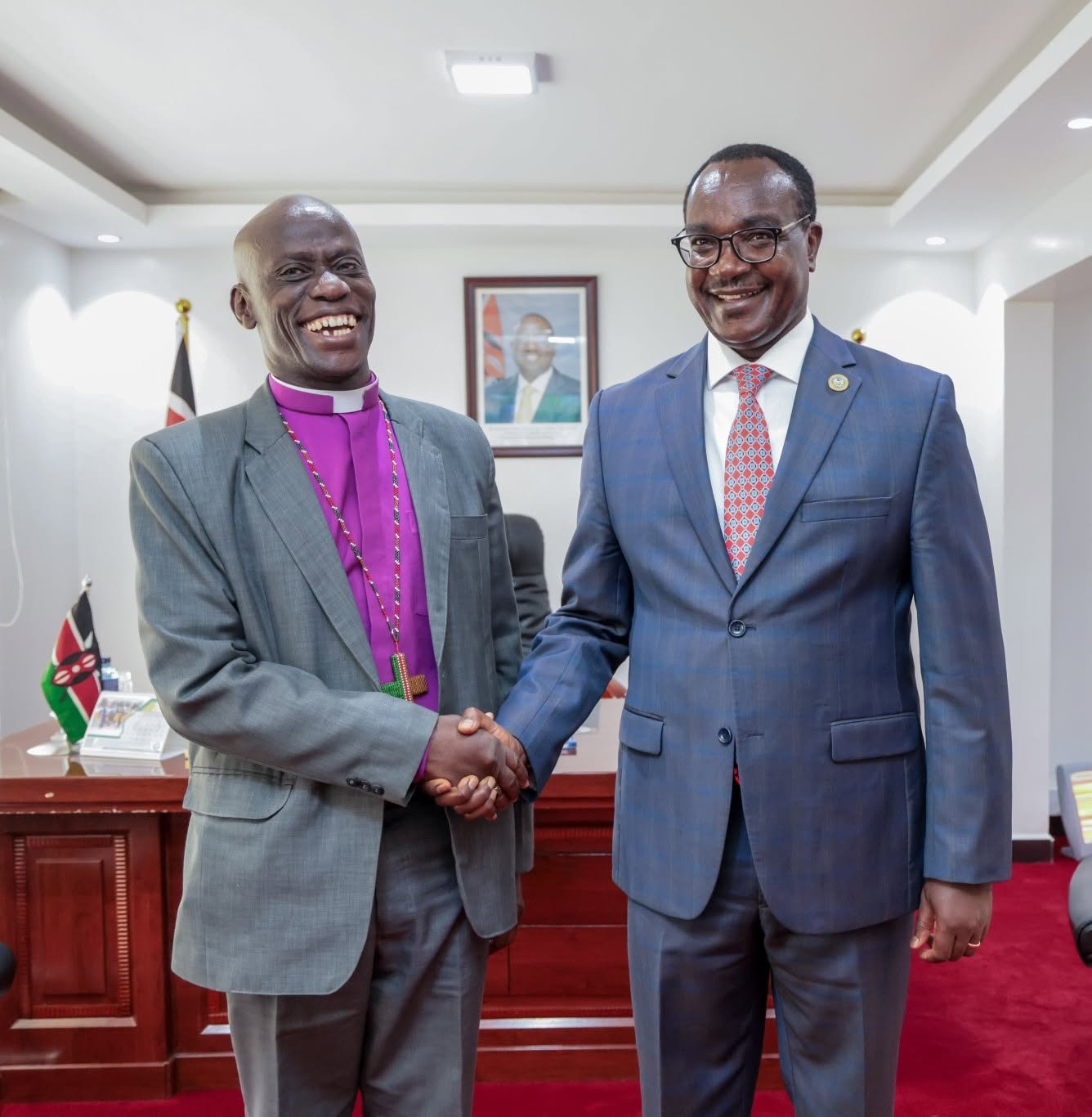
- Education Cabinet Secretary Julius Migos Ogamba has held talks with ACK Nambale Diocese Bishop Isaiah Obuya.
- Hillary Muhalya examines what stronger Government-church cooperation could mean for Kenya’s education system.
- The engagement places access to quality education and community partnerships at the centre of discussions.
Education Cabinet Secretary Julius Migos Ogamba has sent a signal to faith-based organisations: Kenya’s education transformation will require more than Government policies — it will require strong partnerships with institutions deeply rooted in communities.
The message emerged on Wednesday when Ogamba hosted the Anglican Church of Kenya (ACK) Bishop of Nambale Diocese, the Rt. Rev. Isaiah Obuya, at the Centre for Mathematics, Science and Technology Education in Africa (CEMASTEA), Karen.
At the centre of their discussions was a question that goes far beyond one meeting: How can Government and the church work together to ensure that every Kenyan child has access to quality education?
The engagement focused on strengthening the partnership between the church and Government in promoting access to quality education in the region and across the country.
And while the meeting may appear routine, its wider implications for Kenya’s education sector are worth examining.
Long before many of today’s education reforms were conceived, faith-based organisations were already establishing and supporting schools in communities across Kenya.
Church-sponsored institutions have become an integral part of the country’s education architecture, providing learning opportunities to thousands of children and young people.
The Anglican Church of Kenya is among the faith-based organisations with a considerable footprint in education.
Its contribution extends beyond the sponsorship of institutions to participation in national conversations on education policy, legislation and reform.
This makes the church not merely an education stakeholder, but a potential partner in shaping the future of Kenya’s education system.
Ogamba’s engagement with Bishop Obuya reflects the Ministry of Education’s recognition of the importance of partnerships in the education sector.
Education takes place within communities.
Teachers operate in communities. Schools serve communities. Parents raise children within communities.
And faith-based organisations are deeply embedded in many of those communities.
That makes collaboration important, particularly as Kenya seeks to address persistent challenges surrounding access, quality, equity, infrastructure and learner retention.
The CBE test
The transition towards Competency-Based Education (CBE) has changed the conversation about what Kenyan learners should acquire from school.
The emphasis is increasingly shifting from simply accumulating academic knowledge to developing competencies, skills, values and abilities that learners can apply in real-life situations.
But no curriculum can succeed through policy documents alone.
It must be understood by teachers, embraced by parents, supported by communities and implemented effectively in classrooms.
This is where strategic partnerships become crucial.
Faith-based organisations can help strengthen community awareness, support learners and contribute to creating environments that encourage children to remain in school and pursue their education.
Perhaps the biggest message from the Ogamba-Bishop Obuya engagement is that the role of faith-based organisations in education should not be viewed narrowly.
Their contribution can extend into policy dialogue, advocacy, community mobilisation and support for education reforms.
The Government’s willingness to strengthen this relationship therefore opens the door to a broader partnership — one in which faith-based organisations become strategic allies in tackling some of the sector’s most difficult challenges.
Building stronger alliances around education
For Kenya, this could be important.
The country is pursuing an education system that is accessible, equitable, responsive and globally competitive.
Achieving that vision requires resources, political commitment and sound policy.
But it also requires something equally important: partnership.
Ogamba’s meeting with Bishop Obuya could therefore be read as part of a wider effort to build stronger alliances around education.
Government brings policy, public resources and national coordination.
Faith-based organisations bring community networks, institutions and decades of experience in education.
Teachers bring professional expertise.
Parents bring the home-school connection.
And learners remain at the centre of the entire system.
If these forces work together, Kenya’s education reforms could move beyond policy statements and become a transformation experienced by learners in classrooms across the country.
READ ALSO: 112 teams set for Kakamega football tournament aimed at tackling GMO misinformation
That is why the Ogamba-Obuya meeting matters.
It sends a simple message: Kenya’s education transformation will not be built by Government alone. Partnerships with institutions deeply rooted in communities, including the church, could play an important role.
By Hillary Muhalya
Get more stories from our website: Education News
To write to us or offer feedback, you can reach us at: editor@educationnews.co.ke
You can also follow our social media pages on Twitter: Education News KE and Facebook: Education News Newspaper for timely updates.
>>> Click here to stay up-to-date with trending regional stories